

Oil and gas import patterns are changing as countries balance domestic production, energy demand, refinery requirements, infrastructure, and supply security. Global oil demand is expected to remain above 100 million barrels per day in 2026, while global LNG trade reached around 438 million tonnes in 2025.
The U.S. also remained a major energy supplier, exporting around 113 million tonnes of LNG in 2025. These movements highlight the scale of international energy dependence. Tracking oil and gas import trends can help businesses identify markets where import requirements are increasing, suppliers are changing, and sourcing relationships are being reshaped.
Import Dependence Is Changing Across Markets
Import volumes can reveal how strongly markets rely on external energy supplies. Rising imports may reflect stronger consumption, declining domestic production, refinery expansion, or changing sourcing economics. Comparing import growth with domestic supply helps distinguish structural increases in dependence from temporary market movements. This can highlight markets where buyers may need additional suppliers, new trade relationships, or more resilient sourcing arrangements.
Buyers Are Diversifying Their Supply Sources
Changes in the countries supplying oil and gas can reveal how buyers are managing sourcing exposure. Businesses and national energy markets may shift toward alternative origins when prices change, infrastructure improves, or supply risks increase. Tracking supplier shares, origin markets, and destination relationships can therefore reveal diversification trends and identify where new exporters are gaining access to previously established import markets.
Nexdigm’s View on Changing Import Trends
Import data becomes more valuable when it is connected with the conditions driving those movements. Nexdigm combines trade intelligence, energy-market research, pricing analysis, competitive intelligence, company research, and supply-chain assessment to interpret changing import patterns.
Our oil and gas import trends analysis can examine import volumes, origins, suppliers, buyers, trade values, pricing, refinery requirements, domestic production, infrastructure, and transportation routes.
This helps businesses understand where import dependence is increasing, which suppliers are gaining importance, what is driving sourcing changes, and where emerging market opportunities or supply risks may exist.
What Changing Import Patterns Can Reveal
Nexdigm examines import movements across several dimensions to determine whether a change represents a short-term fluctuation or a broader market shift. These dimensions are:
- Demand Signals: Rising imports can indicate stronger consumption, refinery requirements, industrial activity, or insufficient domestic supply.
- Supplier Shifts: Changes in origin countries and supplier shares can reveal diversification, new market access, or increasing concentration.
- Market Exposure: Growing dependence on particular suppliers, routes, or infrastructure can highlight potential sourcing vulnerabilities.
- Commercial Opportunity: Import growth combined with supply gaps, pricing, and infrastructure can identify attractive markets for suppliers and exporters.
Together, these signals provide a clearer view of how import relationships are changing and what those changes could mean commercially.
Nexdigm’s Oil and Gas Import Trend Assessment
Nexdigm’s assessment focuses on specific dimensions that explain why import patterns are changing, where dependence is increasing, and what these shifts mean for sourcing and market opportunities. These major focused areas are:
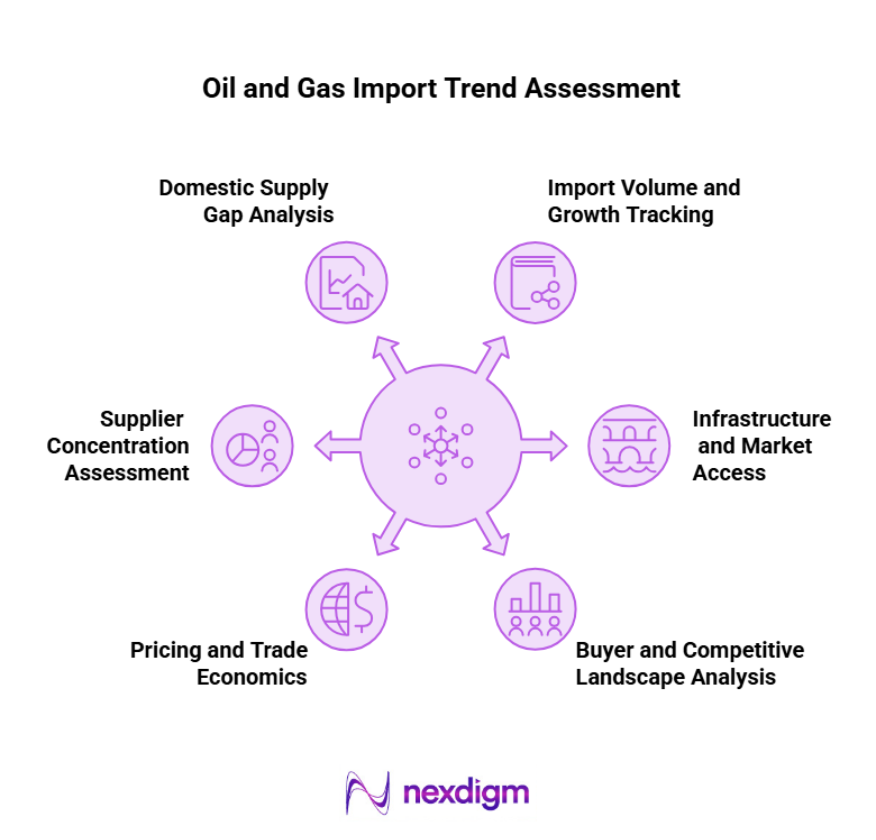
- Import Volume and Growth: Tracking import volumes, growth rates, product categories, seasonality, and historical patterns to identify markets experiencing sustained changes in external energy requirements.
- Domestic Supply and Demand Gap: Comparing imports with domestic production, consumption, refinery requirements, and energy demand to determine the underlying need for imported oil and gas.
- Supplier and Origin Concentration: Examining supplier shares, origin countries, buyer relationships, and sourcing changes to identify diversification opportunities and concentration risks.
- Pricing and Trade Economics: Analyzing trade values, indicative pricing, transportation costs, and sourcing economics to understand the commercial drivers behind changing import relationships.
- Infrastructure and Market Access: Assessing ports, pipelines, LNG terminals, storage, shipping routes, and logistics capacity to determine whether additional supply can reach the market efficiently.
- Buyer and Competitive Landscape: Mapping importers, refiners, utilities, traders, and other participants to understand purchasing behaviour, supplier positioning, and competitive shifts.
The assessment therefore provides a practical basis for market prioritization, supplier diversification, sourcing strategy, competitive positioning, and supply-risk management.
How Nexdigm’s Oil and Gas Import Trend Assessment Creates Competitive Advantage
Nexdigm’s assessment helps businesses gain an advantage by combining import intelligence with market, supplier, pricing, infrastructure, and competitive insights. This enables decision-makers to:
- Spot Opportunities Earlier: Identify markets where import demand is accelerating, supply gaps are emerging, or new suppliers are gaining access before these shifts become widely established.
- Strengthen Sourcing Decisions: Compare suppliers, origins, pricing, routes, and infrastructure to identify commercially viable alternatives and reduce dependence on concentrated supply relationships.
- Improve Market Positioning: Understand buyer behaviour, competitor participation, supplier shares, and changing trade relationships to identify where businesses can differentiate or expand.
- Anticipate Supply Risks: Detect concentration across suppliers, regions, routes, and infrastructure, allowing businesses to develop alternatives before disruptions affect operations.
By linking what markets are importing with why they are importing, who is supplying them, and how accessible that supply is, Nexdigm helps businesses move faster from market observation to informed action.
Nexdigm’s Case
Nexdigm supported an energy-sector client by reviewing 9,500+ oil and gas import transactions across the markets, covering 27 supplier countries and 38 origin-destination combinations. The analysis identified 5 rapidly growing import markets, 10 diversification opportunities, and supply relationships requiring closer monitoring, helping the client strengthen sourcing decisions and prioritize expansion opportunities.
To take the next step, simply visit our Request a Consultation page and share your requirements with us.
Harsh Mittal
+91-8422857704