

The global energy landscape is changing faster than ever. While traditional hydrocarbon demand remains strong in many regions, geopolitical shifts, energy transition commitments, regulatory changes, and infrastructure investments are redefining where oil and gas companies should focus their expansion efforts. For organizations making multi-million or even billion-dollar investments, selecting the right market is no longer a matter of resource availability alone. It requires a structured, data-driven approach supported by specialized oil and gas industry market entry advisory services.
The New Reality of Expansion in the Oil and Gas Sector
Historically, market entry decisions were driven by proven reserves, exploration opportunities, and production economics. Today, decision-makers must evaluate a broader set of variables, including:
- Political stability and regulatory predictability
- Energy security priorities of governments
- Infrastructure readiness
- Local content requirements
- ESG compliance expectations
- Tax and investment incentives
- Investment protection frameworks
- Future energy transition strategies
As a result, expansion decisions have become significantly more complex, increasing the need for expert oil and gas industry market entry advisory services that can combine commercial, regulatory, financial, and operational perspectives.
Where Should Oil and Gas Companies Expand Next?
Rather than looking for a universal destination, companies should identify markets that align with their strategic objectives.
For Upstream Companies
Potential opportunities often exist in:
- Emerging exploration regions
- Countries opening new licensing rounds
- Underdeveloped hydrocarbon basins
- Markets seeking foreign technical expertise
For Midstream Operators
Midstream expansion opportunities are often driven by infrastructure requirements, evolving trade routes, and increasing regional energy connectivity. Its expansion opportunities are generally linked to:
- Pipeline infrastructure gaps: Regions lacking adequate pipeline networks present opportunities for new infrastructure development, improved connectivity, and enhanced energy transportation efficiency.
- LNG transportation corridors: Growing LNG trade creates demand for transportation networks that facilitate efficient movement between production, storage, and consumption hubs.
- Strategic energy transit locations: Geographically important transit hubs enable operators to serve multiple markets, optimize logistics, and strengthen regional energy flows.
- Cross-border energy projects: International pipeline and gas transportation initiatives create opportunities to expand market reach and support regional energy integration.
For Downstream Businesses
Downstream market attractiveness is often influenced by fuel consumption trends, industrial activity, and refining capacity dynamics. Companies entering these markets should assess the following demands:
- Growing fuel demand: Rising transportation activity, urbanization, and economic growth increase fuel consumption, supporting expansion opportunities for downstream operators.
- Expanding petrochemical sectors: Growth in petrochemical manufacturing drives demand for feedstocks and refined products, creating opportunities across downstream value chains.
- Refining capacity shortages: Markets with insufficient refining capabilities often require additional investments to meet demand and reduce import dependence.
The most successful companies evaluate these opportunities through a market attractiveness framework instead of relying solely on resource potential.
A Four-Pillar Market Entry Framework for High-Capital Decisions
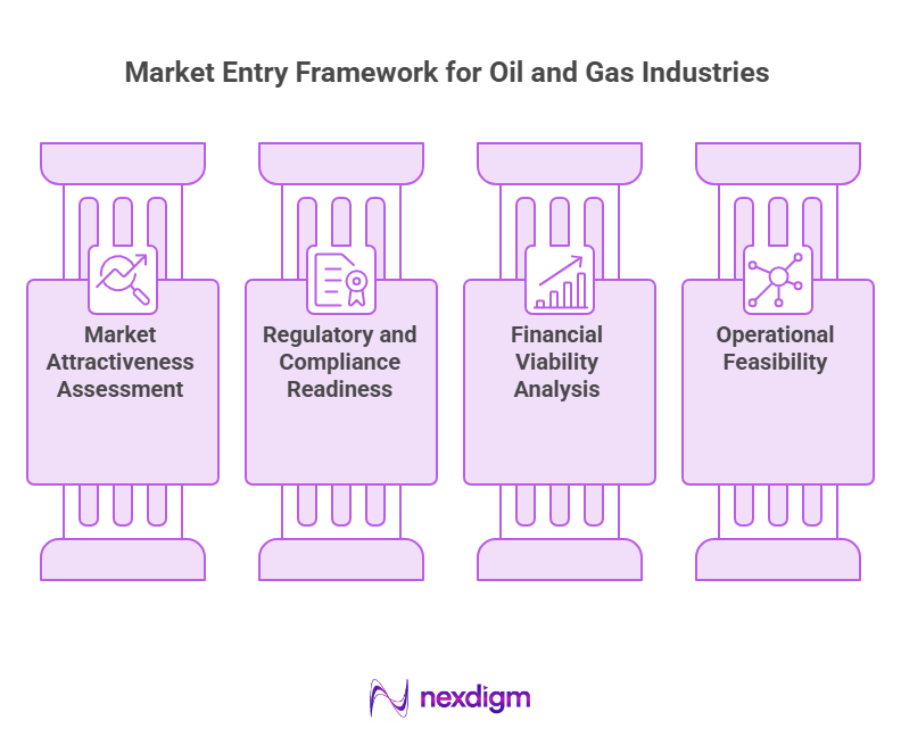
Pillar 1: Market Attractiveness Assessment
Before entering a market, organizations should evaluate:
Demand Indicators
- Energy consumption trends
- Industrial growth rates
- Fuel import dependence
- Long-term energy forecasts
Supply Dynamics
- Existing competition
- Domestic production capacity
- Infrastructure bottlenecks
- Investment pipelines
At Nexdigm, market attractiveness assessments are designed to move beyond surface-level indicators and provide actionable intelligence that aligns with investment objectives.
Pillar 2: Regulatory and Compliance Readiness
A profitable market can quickly become a challenging investment destination if regulatory risks are underestimated. Key considerations include:
- Foreign investment regulations
- Licensing and permitting requirements
- Environmental approvals
- Tax structures
- Local partnership obligations
Through specialized oil and gas industry market entry advisory services, Nexdigm helps organizations understand regulatory barriers before capital commitments are made, reducing uncertainty during execution.
Pillar 3: Financial Viability Analysis
Expansion should never be evaluated solely through top-line opportunity. Companies must assess:
- Capital expenditure requirements
- Operating cost structures
- Expected returns
- Fiscal regime implications
- Currency risks
- Repatriation considerations
Nexdigm helps organizations build financial models that account for market-specific realities, enabling leadership teams to evaluate investments through multiple risk-adjusted scenarios.
Pillar 4: Operational Feasibility
Even highly attractive markets can present execution challenges. Critical questions include:
- Is skilled labor available?
- Can infrastructure support operations?
- Are supply chains reliable?
- What logistics challenges exist?
- How resilient is the local ecosystem?
Nexdigm’s multidisciplinary approach enables businesses to evaluate these practical realities early in the decision-making process, helping avoid costly implementation surprises.
Why Many Market Entry Strategies Fail
A common misconception is that resource-rich markets automatically represent strong investment destinations. In reality, failures often occur because companies:
- Underestimate regulatory complexity
- Overlook stakeholder expectations
- Ignore local market dynamics
- Misjudge operational readiness
- Lack clear entry strategies
A structured advisory-led approach helps organizations identify risks before they become financial liabilities.
This is one reason why demand for oil and gas industry market entry advisory services continues to grow among global energy companies seeking sustainable expansion.
The Nexdigm Perspective: Turning Market Intelligence into Market Success
Market entry is not simply an expansion exercise. It is a long-term strategic commitment. At Nexdigm, the focus extends beyond identifying attractive markets. The objective is to help organizations determine whether a market aligns with their operational capabilities, investment horizon, compliance framework, and growth ambitions. Nexdigm supports businesses through:
- Market opportunity assessments
- Entry strategy development
- Regulatory and compliance evaluations
- Tax structuring support
- Partner and stakeholder analysis
- Financial and commercial due diligence
- Risk management frameworks
By combining consulting, regulatory, financial, and operational expertise, Nexdigm helps organizations move from market interest to confident execution.
Nexdigm’s Case
Recently, Nexdigm got an opportunity to support an oil and gas sector client in prioritizing expansion markets using a structured market entry framework. The real-time analysis improved market attractiveness assessment by 34%, strengthened investment prioritization by 29%, reduced entry risks and accelerated decisions by 31%.
Nexdigm’s market entry approach enabled the client to identify high-potential markets, assess capital requirements, and prioritize expansion opportunities with greater commercial confidence.
To take the next step, simply visit our Request a Consultation page and share your requirements with us.
Harsh Mittal
+91-8422857704