

Oil and gas demand is becoming increasingly regional in its commercial implications. A market can post strong consumption growth while remaining difficult to serve because domestic production is declining, processing capacity is constrained or import infrastructure is inadequate. Another may have substantial resources but limited monetisation because pipelines, terminals or downstream customers are missing.
The investment question is therefore less about identifying the fastest-growing demand market and more about finding where demand, supply and infrastructure are falling out of balance in a way that can support investment. Oil and gas also need to be assessed separately. Crude and refined products move through different infrastructure and respond to different market signals, while gas demand is particularly sensitive to pipeline access, LNG availability, power-sector economics and competing fuels.
The IEA’s 2025 medium-term oil outlook projected global production capacity to expand faster than demand through 2030, with petrochemicals becoming an increasingly important source of incremental oil use. That global balance can coexist with regional shortages because crude quality, refinery configuration, trade routes and product demand vary substantially between markets. In gas, the IEA’s 2025 outlook pointed to a significant increase in LNG supply, making import infrastructure, affordability and downstream demand critical to determining where additional supply can actually be absorbed.
Follow the Bottleneck Through the Value Chain
A useful market assessment starts by identifying where the physical constraint sits. In oil, that could be crude supply, refinery capacity, product storage or import logistics. In gas, the constraint may instead be domestic production, transmission pipelines, regasification capacity or the availability of customers able to switch from competing fuels.
Demand should therefore be segmented by end use rather than treated as a single national figure. Transport fuels, petrochemical feedstocks, power generation, industrial consumption and residential or commercial demand each have different growth drivers and price sensitivities. The supply side should be mapped with equal detail, including production trends, reserve positions, decline rates, refining and processing capacity, imports, exports, storage and pipeline flows.
This approach can reveal why apparently similar markets offer very different investment propositions. A country with rising diesel consumption and limited refining capacity may support additional product imports without requiring new crude production. A gas market with industrial demand growth may instead require pipeline extensions or an LNG terminal before that demand becomes commercially accessible.
Price Determines Whether the Gap Can Be Monetised
A supply deficit becomes investable only when the delivered economics support it. Oil analysis should incorporate crude differentials, refinery yields, product cracks, freight and logistics. Gas analysis needs to compare delivered LNG or pipeline gas with domestic production and substitute fuels such as coal, fuel oil or electricity.
This is where headline benchmark prices can become misleading. Pipeline tariffs, regasification charges, taxes, currency movements, seasonal congestion and domestic pricing rules can materially alter the margin available to an investor. Subsidies and regulated tariffs can support consumption while simultaneously limiting the value captured by infrastructure owners or suppliers.
Policy also needs to be treated as an operating variable rather than a background consideration. A refinery expansion can reduce imports but increase demand for crude or petrochemical feedstocks. New gas-fired generation can create an anchor customer for an LNG terminal, while transmission investment can expand the addressable customer base. Upstream incentives can attract exploration, but fiscal terms, local-content requirements and licensing conditions ultimately determine how much of the resource value reaches the investor.
Match the Market Gap to the Right Investment
The same supply-demand imbalance can support very different investment routes. A market with declining domestic gas production and growing industrial consumption may favour import infrastructure. A crude-producing market with insufficient processing capacity may support refining or storage. A product-importing market with fragmented distribution may create an opportunity further downstream.
For an oil and gas market assessment services engagement, the important distinction is between a market that has a gap and one where the gap can be captured. That requires tracking projects through their development stages, from announcement and permitting through financing, construction and commissioning. Existing competitors, contracted capacity and planned additions should be considered alongside demand growth to determine whether an apparent shortage will still exist when new infrastructure comes online.
A Four-Part Market Screen for Investment Potential
The assessment can be reduced to four commercial tests:
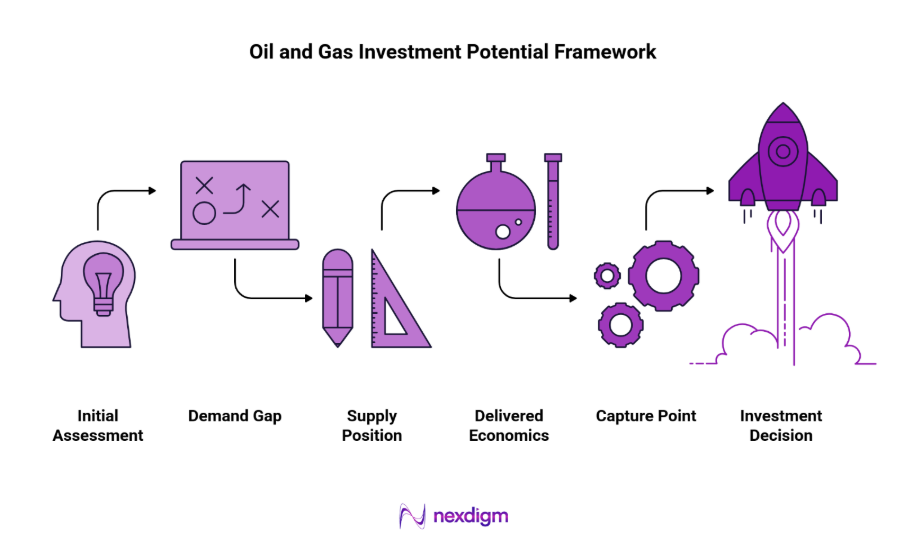
- Confirm the Demand Gap
Determine whether consumption is growing, structurally underserved or simply experiencing a temporary supply disruption. - Establish the Supply Position
Map domestic production, imports, reserves, processing capacity and announced projects to determine whether the gap is likely to persist. - Test Delivered Economics
Compare prices, logistics costs, infrastructure charges and substitute fuels to establish whether the gap supports an investable margin. - Identify the Capture Point
Determine which part of the value chain can monetise the opportunity, whether upstream production, processing, pipelines, LNG, storage, refining or downstream distribution.
Nexdigm can apply this screen across markets and investment types, combining demand forecasts, infrastructure mapping, competitive analysis and project pipelines to establish where an opportunity is both commercially attractive and executable.
Nexdigm Case Study
Nexdigm assessed 8 emerging markets across oil products and natural gas, comparing demand deficits, import dependence, pipeline and terminal capacity, delivered prices and competing projects. 3 markets showed investable gaps, but only 1 combined contracted industrial demand with available terminal capacity. The analysis redirected capital toward a staged gas import and distribution opportunity rather than a speculative greenfield refinery.
To take the next step, simply visit our Request a Consultation page and share your requirements with us.
Harsh Mittal
+91-8422857704