

For oil and gas companies evaluating expansion into a new geography, market opportunity, regulatory feasibility, and investment requirements often dominate the conversation. However, one factor that can significantly impact profitability and operational success is frequently underestimated is the talent cost structure.
A new market may offer strong commercial potential, but if workforce costs, compensation expectations, talent shortages, and localization requirements are not properly assessed, the investment case can quickly become less attractive. This is why many organizations are increasingly leveraging oil and gas market entry pay structure consulting services to understand whether talent-related costs can support long-term business objectives.
What are the Talent Costs?
Talent costs include all expenses associated with hiring and retaining employees, such as salaries, benefits, allowances, recruitment costs, and statutory contributions. For oil and gas companies, talent costs can significantly influence the success of a market entry strategy.
Organizations must also consider talent availability, hiring competition, workforce regulations, and long-term scalability to ensure operational and financial viability. Understanding these factors helps businesses build realistic workforce budgets, mitigate talent-related risks, and support sustainable expansion in new markets.
Benchmarking Costs Across Critical Oil and Gas Roles
A market entry workforce analysis should evaluate compensation expectations across key functions. Understanding role-specific compensation trends help organizations build realistic workforce budgets, assess talent competitiveness, and evaluate the long-term viability of their market entry strategy. These trends are:
Upstream Roles
Upstream operations involve the exploration, drilling, and production of oil and gas resources. These roles are critical for identifying reserves, developing wells, and maximizing hydrocarbon recovery. These include:
- Exploration Managers
- Reservoir Engineers
- Drilling Engineers
- Production Engineers
- Geoscientists
Midstream Roles
Midstream operations focus on the transportation, storage, and distribution of oil and gas between production sites and processing or refining facilities. These roles ensure the safe and efficient movement of energy resources. Important positions often include:
- Pipeline Operations Managers
- Asset Integrity Specialists
- Logistics Managers
- Maintenance Engineers
- Process Control Experts
Downstream Roles
Downstream operations involve refining, processing, marketing, and distributing petroleum products to end users. These roles help optimize plant performance, safety, and product quality. Critical roles frequently include:
- Refinery Managers
- Process Engineers
- Operations Supervisors
- HSE Specialists
- Reliability Engineers
Nexdigm helps companies understand regional compensation variables and workforce dynamics that influence overall project economics. While benchmarking compensation across critical roles provides valuable insights into compensation, however, businesses must also consider the broader costs associated with attracting, employing, and retaining talent in a new market.
Understanding the True Talent Cost
While salaries are an important component, the actual cost of employing talent extends much further. A comprehensive workforce assessment should also consider benefits, bonuses, statutory contributions, recruitment expenses, training costs, relocation support, and employee retention investments.
Nexdigm helps organizations evaluate the total cost of employment, providing a more accurate view of workforce expenses. This enables companies to build realistic business cases, avoid cost overruns, and make informed market entry decisions based on actual employment economics rather than salary assumptions alone.
Can the Talent Cost Structure Actually Support Market Entry?
The answer goes beyond salary benchmarking alone. Organizations must determine whether the available talent pool, compensation levels, workforce regulations, and productivity expectations align with their operational and financial goals. An effective market entry assessment should reveal:
- Expected salary ranges across critical roles
- Availability of skilled professionals
- Competition for talent
- Localization and workforce requirements
- Total employment costs
Without this insight, even commercially promising markets can become operationally challenging and financially inefficient. To make more informed market entry decisions, businesses must assess whether the local talent ecosystem can support long-term growth objectives. Hence, Nexdigm’s strategic approach provides a comprehensive view of conducting this assessment.
The Nexdigm Approach towards Market Entry Decisions
Talent strategy should not be developed after market selection. It should be evaluated during the market entry process itself. Nexdigm supports clients through comprehensive oil and gas market entry pay structure consulting services that combine compensation intelligence with strategic expansion planning. Key focus areas include:
- Compensation Benchmarking: Evaluating market-based pay levels across core oil and gas positions.
- Workforce Availability Analysis: Assessing supply-demand dynamics for specialized technical talent.
Localization Readiness: Understanding local hiring requirements and workforce participation expectations. - Cost Modeling: Calculating total employment costs under multiple business scenarios.
- Talent Risk Assessment: Identifying recruitment and retention challenges before operations begin.
This integrated approach helps companies align workforce planning with broader expansion goals.
Nexdigm’s Framework for Evaluating Talent Cost Structure
Rather than reviewing compensation data in isolation, Nexdigm recommends assessing workforce economics through four interconnected lenses.
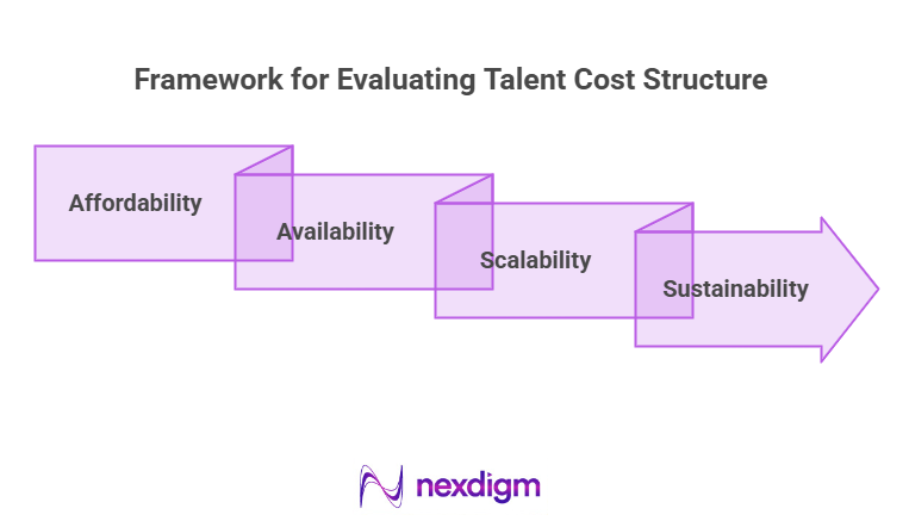
- Affordability: Evaluates salary levels, labor costs, statutory expenses, and benefits to determine whether talent costs align with business profitability objectives.
- Availability: Assesses the size, quality, and accessibility of the talent pool required to support current operations and future growth.
- Scalability: Measures how easily organizations can expand their workforce as business needs evolve without facing significant talent supply constraints.
- Sustainability: Examines long-term workforce stability, retention rates, skill development, and market conditions to ensure continued talent availability and competitiveness.
With the help of Nexdigm’s strategic framework, markets that perform well across affordability, availability, scalability, and sustainability are better positioned to support long-term business expansion and operational success.
Nexdigm’s Case
Nexdigm assisted an oil and gas client in benchmarking compensation across critical roles before market entry. The real-time insights identified 18% workforce cost savings, improved pay-band consistency, strengthened hiring competitiveness by 25%, and reduced workforce planning timelines. Nexdigm’s talent cost assessment enabled the client to establish competitive compensation structures, improve workforce economics, and support a more efficient market-entry strategy.
To take the next step, simply visit our Request a Consultation page and share your requirements with us.
Harsh Mittal
+91-8422857704