

Expanding into a new market is one of the most significant decisions an oil and gas company can make. With high capital requirements, complex regulations, long project timelines, and geopolitical risks, success requires more than identifying attractive opportunities.
A well-defined market entry strategy balances commercial potential with operational realities and investment risks, helping companies achieve sustainable growth and long-term value.
At organizations like Nexdigm, the deep industry expertise helps energy companies navigate these challenges through data-driven market entry strategies that support informed decision-making and successful expansion.
Why Market Entry Is Complex for Oil and Gas Companies
Entering a new market is challenging. It involves more than identifying resource potential or demand growth. Oil and gas companies must evaluate multiple factors that can significantly impact the success and profitability of an expansion initiative. Key considerations include:
- Regulatory and licensing requirements
- Political and geopolitical stability
- Capital investment obligations
- Local partner and supply chain ecosystems
- Environmental and sustainability expectations
- Competitive market dynamics
These factors can influence project timelines, investment returns, operational efficiency, and long-term commercial viability. As a result, organizations need a structured approach to assess opportunities while balancing risk, capital allocation, and growth objectives.
Turning Market Potential into Sustainable Growth
Identifying the right market opportunity is important. A structured framework enables businesses to make informed decisions and build a foundation for long-term value creation. By adopting a systematic approach to market entry, organizations can reduce uncertainty, optimize capital allocation, and improve their ability to achieve sustainable growth in increasingly competitive energy markets.
Market Entry Framework for Oil and Gas Expansion
Successful market entry requires a careful balance of opportunity, risk, and capital investment. A structured framework helps oil and gas companies make informed expansion decisions and build a foundation for sustainable growth. This involves the following steps:
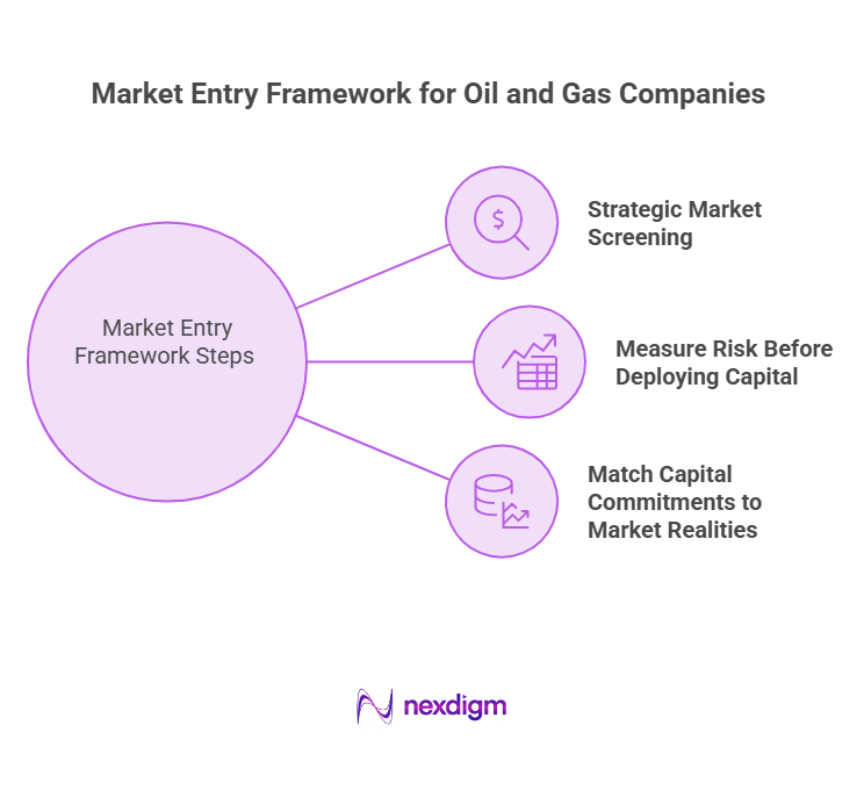
1. Strategic Market Screening
Before committing resources, companies should narrow their focus on markets that align with their business objectives. Some key evaluation areas of the same are:
- Energy demand projections
- Exploration and production potential
- LNG and infrastructure opportunities
- Foreign investment openness
- Tax incentives
- Market accessibility
Nexdigm supports clients through comprehensive market screening exercises that identify opportunities based on both immediate and long-term growth potential. Rather than evaluating dozens of jurisdictions equally, businesses can focus on the markets most likely to support sustainable expansion.
2. Measure Risk Before Deploying Capital
Many expansion failures can be traced back to insufficient risk assessment. A strong oil and gas market entry strategy consulting engagement should evaluate the following risks:
Regulatory Risk
- Licensing requirements
- Environmental regulations
- Foreign ownership restrictions
- Reporting obligations
Political Risk
- Policy stability
- Government priorities
- Contract enforcement environment
Operational Risk
- Workforce availability
- Infrastructure readiness
- Supply chain reliability
Commercial Risk
- Commodity price exposure
- Competitive pressure
- Demand fluctuations
Nexdigm’s risk-focused assessments help organizations understand not only what could go right but also what could go wrong before substantial capital is committed.
3. Match Capital Commitments to Market Realities
A common mistake in international expansion is deploying capital too aggressively before market viability is fully established. A smart capital allocation involves the following steps:
- Testing Before Scaling: Starting with smaller investments to validate market assumptions.
- Phased Infrastructure Development: Expanding operational capacity gradually as market conditions evolve.
- Strategic Partnerships: Reducing financial exposure through shared investment models.
- Asset-Light Entry Structures: Leveraging existing infrastructure where possible.
Nexdigm helps businesses align capital deployment strategies with market maturity, reducing investment risks while preserving growth opportunities.
The Role of Entry Models in Oil and Gas Market Expansion Success
Choosing the right market is not easy. Selecting the right market entry structure can significantly influence project outcomes. The entry model determines the following options through which a company can establish its presence in a new market:
- Joint Ventures: Ideal for markets where local relationships and regulatory navigation are critical.
- Strategic Alliances: Useful for accessing established infrastructure and market networks.
- Acquisitions: Suitable for organizations seeking rapid market presence and operational capabilities.
- Greenfield Investments: Best suited for companies seeking full operational control and long-term strategic positioning.
Nexdigm assists organizations in evaluating each option based on financial objectives, compliance requirements, and operational priorities.
How Should Oil and Gas Companies Enter New Markets?
The most effective approach is not to pursue the largest opportunity, but the one that best aligns with the company’s strategic objectives, capabilities, and risk assessment. In a highly dynamic energy landscape, strategic planning can significantly improve the chances of long-term success. A successful market entry should follow a structured path:
- Assess market attractiveness
- Evaluate regulatory and geopolitical risks
- Validate capital requirements
- Select the optimal entry model
- Build local market capabilities
- Create a long-term growth roadmap
At Nexdigm, this phased approach helps organizations minimize uncertainty while maximizing investment efficiency.
Nexdigm’s Approach towards Market Expansion and Long-term Growth
Many advisory engagements focus primarily on identifying attractive market opportunities. Nexdigm takes a broader perspective, recognizing that successful expansion requires aligning growth objectives and financial sustainability. Through integrated advisory services, Nexdigm supports clients with:
- Market attractiveness assessments
- Regulatory due diligence
- Investment feasibility analysis
- Risk evaluation frameworks
- Tax and compliance advisory
- Partner ecosystem assessments
- Financial modeling and forecasting
This holistic approach ensures that expansion strategies are commercially viable, operationally achievable, and aligned with long-term business objectives. By combining strategic insight with execution-focused guidance, Nexdigm helps organizations confidently navigate market complexities and unlock sustainable growth opportunities.
Nexdigm’s Case
Nexdigm recently supported an oil and gas client in evaluating new-market entry options, balancing risk, capital, and commercial opportunity. Data-led analysis improved market prioritization, optimized capital allocation by 28%, reduced entry-risk exposure and accelerated investment decisions by 30%.
Nexdigm’s market entry framework enabled the client to balance capital intensity with market potential, mitigate risks, and pursue high-value expansion opportunities with greater confidence.
To take the next step, simply visit our Request a Consultation page and share your requirements with us.
Harsh Mittal
+91-8422857704