

Oil and gas trade decisions depend on the interaction between supply availability, consumption patterns, pricing conditions and the ability to move commodities between markets. Production growth in one region may create export opportunities, while changes in refinery demand or pipeline availability elsewhere can redirect trade flows.
Energy companies need a structured way to connect these signals to decisions about procurement, export allocation, contracts and market entry.
Read Demand and Supply Together
Demand forecasts alone are insufficient for trade planning. A market may consume large volumes but rely on long-term contracts, domestic production or established supplier relationships that limit opportunities for new entrants.
Supply analysis must account for current production, planned projects, refinery capacity, storage levels and transportation constraints. Demand analysis should consider fuel consumption, industrial activity, power generation, refinery requirements and the availability of alternative energy sources.
The IEA’s Oil 2025 report examines supply and demand dynamics across fuels, sectors and regions through 2030. Its analysis helps distinguish changes in total oil demand from shifts in the mix of products and the regions supplying them.
For natural gas, LNG capacity additions and changing pipeline flows can alter the balance between importing regions. Companies should evaluate these developments alongside contract structures and the ability of buyers to accept alternative supply.
Track Trade Flows and Competitive Shifts
Trade data provides evidence of how supply and demand are being matched in actual transactions. It can identify changes in destination markets, supplier concentration, import volumes and the relative importance of crude oil, refined products and natural gas.
The phrase oil and gas market trade intelligence describes the process of connecting these observations with commercial context. It involves asking why a flow changed, whether the change is persistent and what it means for the next trading or investment decision.
Useful analytical comparisons include:
- Import Growth Versus Supplier Growth: Determine whether exporters are gaining share in expanding markets.
- Volume Versus Value: Separate changes in physical quantities from price-driven changes in trade value.
- Historical Patterns Versus Current Conditions: Identify seasonal movements and longer-term structural changes.
- Contracted Supply Versus Market Availability: Assess how much demand may be accessible to additional suppliers.
- Route And Infrastructure Exposure: Understand whether transport constraints could alter delivered costs or supply reliability.
For example, a rise in LNG imports may reflect increased demand, reduced pipeline deliveries or a temporary shortage in domestic production. The commercial response differs depending on which factor explains the increase.
Account For Price and Policy Uncertainty
Trade strategy must reflect the fact that physical demand and commercial attractiveness are not the same. A destination may need additional supply but become less profitable when prices, freight costs or insurance premiums rise.
The World Bank’s October 2025 Commodity Markets Outlook projected lower energy prices amid expanding oil supply and subdued demand growth. Such forecasts provide context for evaluating market exposure, although they should not be treated as guarantees of future prices.
Businesses should also monitor sanctions, export restrictions, taxes, local-content rules and changes in energy policy. These factors can affect which suppliers can access a market, how contracts are structured and whether existing routes remain commercially viable.
Scenario analysis helps test how a strategy performs under different assumptions. A business can compare outcomes under stronger demand, lower prices, delayed infrastructure projects or the loss of a major supplier.
Build A Repeatable Trade Strategy
Market intelligence should connect directly to decisions. Exporters may use it to prioritise destinations; buyers may use it to diversify supply; traders may use it to evaluate arbitrage opportunities; and investors may use it to assess infrastructure requirements.
A repeatable process also needs consistent definitions. Crude oil, refined products, pipeline gas and LNG should be analysed separately before drawing conclusions about the wider energy market. Trade value, volume and unit value should be compared using compatible periods and product classifications.
Nexdigm’s Energy Trade Strategy Framework
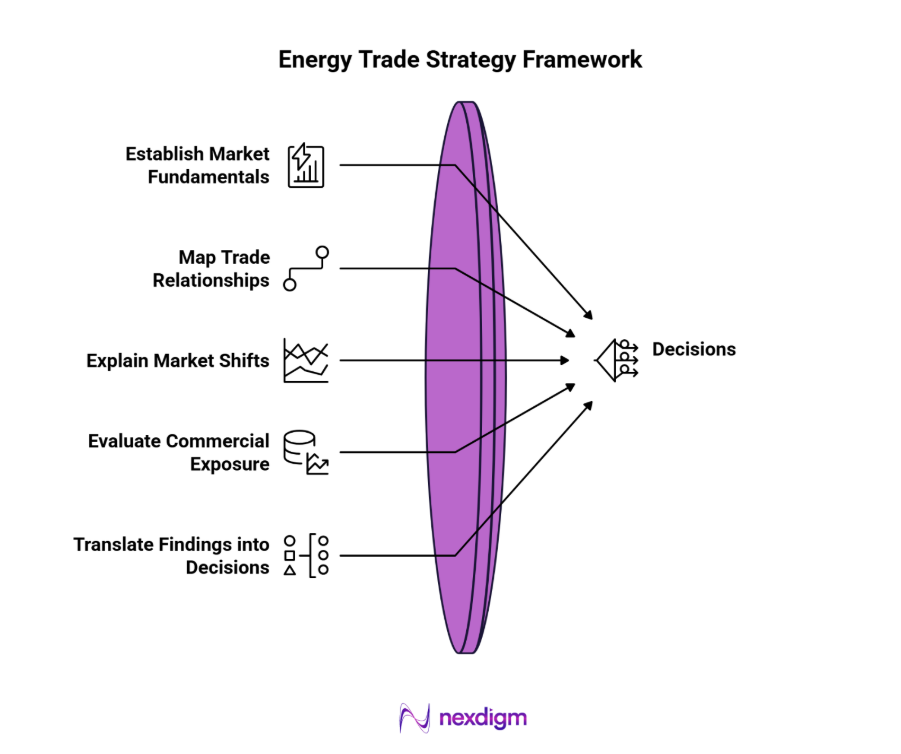
- Establish Market Fundamentals: Review production, consumption, capacity and demand forecasts.
- Map Trade Relationships: Identify major exporters, buyers, routes and changes in market share.
- Explain Market Shifts: Test whether changes reflect prices, supply disruptions, infrastructure or demand.
- Evaluate Commercial Exposure: Compare delivered costs, contract conditions and regulatory constraints.
- Translate Findings into Decisions: Prioritise suppliers, destinations, contract changes and contingency options.
Nexdigm’s Case Study: Reassessing An Import Strategy
An industrial energy buyer notices that one supplier’s share of regional imports is increasing while alternative sources remain available. It compares trade volumes, delivered costs, contract terms and transport risks before deciding to retain its core supplier while qualifying an additional source for future procurement.
Energy market intelligence is useful when it explains not only what has changed but also why it matters commercially. Combining supply, demand, trade and competitive indicators helps companies make more informed decisions about sourcing, exports and market exposure.
To take the next step, simply visit our Request a Consultation page and share your requirements with us.
Harsh Mittal
+91-8422857704