

Global oil and gas trade is being reshaped by supply disruptions, changing demand, alternative trade routes, new LNG capacity, and shifting supplier relationships. In 2026, the Strait of Hormuz disruption has had a major impact on energy flows. IEA data shows global oil supply fell sharply, while oil inventories declined by 507 million barrels between the start of the conflict and September. Meanwhile, U.S. LNG exports averaged 17.4 billion cubic feet per day in the first half of 2026, 23% higher than a year earlier. Global LNG trade is expected to remain broadly flat in 2026 despite major supply changes across regions.
These developments demonstrate why country-level trade statistics alone may not explain the changing energy landscape. Oil and gas trade analysis can help businesses examine where supply is moving, which markets are becoming more dependent on imports, how trade routes are changing, and where alternative suppliers or market opportunities may emerge.
Trade Routes Are Becoming More Important
Oil and gas markets depend heavily on infrastructure and transportation corridors. Disruptions at major chokepoints can quickly alter supplier economics, shipping patterns, inventories, and regional availability. EIA data shows oil flows through the Strait of Hormuz averaged just 4.9 million barrels per day in Q2 2026, compared with 21.6 million barrels per day in Q4 2025.
Supply Gaps Can Create New Market Dynamics
When established supply routes become constrained, alternative producers and destinations can gain importance. IEA data shows producers outside the Gulf added 2.3 million barrels per day of oil supply between February and August 2026, illustrating how supply networks can adjust when major sources are disrupted.
- Alternative Suppliers: Identify producers gaining relevance as traditional supply sources face constraints.
- Emerging Destinations: Track markets where changing supply conditions create new import requirements.
Shifts in global supply patterns can create new opportunities for both suppliers and buyers. By monitoring alternative sourcing hubs and emerging demand markets, businesses can identify supply chain opportunities, strengthen resilience, and respond more effectively to changing trade dynamics.
Nexdigm’s Expert-led Energy Trade Intelligence Service Offering
Changing oil and gas flows can create both opportunities and exposure for businesses. Nexdigm helps interpret these movements by combining trade intelligence with energy-sector research, market intelligence, pricing analysis, competitive intelligence, and supply-chain assessment. Its approach can help businesses understand:
- Where Supply Is Shifting: Track changing exporters, importers, origins, destinations, and trade routes across energy products.
- Where Demand Is Emerging: Analyze import growth, buyer activity, market dependence, and product movements to identify markets with changing requirements.
- What the Changes Mean: Connect trade movements with pricing, infrastructure, production, logistics, and market conditions to assess their commercial implications.
This provides businesses with a clearer view of changing energy markets, emerging opportunities, sourcing alternatives, and potential supply risks.
Why Energy Trade Assessment Matters
Oil and gas trade movements can be driven by several factors at the same time, making headline import and export figures difficult to interpret on their own. Nexdigm’s assessment can bring these signals together to:
- Separate Demand from Disruption: Determine whether changing trade volumes reflect genuine demand, temporary shortages, inventory movements, or supply interruptions.
- Identify Supply Exposure: Assess dependence on specific countries, suppliers, products, or trade routes and identify areas requiring greater diversification. This creates a stronger foundation for assessing market shifts, sourcing options, supply risks, and potential growth opportunities before moving to strategic decisions.
Nexdigm’s Oil and Gas Trade Assessment Framework
Nexdigm can structure oil and gas trade analysis through five connected steps, moving from understanding trade flows to identifying commercially relevant opportunities and risks. These steps are:
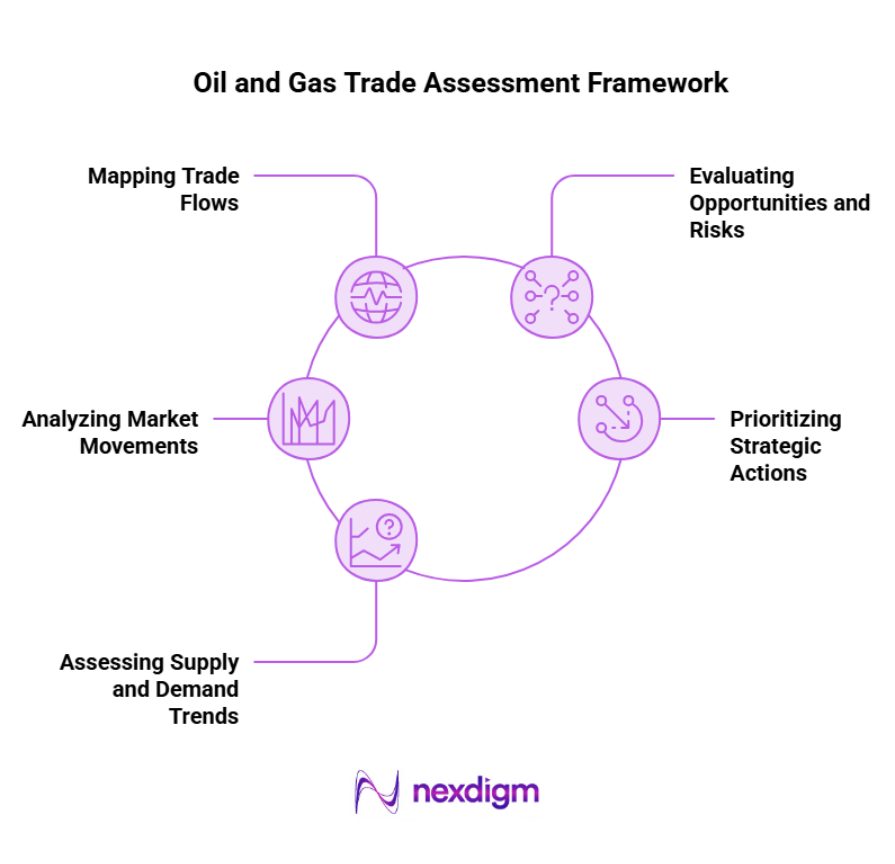
- Mapping Trade Flows: Identify crude oil, refined products, natural gas, and LNG flows across origins, destinations, suppliers, buyers, trade routes, and relevant time periods.
- Analyzing Market Movements: Assess import and export values, volumes, growth rates, shipment activity, supplier shares, and indicative pricing to identify significant changes.
- Assessing Supply and Demand: Examine production, import dependence, supplier capacity, buyer activity, infrastructure, and regional demand to understand changing market balances.
- Evaluating Opportunities and Risks: Assess alternative suppliers, emerging markets, pricing differences, route dependencies, supplier concentration, and infrastructure constraints to identify commercial opportunities and potential exposure.
- Prioritizing Strategic Actions: Rank markets, suppliers, products, and trade routes according to demand potential, supply availability, pricing, accessibility, resilience, and strategic relevance.
This framework helps businesses convert complex energy trade movements into clear priorities for sourcing, market entry, procurement, supply diversification, and investment decisions.
How Nexdigm’s Trade Assessment Creates Strategic Advantage
Nexdigm’s structured framework helps businesses turn fragmented oil and gas trade information into a clearer basis for strategic action by offering the following advantages of:
- Stronger Sourcing Decisions: Identify alternative suppliers, origins, and trade routes to reduce concentration and improve supply flexibility.
- Earlier Risk Identification: Detect changes in supplier concentration, trade routes, market balances, and infrastructure that could affect future supply.
- More Informed Investment Decisions: Combine market and trade signals to evaluate opportunities across energy markets, infrastructure, sourcing, and expansion.
Nexdigm’s Case
Nexdigm’s trade intelligence approach helped a manufacturer identify market shifts, contributing to 18% export-volume growth, 24% higher distributor orders, and 15% fewer inventory gaps. The analysis supported faster demand forecasting, stronger sourcing decisions, and more informed international market planning.
To take the next step, simply visit our Request a Consultation page and share your requirements with us.
Harsh Mittal
+91-8422857704