

New oil and gas trade opportunities emerge when production capacity, buyer demand, infrastructure and commercial conditions align. They may appear in established importing markets seeking new suppliers, developing economies expanding energy infrastructure or regions where new export facilities are changing the availability of supply.
For producers, traders and energy investors, identifying these opportunities requires more than tracking headline demand growth. The key is determining which markets can absorb additional volumes on commercially sustainable terms.
Identify Emerging Demand Centres
Demand growth varies by fuel, region and end use. Oil demand is influenced by transport, petrochemicals, industrial activity and refining requirements. Natural gas demand depends on power generation, industrial consumption, heating needs and the availability of alternative fuels.
The IEA’s Gas 2025 report anticipated a major expansion of global LNG export capacity by 2030, primarily driven by the United States and Qatar. The report also noted that the additional supply could improve availability and affordability for importing markets, including price-sensitive emerging economies.
This expansion may create new procurement opportunities, but additional supply does not guarantee equally strong demand in every destination. Importing countries differ in regasification capacity, pipeline connectivity, storage, financing and the ability to secure long-term contracts.
Businesses should therefore assess demand growth alongside the practical ability of a market to receive, distribute and pay for additional energy supplies.
Map Supply Growth Against Buyer Requirements
A market becomes commercially attractive when available supply matches the buyer’s product, quality, delivery and pricing requirements.
For oil, crude grades, refinery configurations, product specifications and transportation costs influence supplier suitability. For natural gas, pipeline access, LNG regasification terminals, contract flexibility and pricing arrangements can determine which suppliers are viable.
Trade data helps reveal where buyers are changing supplier relationships or increasing imports. It can also highlight markets where import dependence is rising, although this should be verified against domestic production, inventories and changes in consumption.
The U.S. Energy Information Administration reported that global LNG trade volumes reached a record 56.3 billion cubic feet per day in 2025, an increase of 5.4% from 2024. U.S. LNG exports rose by 26%, while European LNG imports increased by 29%. These shifts illustrate how export capacity, changes in pipeline supply and regional procurement needs can reshape trade opportunities.
The implications differ by market. Exporters may pursue buyers with rising import requirements, while buyers may use additional supply options to diversify procurement and manage security risks.
Evaluate The Commercial Opportunity
The phrase oil and gas trade opportunities should lead to a structured commercial assessment, not simply a list of countries with growing imports.
Companies should examine the following factors:
- Demand Durability: Determine whether growth is structural, seasonal or linked to temporary supply disruption.
- Supplier Competition: Assess incumbent suppliers, market concentration, contract commitments and available alternatives.
- Delivered Economics: Compare commodity prices, freight, insurance, handling costs and applicable duties.
- Market Access: Review sanctions, licensing, import rules, quality specifications and contractual requirements.
- Execution Feasibility: Evaluate infrastructure, credit risk, payment conditions and the ability to meet delivery schedules.
A market with strong demand growth may still be unattractive if transport costs absorb the margin or if a new supplier cannot meet the required specifications.
Consider Infrastructure and Route Risk
Trade opportunities depend on the infrastructure connecting producers and consumers. New liquefaction facilities can increase LNG export availability, while pipeline expansions can open or strengthen regional gas markets. Refinery projects may change demand for specific crude grades or refined products.
Route risks must also be included in market assessments. Maritime chokepoints, port capacity, pipeline outages and shipping constraints can affect both the timing and cost of delivery. Alternative routes should be evaluated for actual capacity, transit time and cost rather than assumed to be readily available.
Companies should compare opportunities under different scenarios, including lower commodity prices, delayed projects, higher freight expenses and weaker-than-expected demand.
Nexdigm’s Oil And Gas Opportunity Prioritisation Framework
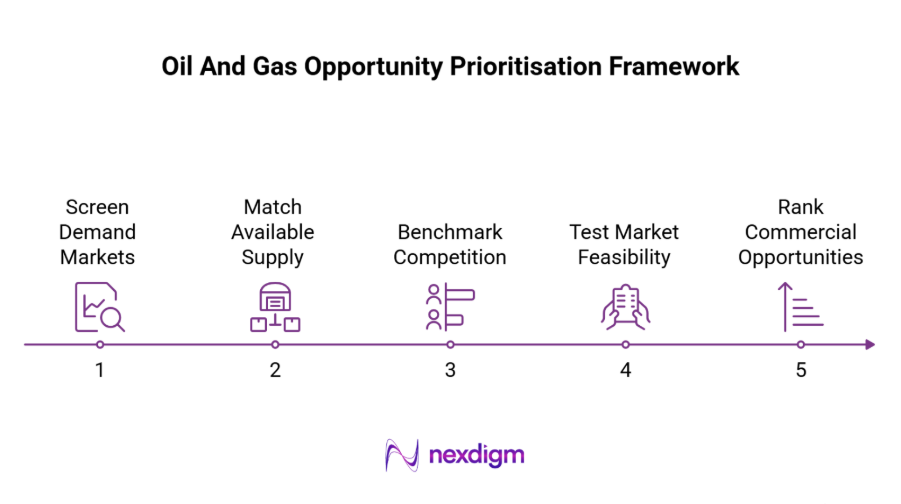
- Screen Demand Markets: Identify rising import requirements and changes in consumption by fuel and product.
- Match Available Supply: Assess exporter capacity, product suitability and contract availability.
- Benchmark Competition: Compare existing suppliers, delivered prices and market concentration.
- Test Market Feasibility: Evaluate infrastructure, regulations, financing and route reliability.
- Rank Commercial Opportunities: Prioritise markets by expected returns, demand durability and downside exposure.
Nexdigm’s Case Study: Selecting A New Trading Corridor
An energy trader evaluates two potential markets for LNG sales. The first has higher projected demand but limited terminal flexibility. The second offers moderate growth, available import infrastructure and a broader range of potential buyers. After comparing delivered costs and contract conditions, the trader prioritises the second corridor.
Oil and gas market opportunities are strongest where demand, available supply, infrastructure and commercial terms align. By combining trade data with buyer intelligence, competitor monitoring and scenario analysis, energy businesses can prioritise markets more effectively and respond as global trade patterns evolve.
To take the next step, simply visit our Request a Consultation page and share your requirements with us.
Harsh Mittal
+91-8422857704