

Oilseed expansion opportunities are increasing as global demand for edible oils rises across food processing, household consumption, animal feed, and biofuel applications. Crops such as soybean, sunflower, rapeseed, and palm-related oilseeds are gaining importance as processors and traders seek reliable supply sources and scalable growth markets. Companies entering this sector must assess production capacity, crushing infrastructure, import dependence, pricing volatility, quality standards, and buyer requirements.
A clear market entry strategy helps identify attractive regions, manage supply-chain risks, and evaluate commercial feasibility. A focused Oilseed market entry strategy supports informed expansion decisions across evolving edible oil and oilseed value chains.
Global oilseed production in 2027 is forecast at a record 718 million metric tons, up 3% from 2026, supported by soybean, rapeseed, sunflower seed, and other oilseed crops. Data also reported that vegetable oil prices rose 5.9% month-on-month in April 2026, reaching their highest level since July 2022.
These figures support Oilseed market entry strategy planning by highlighting supply growth, edible oil demand, price volatility, and processing opportunities.
Role of Edible Oil Demand in Oilseed Market Expansion
Rising edible oil demand drives oilseed market expansion by increasing needs for soybean, rapeseed, sunflower, and other crops used in crushing, processing, trade, and supply-chain development:
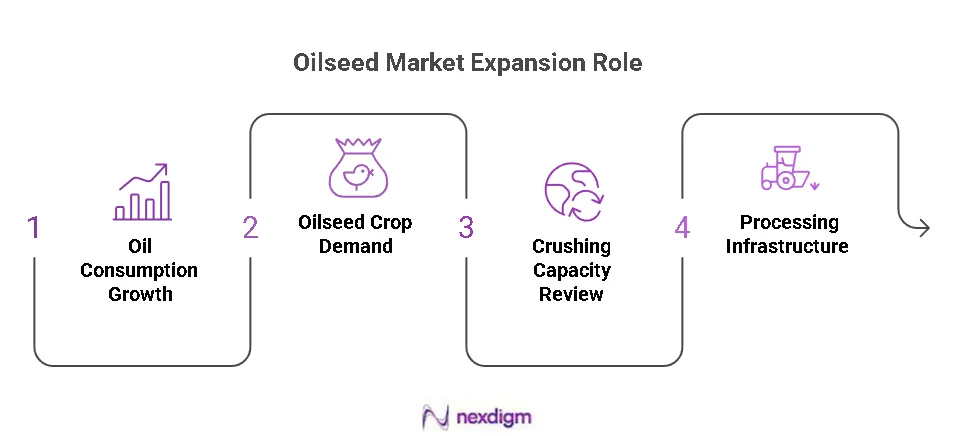
-
Edible Oil Consumption Growth
Assess household, foodservice, and packaged food demand driving higher oilseed crushing and processing requirements.
-
Oilseed Crop Demand
Evaluate demand for soybean, rapeseed, sunflower, and other oilseeds used in edible oil production.
-
Crushing Capacity Review
Analyze existing and planned crushing facilities to identify regions needing stronger oilseed supply networks.
-
Processing Infrastructure Assessment
Review refining, storage, packaging, and transport infrastructure supporting edible oil value-chain expansion.
Nexdigm Oilseed Trade Flow Analysis for Market Entry Planning
Nexdigm can help oilseed market entrants analyze import-export volumes, sourcing regions, trade corridors, tariff exposure, logistics routes, and buyer demand. This supports market entry planning by identifying reliable supply sources, high-demand destination markets, cost-efficient routes, regulatory risks, and expansion opportunities across edible oil and oilseed value chains.
Nexdigm Global Opportunity Mapping for Oilseed Market Growth
Nexdigm can assess regional demand, edible oil consumption, import dependence, crushing capacity, trade flows, competition, and pricing trends to identify high-potential oilseed growth markets.
-
Import Dependence Review
Assess domestic production gaps, edible oil imports, oilseed shortages, and sourcing needs across target regions.
-
Crushing Capacity Mapping
Analyze existing and planned crushing facilities to identify regions with strong oilseed processing demand.
-
Trade Flow Analysis
Review import-export volumes, sourcing corridors, tariff exposure, and logistics routes supporting oilseed market entry.
-
Competitive Landscape Review
Benchmark existing suppliers, processors, pricing models, distribution reach, and market positioning across oilseed value chains.
Nexdigm’s case:
Nexdigm assisted an oilseed processor assess global opportunity mapping for market growth. The analysis identified regions with 20–25% edible oil demand growth potential, 18% import-dependence gaps, and 12–15% pricing variation across oilseed trade routes. These insights helped the company prioritize high-potential markets, evaluate crushing capacity, assess sourcing corridors, and build a focused oilseed market entry strategy.
To take the next step, simply visit our Request a Consultation page and share your requirements with us.
Harsh Mittal
+91-8422857704