

Oilseed procurement decisions are shaped by changing crop supplies, processing demand, quality expectations, and price movements across producing markets. The USDA’s November 2026 outlook projects global oilseed production at approximately 721.9 million metric tons for the 2026/27 marketing year, while global soybean crushing is forecast to reach 386.2 million metric tons.
In India, the third advance estimate places 2025–26 oilseed production at 43.06 million tonnes. These developments highlight the importance of evaluating sourcing options beyond quoted prices. Oilseed procurement research helps businesses understand origin markets, assess supplier capabilities, compare quality and extraction potential, and identify sourcing options that align with their processing and commercial requirements.
The Procurement Challenge: Balancing Raw Material Cost with Processing Value
The lowest-priced oilseed may not deliver the best procurement outcome. Differences in oil content, moisture, impurities, crop condition, and transport costs can influence processing efficiency and the value recovered from each consignment. Buyers therefore need to consider the relationship between purchase price and usable output. A more complete assessment connects the economics of raw material procurement with the operational requirements of the crushing facility.
Variables That Shape an Oilseed Purchase
Before approaching suppliers, procurement teams should establish the factors that determine whether an oilseed lot is commercially and operationally suitable:
- Price and Cost Structure: Compare market quotations alongside freight, handling, duties, storage, and other landed-cost components to understand the actual procurement cost.
- Quality and Oil Content: Examine moisture, foreign matter, purity, seed condition, and oil content against processing specifications and acceptable quality thresholds.
- Crush Yield and Processing Fit: Assess expected oil recovery, meal output, and processing characteristics to understand how raw material quality may affect plant performance.
- Availability and Delivery Reliability: Review seasonal supply, origin-level production, supplier inventory, shipment schedules, and logistics access to assess continuity of procurement.
Considering these variables together helps buyers evaluate the economic and operational value of different sourcing options.
How Nexdigm Builds an Origin-Level View of Oilseed Supply
Nexdigm helps businesses understand where relevant oilseeds are produced, how supply is organized, and which markets offer potential sourcing opportunities. Our oilseed procurement research can cover major oilseed categories such as soybeans, rapeseed, sunflower seeds, groundnuts, sesame, and other commercially relevant varieties.
We examine producing regions, crop availability, export participation, trade flows, and the presence of aggregators, traders, processors, and exporters. This origin-level view helps procurement teams understand the structure of supply markets before moving into supplier-level evaluation.
Nexdigm’s Supplier and Quality Assessment
A supplier’s quoted price does not necessarily reflect the value of the material being offered. Our research helps buyers examine suppliers against relevant product and operational parameters, including:
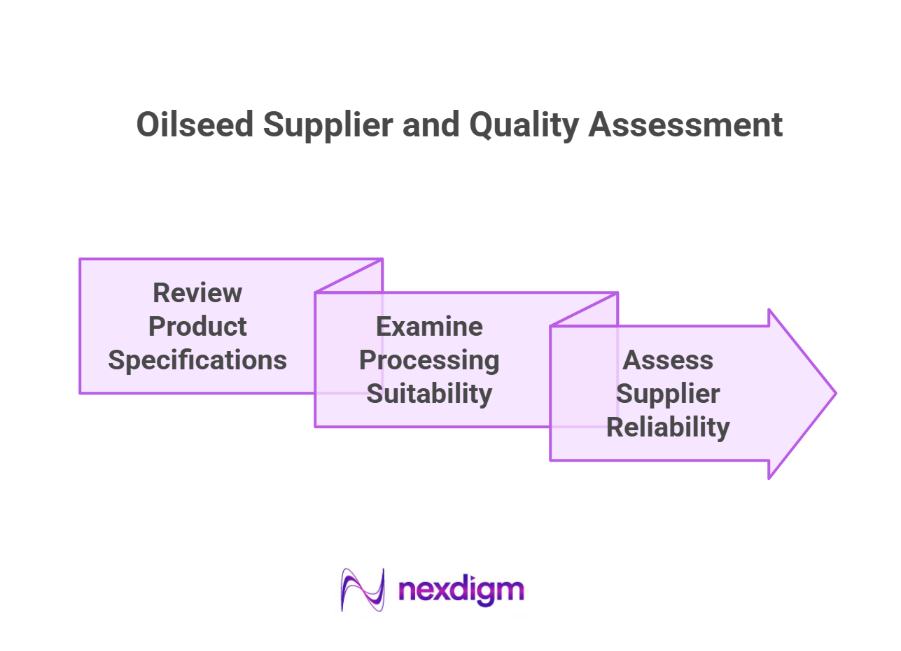
- Product Specifications: Review seed variety, moisture, impurities, foreign matter, oil content, and other available quality indicators.
- Processing Suitability: Examine how the offered material aligns with crushing requirements, expected oil recovery, meal characteristics, and processing preferences.
- Supplier Reliability: Assess sourcing networks, procurement arrangements, storage facilities, quality-control practices, supply volumes, and delivery capabilities.
This assessment provides a more consistent basis for comparing suppliers and identifying potential gaps that require further technical verification.
Nexdigm’s Application-Based Approach to Oilseed Supplier Assessment
Oilseed requirements can differ depending on the intended application, processing technology, and desired output. Our assessment helps businesses assess supplier suitability across relevant oilseed categories and end-use requirements:
- Edible Oil Production: Identify suppliers offering oilseeds with suitable oil content, quality characteristics, and consistency for edible oil extraction.
- Oilseed Meal and Feed Applications: Examine seed and processing characteristics that influence meal output, protein content, and suitability for animal nutrition.
- Specialty and Industrial Applications: Assess suppliers serving applications such as specialty oils, food ingredients, and industrial processing, based on product specifications and supply capabilities.
This application-led assessment helps businesses compare relevant suppliers and align sourcing choices with their processing objectives.
Nexdigm’s Case
A vegetable oil processor sought to diversify its soybean and rapeseed sourcing network across three markets. Nexdigm assessed 24 suppliers, comparing indicative prices, quality parameters, oil content, and delivery capabilities. The assessment found that 29% had limited quality documentation, while 23% showed inconsistent seasonal availability. The processor used these findings to prioritize suppliers for sample testing and commercial discussions.
To take the next step, simply visit our Request a Consultation page and share your requirements with us.
Harsh Mittal
+91-8422857704