

An online course can attract thousands of registrations and still struggle to make money. Learners may sign up because a course is free, abandon it after a few lessons, or complete it without purchasing another programme. High enrolment is useful, but it does not establish that a course category can support a sustainable business.
Which learners have a strong reason to enroll, what are they willing to pay, and what makes them stay long enough to realise value?
Which Online Courses Have the Strongest Demand?
Course demand is closely tied to the reason someone is learning. A professional seeking a promotion behaves differently from a student preparing for an entrance examination or a hobbyist exploring a new subject.
Career-oriented learning has a clear commercial rationale. Coursera’s 2025 Learner Outcomes Report, based on responses from more than 52,000 learners across 179 countries, found that 86% used the platform to build skills and advance their careers. The report also found that 91% of respondents reported at least one positive career outcome after completing a course or programme. These are self-reported results from Coursera learners, not estimates of outcomes across the entire online education market, but they illustrate the importance of linking learning to a tangible objective.
Demand research should go beyond search volume and competitor enrolments. Providers need to understand what prompts a purchase, whether learners are actively looking for a solution, and how much time they can realistically commit. Course categories with clear professional, academic or examination-related goals may have stronger purchase intent than broad subjects that attract casual interest.
Online Course Pricing and Revenue Models
Pricing depends on the value learners associate with the outcome, not simply the number of hours of content. A short course tied to a recognised credential may command a higher price than a longer course offering general information. Live instruction, expert feedback, assessment, and career support can also influence willingness to pay.
Common revenue models include:
- One-time course fees: Suitable for defined learning goals, examination preparation, and specialist subjects.
- Subscriptions: Work when providers can sustain repeat engagement through a broad, regularly updated course library.
- Cohort-based programmes: Combine scheduled learning, instructor interaction and peer accountability, often supporting higher prices.
- Institutional and employer licences: Generate revenue through schools, universities or companies purchasing access for groups of learners.
The choice has implications for customer acquisition, delivery costs, and retention. A subscription business needs recurring usage, while a single-course provider must continually acquire new customers or encourage additional purchases.
Course Completion Rates and Monetization Potential
Completion is often treated as a quality metric, but its meaning depends on the product. A learner who watches a short tutorial and leaves may have achieved the intended outcome. Someone who pays for a six-week certification programme and abandons it halfway through presents a different commercial problem.
An Online learning market opportunity analysis should examine the full learner journey, from discovery and enrolment to active participation, completion and subsequent purchase. Drop-off points can reveal whether the course is too demanding, poorly structured, overpriced, or mismatched with the learner’s expectations.
Providers should monitor enrolment-to-activation rates, lesson progression, completion, refunds, repeat purchases, and revenue per learner. They should also calculate the cost of acquiring and supporting each paying learner. A course with strong sales, but high refund rates or expensive instructor support may be less attractive than a smaller, more focused offering.
Nexdigm’s Online Learning Business Model Framework
The Online Course Demand and Monetization Framework evaluates commercial potential through four connected areas:
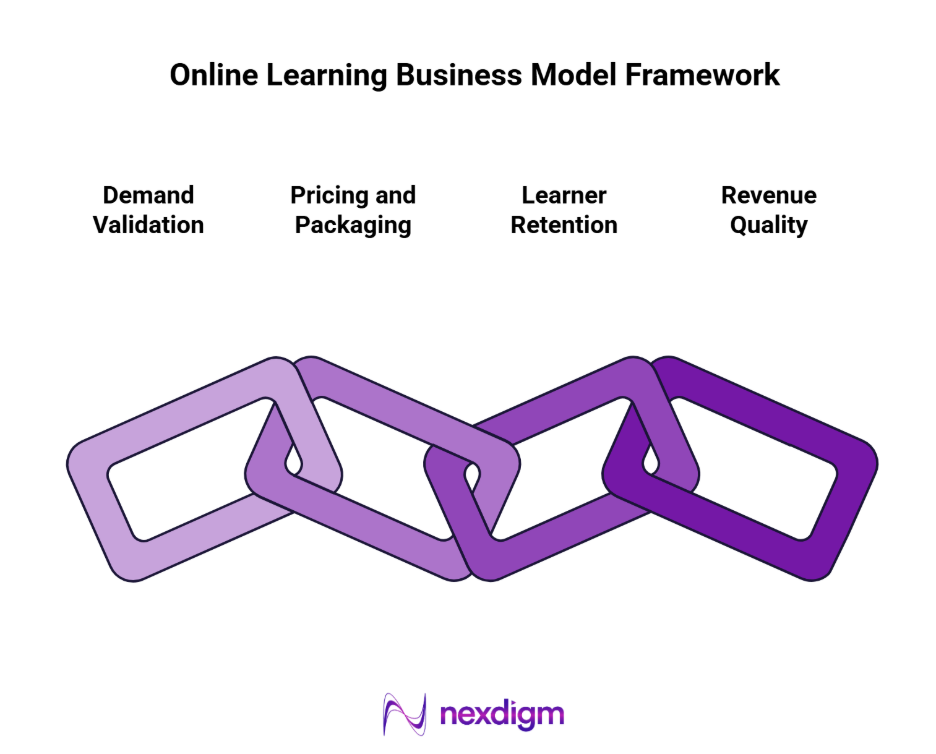
- Demand Validation: Identify the learner segment, purchase motivation, competing courses, and evidence of willingness to pay.
- Pricing and Packaging: Compare one-time fees, subscriptions, cohorts and institutional licences against the value delivered.
- Learner Retention: Track activation, participation, completion and the reasons learners disengage.
- Revenue Quality: Measure acquisition costs, refunds, repeat purchases, contribution margin and recurring revenue potential.
The objective is to identify courses that attract the right learners and deliver enough value to support profitable growth, rather than maximising registrations alone.
Nexdigm Case Study: Evaluating an Online Course Portfolio
Nexdigm assessed 36 courses for an online learning provider, reviewing enrolment trends, pricing, learner progression and acquisition costs. Twelve courses showed consistent demand, but only seven combined strong purchase intent with manageable delivery costs and repeat-purchase potential. The provider prioritised those seven for further investment and revised the packaging of courses with high enrolment but weak completion.
To take the next step, simply visit our Request a Consultation page and share your requirements with us.
Harsh Mittal
+91-8422857704