

Online retail logistics has expanded beyond the traditional task of moving an order from warehouse to customer. Fulfilment, mid-mile transportation, last-mile delivery, returns, and cross-border operations now form an interconnected network, with inefficiency in one stage affecting the economics of the others.
For logistics providers and retailers, this creates a broader opportunity question. Where is demand growing, which parts of the logistics chain remain underserved, and where can additional infrastructure or specialized services generate sustainable returns?
The Opportunity Starts Before the Parcel Leaves the Warehouse
Fulfilment determines how much of the delivery promise remains once an order enters the network. Inventory positioned too far from customers raises transport costs, while excessive decentralization increases facility and inventory costs.
The choice between marketplace-managed, seller-operated, and third-party fulfilment depends on order density, SKU velocity, service commitments, and the level of channel control required.
Warehouse productivity also matters. Pick paths, batch picking, automated sorting, and goods-to-person systems affect dispatch speed. Delays can reduce the transportation window and turn a feasible next-day delivery into an expensive expedited shipment.
Fulfilment Becomes a Network Problem Once Orders Scale
After dispatch, parcels must be consolidated into efficient mid-mile movements through regional sortation centres, hubs, linehaul routes, and cross-docks.
High-volume operators increasingly use automated sorting and direct-injection models to reduce handling. Zone skipping can consolidate parcels by destination and inject them directly into local delivery networks, lowering transport costs and delivery times.
The opportunity depends on sufficient parcel density along specific corridors. Providers therefore need to identify where volumes justify dedicated linehaul or direct injection rather than applying the same network model across markets.
Last Mile Determines the Economics
The last mile can account for up to 53% of shipping expenditure, making delivery density a key driver of online retail logistics economics.
Urban routes spread driver and vehicle costs across more deliveries, while suburban and rural routes involve greater travel between stops and higher cost per delivery.
Failed first attempts add re-delivery, communication, handling, and return-to-origin costs. Address verification, delivery notifications, and parcel lockers can improve first-attempt success where commercially viable.
Returns Create a Second Logistics Network
Returns are often treated as a customer-service issue, but they directly affect logistics costs and inventory recovery.
Fashion and footwear can generate high return volumes, requiring pickup, inspection, grading, repackaging, and decisions on restocking, resale, refurbishment, or liquidation.
Delays can reduce the value of seasonal or fast-moving inventory. Regional return-processing hubs can help logistics providers manage grading and disposition closer to customers, rather than routing every return to a central facility.
Cross-Border Logistics Adds Another Layer of Complexity
International online retail expands the customer base but adds customs, duties, documentation, payments, and multi-carrier coordination.
As low-value import thresholds change across markets, logistics providers increasingly need capabilities in tariff classification, duty calculation, customs documentation, and destination delivery. Returns add another challenge. Cross-border return costs can exceed the product’s value, making regional return hubs and local 3PL partnerships more attractive, especially for high-return categories.
Where Is the Real Opportunity?
The most attractive opportunities are increasingly concentrated in specialized parts of the online retail logistics value chain.
- Reverse logistics: Returns intake, grading, refurbishment, resale, and liquidation can create opportunities where retailers lack specialized infrastructure.
- Specialized fulfilment: High-value, temperature-sensitive, or otherwise complex products require capabilities beyond standard storage and parcel handling.
- Cross-border logistics: Customs brokerage, landed-cost management, consolidation, and localized delivery can support premium services for international sellers.
- Network optimization: High-volume corridors can support zone skipping, dedicated linehaul, and other models that reduce handling and transit time.
The commercial opportunity depends on matching these services with sufficient demand density and customer willingness to pay.
Nexdigm’s Approach to Identifying the Most Valuable Logistics Opportunities
Nexdigm’s online retail logistics market opportunity study examines the movement of products from fulfilment through delivery and, where relevant, back through the returns network.
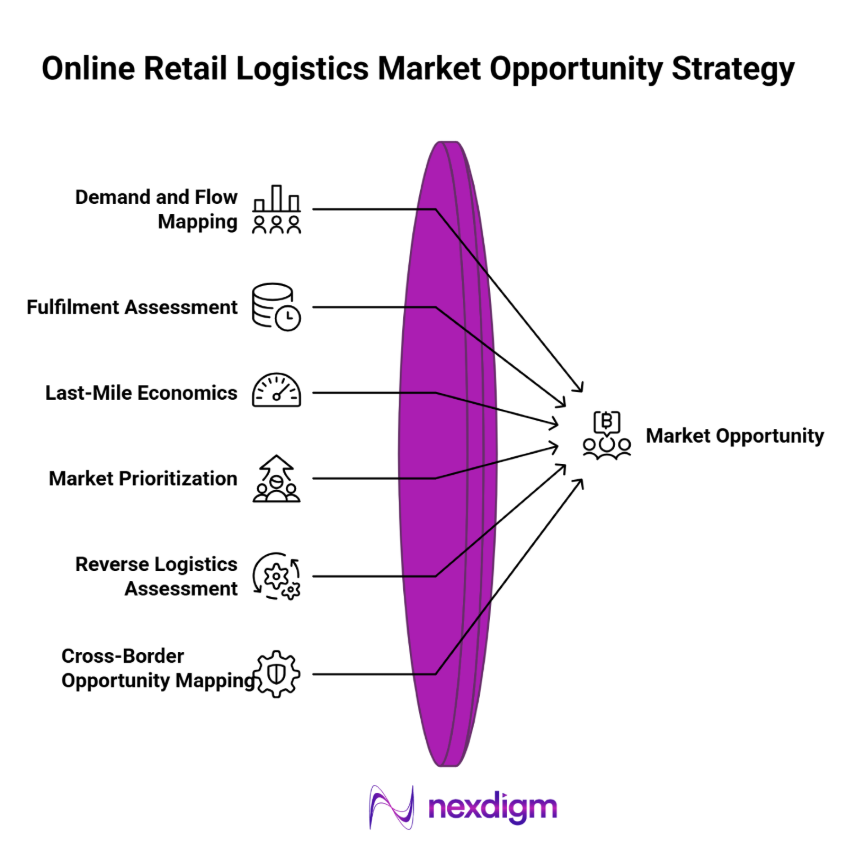
- Demand and Flow Mapping: Analyse transaction volumes, SKU profiles, order density, geographic corridors, and seasonal patterns to identify where logistics demand is concentrated.
- Fulfilment Assessment: Compare centralized, regional, and outsourced fulfillment models based on inventory positioning, facility requirements, order velocity, and service commitments.
- Last-Mile Economics: Evaluate delivery density, route productivity, first-attempt success, transportation costs, and customer service requirements to identify attractive delivery markets.
- Reverse Logistics Assessment: Measure return rates, processing requirements, recovery values, and disposition options to determine where dedicated returns infrastructure can create value.
- Cross-Border Opportunity Mapping: Assess trade corridors, customs requirements, landed costs, carrier ecosystems, and regional return options to identify viable international logistics opportunities.
- Market Prioritization: Benchmark competing providers and rank opportunities according to demand potential, operating requirements, investment needs, and expected commercial returns.
How Nexdigm Identifies High-Value Logistics Opportunities
A third-party logistics provider saw parcel volumes grow 44% year-on-year, while operating margins fell from 11.2% to 3.8%. Apparel and footwear returns were a major source of pressure. Nexdigm found that returns sat at delivery stations for 26 days, consuming 32% of warehouse labour while generating less than 12% of contracted revenue.
Nexdigm introduced regional returns hubs, digital grading, and localized resale. Within eight months, processing time fell to 72 hours, restocking rose from 48% to 81%, $6.4 million in merchandise value was recovered, and EBIT margins improved by 430 basis points.
To take the next step, simply visit our Request a Consultation page and share your requirements with us.
Harsh Mittal
+91-8422857704