

People rarely enrol in an online course simply because they have spare time. They want something: a better job, a promotion, a professional credential, confidence with a new tool or a way to change careers. Providers that understand the motivation behind enrolment are better placed to choose what to teach, how to price it and how to keep learners engaged.
The difficult part comes after registration. Interest gets a learner through the checkout page. Course design, relevance and support influence whether they continue.
Which Online Skills Are Learners Willing to Pay For?
Career-linked skills have a clear commercial advantage because learners can connect the effort to a potential outcome. Data analysis, AI tools, cybersecurity, digital marketing, project management and business communication can be attractive when they address an identifiable gap in a learner’s current role or target occupation.
Coursera’s 2025 Learner Outcomes Report found that 86% of surveyed learners used the platform to build skills and advance their careers. The report, based on more than 52,000 learners across 179 countries, also found that 84% reported improving or developing technical skills relevant to their industries. These are self-reported findings from one platform’s learner base, not a universal ranking of online course demand.
A subject’s popularity does not automatically make it commercially attractive. Learners may browse free introductory content but pay for structured instruction, feedback, assessed projects or a recognised credential. Practical programmes that help learners produce a portfolio, demonstrate a skill or prepare for a specific role can offer a clearer reason to purchase.
Providers should also account for learner circumstances. Working professionals may favour short, flexible modules. Beginners may need more support and a carefully sequenced curriculum. Learners changing careers may value guidance on applying their new skills to actual job requirements.
Why Do Online Learners Abandon Courses?
Course abandonment is not always a motivation problem. Sometimes the programme promises a practical outcome but delivers long lectures without meaningful exercises. In other cases, learners discover that the difficulty level is wrong, the weekly workload is unrealistic or the course does not fit their schedules.
The design of the learning experience can reduce these barriers. Clear milestones help learners see progress. Practical assignments make the content relevant. Timely feedback identifies mistakes before they become reasons to quit. Shorter modules can help with scheduling, although breaking content into small pieces is not a substitute for good teaching.
Providers should distinguish between a learner who leaves after achieving the intended outcome and one who abandons a paid programme without gaining the promised skills. A single completion-rate target can obscure this difference.
Online Skill Learning Market Assessment: What Predicts Repeat Engagement?
An Online skill learning market assessment should consider both what learners want to acquire and what helps them finish.
The most useful evidence comes from learner behaviour:
- Purchase motivation: Career progression, job switching, certification, academic needs or personal interest.
- Course activation: Whether enrolled learners begin the first lesson and complete an initial activity.
- Learning progression: Movement through modules, submission of assignments and participation in assessments.
- Completion barriers: Workload, price, technical problems, weak instruction or mismatch between the course and its description.
- Post-course behaviour: Repeat purchases, referrals, continued platform use or application of the acquired skill.
This evidence can guide product decisions. If learners enrol but do not start, the issue may involve onboarding or a mismatch between marketing and expectations. If they start but stop midway, the provider may need to revisit course pacing, support or instructional design. If they complete but do not return, the catalogue may lack a credible next step.
Online Course Engagement and Retention Framework
The Online Learning Engagement and Completion Framework helps providers improve learner retention without relying on reminders alone.
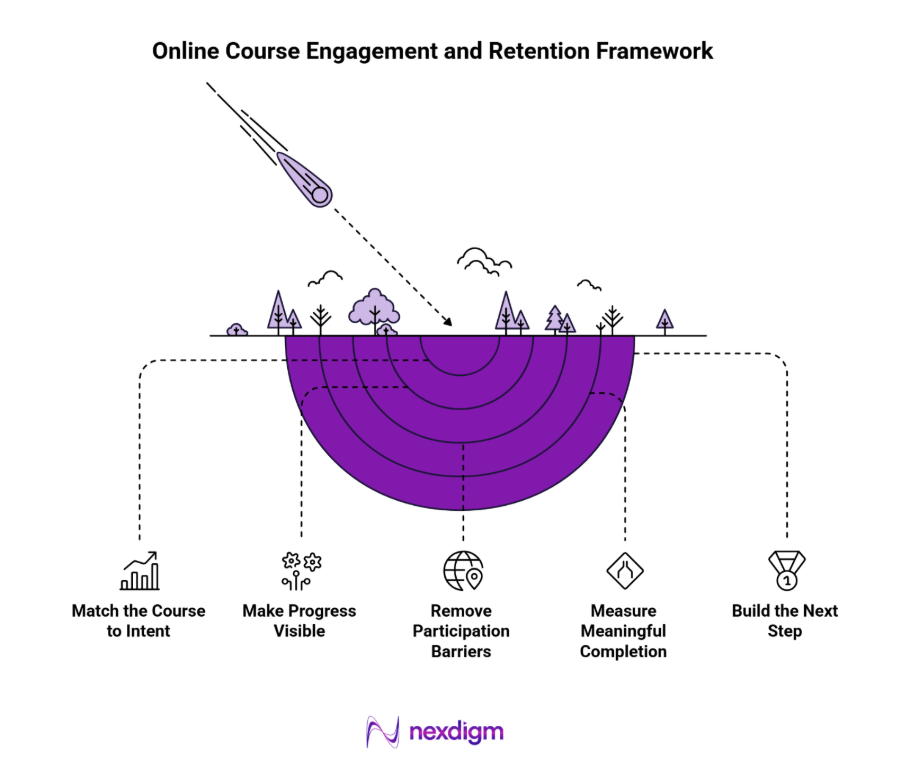
- Match the Course to Intent: Define the learner’s goal and ensure the syllabus delivers what the course description promises.
- Make Progress Visible: Use milestones, practical tasks and clear feedback to show how skills are developing.
- Remove Participation Barriers: Offer flexible schedules, accessible materials and appropriate support for different skill levels.
- Measure Meaningful Completion: Track assessment performance and demonstrated skills alongside course completion.
- Build the Next Step: Offer relevant advanced learning, credentials or practical projects when learners are ready to progress.
Completion improves when the learning experience respects the learner’s time and provides evidence of progress. Engagement tactics can help, but they cannot compensate for a course that delivers little value.
Nexdigm Case Study: Improving Online Course Completion
Nexdigm reviewed 30 online courses for a skills-training provider, comparing enrolment, early lesson activity, assessment participation and completion. Nine courses attracted strong initial interest but experienced substantial mid-course drop-off. The provider prioritised changes to course sequencing, practical exercises and feedback for six programmes before expanding acquisition spending.
To take the next step, simply visit our Request a Consultation page and share your requirements with us.
Harsh Mittal
+91-8422857704