

India’s organic agriculture sector is expanding, increasing the importance of reliable suppliers of organic-compatible fertilizers, biofertilizers, biopesticides, and soil amendments. APEDA’s 2024–25 data records approximately 2.25 million hectares of organically cultivated land and 4.39 million tonnes of organic farm production.
During the same period, organic product exports reached 368,155 tonnes, valued at approximately USD 665.97 million. This growing production and trade ecosystem makes supplier suitability an important procurement consideration.
Businesses must look beyond product availability to understand input composition, permitted-use requirements, documentation, traceability, and supply consistency. A structured organic agriculture input supplier analysis helps organizations identify vendors whose products and capabilities align with crop requirements and applicable organic certification standards.
Why Organic Input Procurement Requires Greater Scrutiny
An input described as natural or biological is not automatically suitable for certified organic production. Its composition, source, manufacturing process, and intended application must be assessed against the relevant organic standard. India’s National Programme for Organic Production (NPOP) includes requirements for crop production and input records, making supplier documentation and product-level verification important parts of procurement evaluation.
Questions to Ask Before Selecting an Organic Input Supplier
Before entering a supplier relationship, procurement teams should establish whether a vendor can meet both agricultural and certification-related requirements.
- Is the Product Suitable for the Intended Crop? Examine composition, application method, crop compatibility, and relevant organic production requirements before approving an input.
- Can the Supplier Substantiate Its Claims? Review product documentation, certifications where applicable, traceability records, and technical information rather than relying solely on marketing statements.
- Can the Supplier Maintain Consistent Availability? Assess production capacity, delivery coverage, seasonal supply, distribution reach, and technical support to understand procurement reliability.
These questions help businesses distinguish suppliers with credible product information and dependable capabilities from vendors that may not meet their sourcing requirements.
Nexdigm’s Expertise in Offering Agricultural Supplier Research Services
Our organization brings market research and supplier intelligence capabilities to the agricultural sector, helping businesses navigate evolving input markets and vendor networks. Our research examines market participants, product portfolios, sourcing dynamics, and commercial considerations across agricultural categories. This industry-led view helps procurement teams understand supplier capabilities, identify relevant market alternatives, and evaluate sourcing opportunities against their operational and sustainability requirements.
Nexdigm’s Framework Approach for Selecting an Organic Input Supplier
Our framework follows a structured organic agriculture input supplier analysis process to help businesses shortlist organic input suppliers based on product suitability, certification requirements, and commercial capabilities. Steps of the process are:
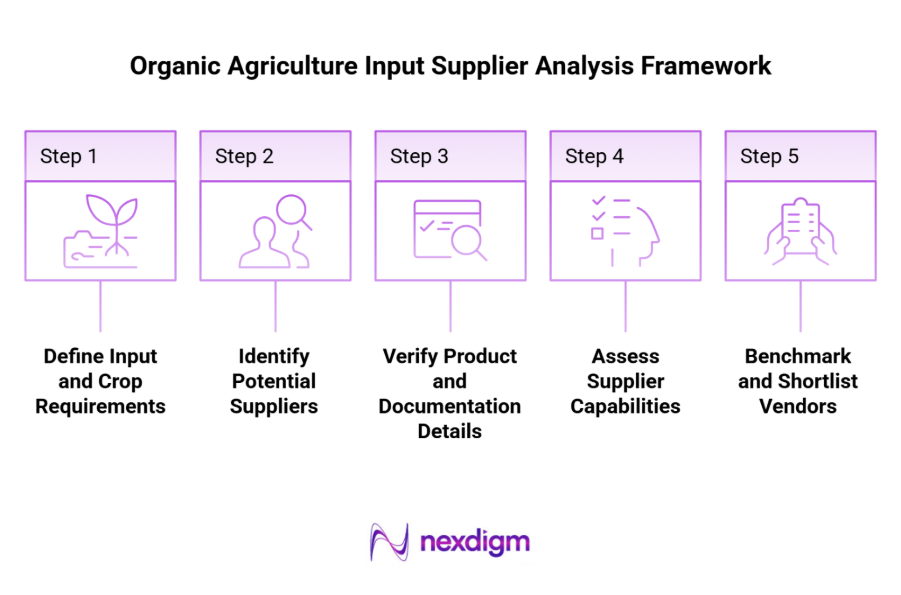
- Defining Input and Crop Requirements: Establish the required input categories, intended crop applications, product specifications, and relevant organic production standards to guide supplier evaluation.
- Identifying Potential Suppliers: Map manufacturers, distributors, and specialized vendors across relevant markets to develop a pool of potential sourcing partners.
- Verifying Product and Documentation Details: Examine product composition, available certifications, technical specifications, traceability records, and supporting documents to identify information gaps requiring further verification.
- Assessing Supplier Capabilities: Evaluate production capacity, quality processes, geographic reach, distribution infrastructure, delivery consistency, and technical support against procurement needs.
- Benchmarking and Shortlisting Vendors: Compare suppliers across product suitability, certification-related documentation, commercial terms, and operational capabilities to prioritize vendors for further technical assessment and engagement.
This framework helps procurement teams move from a broad supplier search to a structured shortlist, with clear evaluation criteria for selecting potential organic input partners.
How Nexdigm’s Framework Creates Distinct Value in Organic Input Supplier Selection
Our approach goes beyond compiling supplier lists by connecting market intelligence, product-level assessment, and commercial evaluation within a single research framework. This integrated view creates value in several ways:
- Market-led Supplier Identification: Explore a wider supplier landscape across manufacturers, distributors, and specialized organic input providers rather than relying only on familiar vendors.
- Evidence-based Evaluation: Bring together product information, available certification documents, traceability details, and operational capabilities to support more consistent supplier comparisons.
- Commercial and Operational Perspective: Consider pricing, availability, production capacity, and distribution reach alongside sustainability and product suitability requirements.
- Actionable Supplier Prioritization: Translate research findings into structured supplier comparisons and shortlists, helping procurement teams determine which vendors warrant further technical and commercial evaluation.
By combining these dimensions, we help businesses approach organic input sourcing with greater market visibility, clearer supplier evaluation criteria, and a stronger basis for procurement decisions.
Nexdigm’s Case
An organic food producer engaged Nexdigm to evaluate suppliers of organic fertilizers and bio-based crop protection inputs across three sourcing regions. The assessment covered 26 suppliers and found that 31% had incomplete certification-related documentation, while 22% offered limited product traceability. Based on the research, the company shortlisted 8 suppliers for further technical verification and commercial evaluation.
To take the next step, simply visit our Request a Consultation page and share your requirements with us.
Harsh Mittal
+91-8422857704