

Organic agriculture operates with a different procurement structure from conventional farming. The sourcing of approved fertilizers, biological crop protection products, seeds, soil amendments and certification-related services must align with organic production requirements. This can narrow the pool of eligible suppliers and create cost differences across regions, product categories and certification systems.
India’s certified organic sector has expanded considerably. During 2024–25, the National Programme for Organic Production recorded approximately 2.25 million hectares of certified organic cultivated area, alongside 1.71 million hectares under conversion. Certified farm production reached approximately 4.39 million metric tonnes, while organic exports totalled around 368,155 metric tonnes, valued at approximately ₹5,394 crore.
These figures reflect a substantial production and commercial ecosystem. However, growth in certified production does not automatically create uniform access to affordable agricultural inputs. Supplier availability, certification requirements, distribution networks and product quality continue to influence procurement costs.
A structured organic farming cost benchmarking procurement research exercise helps organisations understand these differences, compare equivalent products and identify opportunities to improve purchasing economics without compromising organic compliance.
Why Organic Agriculture Procurement Costs Differ
Approved inputs create a more specialised supplier market
Organic farming requires inputs that comply with applicable production standards and certification requirements. Fertilizers, soil conditioners, biological pest management products and other agricultural inputs must be assessed for suitability rather than selected solely on price.
This can limit the number of suppliers available for certain product categories. In regions where distribution networks are less developed, organisations may face higher transportation costs or longer replenishment times.
The result is a market where two buyers sourcing similar products may receive substantially different commercial offers depending on their location and supplier relationships.
Product composition makes price comparison difficult
Organic inputs include compost, vermicompost, biofertilizers, microbial formulations, botanical pesticides, mineral-based amendments and other products. Their nutrient composition, microbial content, concentration, packaging and application requirements can vary considerably.
A lower price per kilogram or litre does not necessarily indicate better value. Products may differ in nutrient availability, concentration, application frequency and expected performance.
Procurement teams need to compare products using relevant technical specifications and cost per application wherever possible.
Certification and traceability add procurement requirements
Organic supply chains often require documentation that establishes product eligibility, traceability and compliance with applicable standards. Buyers may need to verify supplier credentials, product documentation, batch information and certification status.
These requirements can increase administrative effort and narrow the supplier pool. They also make informal sourcing arrangements more difficult to evaluate.
Where certification information is incomplete, the apparent cost advantage of a supplier may be offset by additional verification work or the risk of non-compliant inputs entering the production system.
Regional supply conditions influence landed costs
Organic input availability varies across agricultural regions. States with larger certified production clusters may have more developed supplier networks for certain products, while buyers in less established markets may rely on longer distribution routes.
Transportation, storage, product shelf life and seasonal demand can further influence the landed cost. Biological formulations, for example, may require careful storage and handling conditions that affect supplier selection and logistics planning.
Where Organic Procurement Spending Can Become Inefficient
Cost inefficiencies often emerge when organisations lack a consistent method for comparing products and suppliers. Common issues include purchasing similar inputs from multiple vendors at different rates, relying on a narrow supplier base, and comparing products without accounting for concentration or application dosage.
There may also be limited visibility into the cost of certification-related services, testing, documentation and traceability. These costs are not always included in input-level procurement reports, even though they influence the overall economics of organic production.
A further challenge is the difference between conventional and organic input markets. Conventional products should not be used as direct price benchmarks when their composition, approval status or application requirements differ. Meaningful benchmarking requires comparisons within technically and commercially equivalent product groups.
How Organisations Can Improve Organic Input Procurement
The first step is to map expenditure across organic fertilizers, soil amendments, biological inputs, seeds, crop protection products, certification services and related categories. This creates visibility into the products that account for the largest share of spending.
Buyers should then establish technical specifications for each category. Product composition, concentration, application dosage, shelf life, packaging and certification requirements should be documented before supplier comparisons begin.
External supplier research can help identify alternative manufacturers and regional distributors. Organisations should compare landed prices and commercial terms while assessing product documentation, delivery capability and quality consistency.
Nexdigm supports organisations through supplier research, market assessment, category benchmarking and procurement analysis. Its research can help buyers understand the organic input landscape, evaluate supplier competitiveness and identify commercial opportunities within the constraints of organic production requirements.
Organic Agriculture Cost Benchmarking Framework
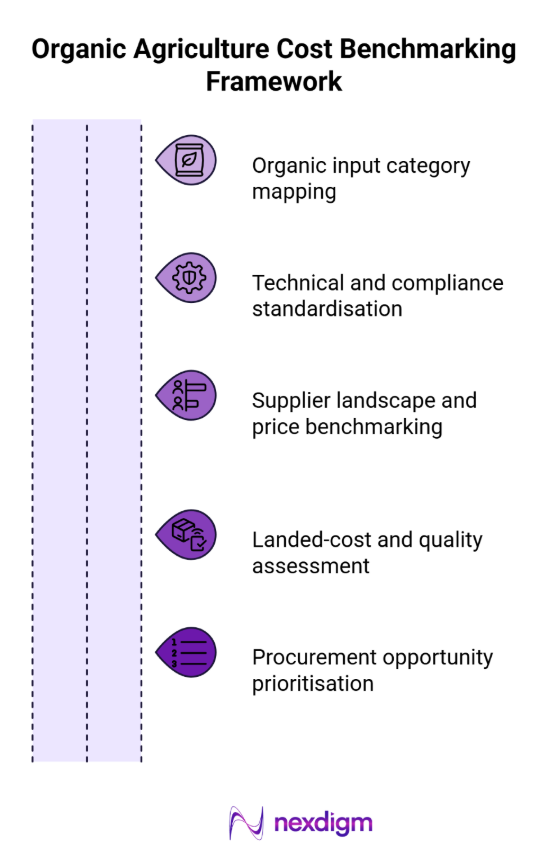
- Organic input category mapping
Classify expenditure across approved fertilizers, compost, soil conditioners, biofertilizers, biological crop protection, seeds and certification-related services. Identify high-spend products and recurring procurement requirements. - Technical and compliance standardisation
Document product composition, concentration, application dosage, shelf life and relevant certification or approval requirements. Establish comparable specifications before evaluating supplier prices. - Supplier landscape and price benchmarking
Map manufacturers, regional producers, distributors and specialist suppliers. Compare prices across equivalent products and assess differences in availability, distribution coverage and commercial positioning. - Landed-cost and quality assessment
Include freight, storage, handling, packaging, credit terms and delivery conditions in the cost comparison. Evaluate product quality, documentation, traceability and supplier reliability alongside price. - Procurement opportunity prioritisation
Identify categories where supplier competition is limited, price variation is unexplained or purchasing volumes are fragmented. Prioritise opportunities for consolidated sourcing, improved contracts and qualified alternative suppliers.
Nexdigm’s Case Study: Benchmarking Organic Input Procurement
Nexdigm assessed organic input sourcing across 5 product categories, 4 agricultural regions and 14 suppliers. The study identified price variations of up to 12% among comparable inputs and highlighted opportunities in supplier diversification, consolidated purchasing and commercial-term negotiation.
To take the next step, simply visit our Request a Consultation page and share your requirements with us.
Harsh Mittal
+91-8422857704