

Organic farming can command a premium, but that premium has a ceiling. At the farm level, the harder question is whether the additional realisation can compensate for lower yields, higher labour requirements, certification costs, and the three-year transition period. A crop may be technically suitable for organic cultivation and still be commercially unattractive if its consumers will not pay enough to absorb the transition economics.
Where Consumer Demand Creates a Viable Premium
India’s packaged organic food market is estimated in the source material at $1.4–$1.8 billion in 2025/2026, with 15%–18% CAGR. Demand is concentrated in Tier-1 metropolitan markets, which account for more than 70% of domestic consumption.
That concentration matters because organic economics depend heavily on willingness to pay. Demand begins to weaken when retail premiums move beyond roughly 20%–25% over branded conventional staples. Premiums of 50%–100% therefore remain concentrated in smaller luxury segments rather than representing a dependable mainstream market.
Export markets add another layer of complexity. Organic soybean meal, tea, basmati rice, and spices have historically supported exports, but tighter residue scrutiny in major markets increases the importance of traceability, certification, and compliance.
The Three-Year Transition Changes the Farm Economics
The conversion period creates a temporary gap between higher production costs and the eventual price premium. Field cereals such as wheat and paddy can experience 20%–30% yield losses during the transition, while pulses and oilseeds can see 15%–25% declines. Perennial plantations and spices have a lower estimated exposure of 8%–15%.
Labour economics can move in the opposite direction. Reduced dependence on synthetic chemicals may lower some input costs, while manual weed management can increase labour expenditure by 30%–50%. Certification creates another fixed cost, with NPOP third-party certification estimated in the source material at ₹35,000–₹60,000 annually per smallholder cluster.
This makes farm-level cash-flow modelling more useful than comparing organic and conventional selling prices in isolation.
Crop and Corridor Selection Matters More Than Organic Acreage
The strongest opportunities are likely to emerge where three conditions overlap: high crop value, relatively low baseline dependence on synthetic inputs, and access to consumers or buyers willing to pay for verified organic production.
The source identifies black pepper, small cardamom, ginger, and turmeric across Kerala, Karnataka, and the Northeastern states as potential high-margin corridors. Organic tea in Assam and the Nilgiris, shade-grown Arabica coffee, culinary herbs, exotic vegetables, sesame, and mustard also offer more targeted opportunities.
The underlying logic is important. Organic farming does not need to scale uniformly across every crop. It needs to scale where the relationship between yield risk, production cost, certification burden, and achievable price realisation produces an attractive farm-level return.
Nexdigm’s Organic Farming Opportunity Framework
Nexdigm can structure an organic farming market opportunity analysis around five analytical dimensions:
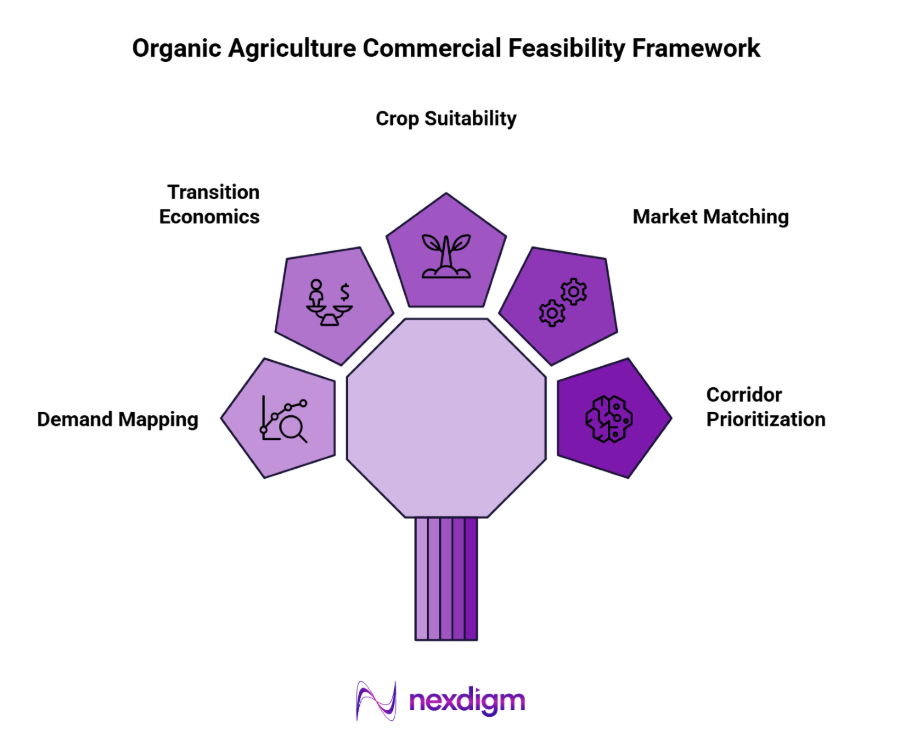
- Consumer Premium and Demand Mapping: Consumer segments, geographic demand concentration, willingness to pay, retail premiums, channel preferences, and purchase frequency are assessed to establish the realistic revenue pool for organic products.
- Transition Economics Modelling: Yield reductions, labour requirements, input substitution, certification costs, financing needs, and the duration of the conversion period are modelled to calculate cumulative cash-flow pressure before premium realisation begins.
- Crop Suitability Screening: Crops are evaluated against baseline chemical-input dependency, pest pressure, yield sensitivity, unit value, certification requirements, and availability of biological alternatives to identify commodities capable of absorbing transition costs.
- Market and Channel Matching: Domestic premium retail, direct-to-consumer models, contract sourcing, institutional buyers, and export corridors are assessed according to pricing, certification, traceability, and volume requirements.
- Corridor-Level Opportunity Prioritisation: Production clusters are ranked according to farm economics, consumer access, aggregation potential, certification infrastructure, and buyer demand, creating a practical pipeline of viable organic farming opportunities.
Nexdigm Case Study: Biological Soil-Health Programme
Nexdigm evaluated a biological soil-health programme across 16,000 managed acres. The programme achieved an 82% farmer repeat-purchase rate, reduced conventional nitrogen expenditure by 22%, and maintained baseline crop yields during the conversion phase, demonstrating measurable commercial viability for lower-synthetic-input farming.
To take the next step, simply visit our Request a Consultation page and share your requirements with us.
Harsh Mittal
+91-8422857704