

Organic farming depends on a supply network that extends well beyond the farm itself. Seeds, biofertilizers, biopesticides, compost, soil amendments, botanical inputs and certification services all contribute to production. For agricultural businesses, food processors, exporters and organised farming networks, the reliability of these suppliers can influence crop performance, certification status and access to premium markets.
The difficulty is that products marketed as organic or natural do not automatically meet the requirements of certified organic production. Suppliers may use similar claims while offering products with different compositions, quality standards and regulatory status. Buyers need to distinguish genuine compliance and product suitability from broad sustainability claims.
Organic Agriculture Is Expanding Across Multiple Product Categories
India’s organic sector has developed a sizeable production and certification ecosystem. During 2024–25, approximately 3.96 million hectares of farm area were under the National Programme for Organic Production certification system, including land already certified as organic and land under conversion. Certified organic farm production was approximately 4.39 million metric tonnes.
The supply base includes individual producers, grower groups, processors, traders and other certified operators. This creates opportunities for buyers, but the market is not uniform. Supplier capabilities differ by crop, input category, geography and certification status.
A company sourcing organic inputs for commercial cultivation may need a very different supplier network from a food processor procuring certified organic commodities for export. Treating these requirements as interchangeable can create gaps in both procurement and compliance.
Product Claims and Certification Need to Be Examined Separately
One of the most important distinctions in organic procurement is between a product being naturally derived and being permitted under a particular organic production standard.
A biological fertilizer may contain microbial cultures, while another product may be based on composted organic matter or plant extracts. Both may be marketed as sustainable agricultural inputs, but their compositions, permitted uses and applicable requirements can differ.
Similarly, an organic food ingredient supplier may hold certification for specific products, facilities or production processes. That certification should not be assumed to cover every product sold by the company.
Buyers need to verify the relevant certification scope, validity period, product category and intended market. Export-oriented businesses may also need to account for destination-market requirements and recognition arrangements.
Product Performance Can Vary Between Suppliers
Organic inputs often depend on biological activity, natural raw materials and processing conditions. This can create variation in nutrient content, microbial viability, maturity, moisture, shelf life and formulation stability.
A compost supplier may offer inconsistent maturity or organic matter content across batches. A biofertilizer manufacturer may struggle to maintain viable microbial counts during storage and transportation. A botanical crop protection supplier may have limited field evidence across different crops and pest conditions.
These differences affect more than product quality. They can influence application rates, crop response, storage losses and the cost of maintaining production standards.
Traceability and Documentation Are Essential for Commercial Buyers
Organic supply chains require reliable information about production practices, input usage, processing, storage and movement through intermediaries. Weak documentation can create problems during certification audits, customer assessments and export inspections.
A supplier may have access to certified producers but lack effective systems for segregating organic and conventional material. Another may maintain certification but have limited visibility into the origin of its raw materials.
For buyers, these gaps can create a risk of rejected consignments, certification complications and loss of access to customers who require documented organic sourcing.
How Organisations Should Evaluate Organic Farming Suppliers
A structured organic farming supplier evaluation consulting exercise should begin by identifying the intended use of each product and the certification standards applicable to the business. Suppliers should then be assessed on product composition, performance evidence, manufacturing practices, certification scope, traceability and commercial capacity.
Technical evaluation should include product specifications, batch-level testing, storage requirements and suitability for the intended crop or production system. Compliance checks should cover certificates, approved product status where relevant, documentation and the supplier’s ability to maintain traceability.
Commercial assessment should examine price, delivery coverage, seasonal availability, minimum order quantities and the cost of maintaining product quality. Buyers should also assess whether the supplier can scale as certified production volumes increase.
Nexdigm supports organisations through supplier research, organic market mapping, vendor benchmarking and compliance-oriented market intelligence. Its work can help buyers identify credible suppliers, compare product capabilities and understand sourcing opportunities across organic agricultural markets.
Organic Farming Supplier Evaluation Framework
A practical supplier assessment should include five dimensions:
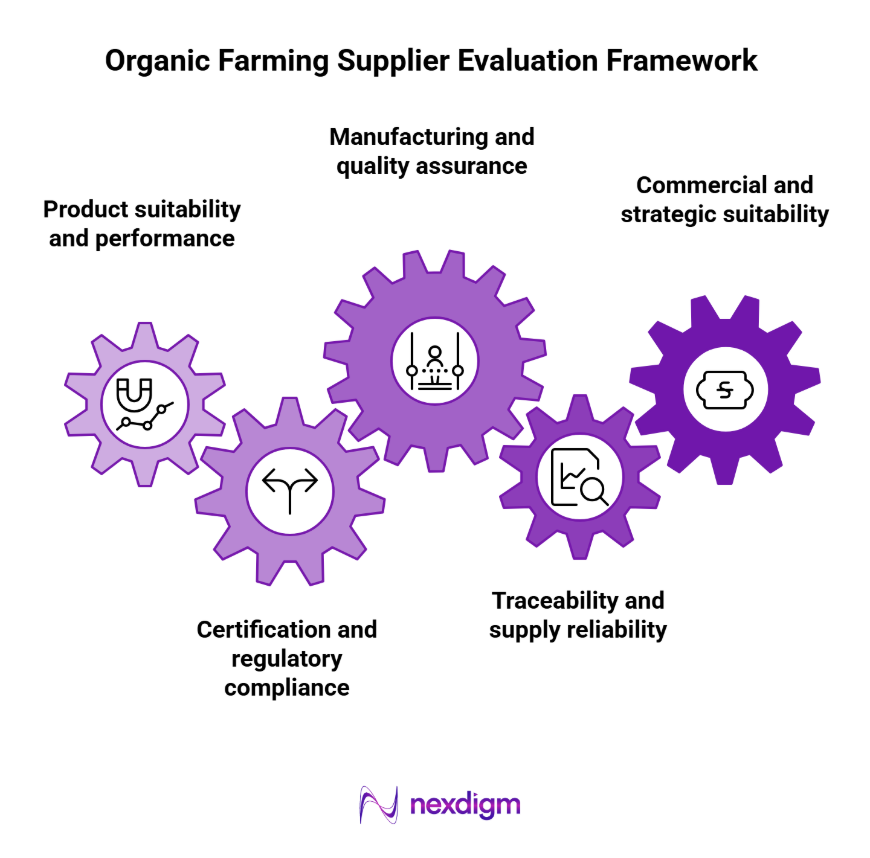
- Product suitability and performance: Identify the product category, intended crop application, composition, nutrient or biological characteristics, application requirements and evidence of performance. Compare product consistency across batches and assess suitability for the buyer’s production system.
- Certification and regulatory compliance: Verify applicable organic certification standards, product permissions, certificate validity, scope, manufacturing location and intended market coverage. Distinguish between a supplier’s general certification and certification applicable to the specific product.
- Manufacturing and quality assurance: Review production methods, raw material sourcing, processing controls, laboratory testing, batch records, contamination prevention, packaging and shelf-life management.
- Traceability and supply reliability: Examine origin documentation, segregation procedures, supplier networks, inventory management, seasonal availability and the ability to deliver consistent volumes without compromising certification requirements.
- Commercial and strategic suitability: Compare pricing, delivered cost, minimum order quantities, payment terms, technical support and scalability. Assess whether the supplier can support future expansion into additional crops, regions or export markets.
Nexdigm’s Case Study: Assessing Organic Input Suppliers
Nexdigm evaluated 31 organic farming suppliers across 6 input categories, comparing certification scope, product specifications, quality systems and regional availability. The assessment shortlisted 8 suppliers for further qualification and identified documentation gaps across 3 product categories.
To take the next step, simply visit our Request a Consultation page and share your requirements with us.
Harsh Mittal
+91-8422857704