

Organic fertilizers have moved beyond the environmental conversation and into a harder commercial question: can farmers adopt them at sufficient scale without compromising yield or increasing the cost and complexity of cultivation?
In India, biological and carbon-based nutrient sources still account for less than 3% of agricultural nutrient applications by volume. Government initiatives such as PM-PRANAM and market development assistance for fermented organic manure are encouraging greater use, but policy support alone does not determine repeat purchases. Farmers ultimately need to see acceptable yields, manageable application costs and a credible return on every acre.
Awareness Is Rising Faster Than Adoption
Soil degradation has created a growing awareness of the need to rebuild soil organic matter. In several intensive agricultural regions, soil organic carbon levels have fallen below 0.4%, compared with approximately 0.75% considered a healthier agronomic benchmark.
This creates an underlying demand signal. Farmers increasingly understand that declining organic matter can affect moisture retention and nutrient-use efficiency.
Yet awareness does not necessarily produce a purchase. The commercial transition begins only when farmers believe the product can improve or preserve farm economics.
The First Trial Usually Happens Where Margins Can Absorb Risk
Adoption is concentrated in crops where the financial consequences of experimentation are relatively manageable.
High-value horticulture, protected cultivation, export-oriented spices and peri-urban vegetables are more suitable early markets because input costs represent a smaller share of crop value and certified production can sometimes command a premium.
Broadacre cereals, pulses and oilseeds face a different equation. A farmer operating on a narrow margin has less capacity to absorb an uncertain yield outcome, particularly during the first season of changing nutrient practices.
The result is a market where willingness to experiment varies significantly by crop and farmer economics.
Repeat Purchase Depends on Surviving the Transition
The largest obstacle to mainstream adoption is not necessarily the first purchase. It is the second and third.
Abruptly replacing synthetic nitrogen and soluble phosphorus with slower-release organic formulations can create temporary nutrient deficiencies. Research and field experience indicate that yield reductions of 15% to 25% can occur during early conversion under unsuitable transition models.
For a smallholder, a 20% yield decline is difficult to absorb even if soil conditions improve over the longer term.
This makes integrated nutrient management commercially more practical than complete replacement. Organic manures, bio-stimulants and biological fertilizers can be introduced alongside reduced chemical applications, allowing farmers to manage transition risk while improving nutrient-use efficiency.
Bulk Logistics Can Destroy the Apparent Cost Advantage
Organic inputs also have a physical-density problem.
A 45-kg bag of urea contains approximately 20.7 kg of elemental nitrogen. Standard compost and farmyard manure may contain only around 0.5% to 1.5% nitrogen by weight.
Supplying comparable nutrient volumes can therefore require several tonnes of organic material per acre. Freight, handling, storage and application labour can quickly offset the apparent input-cost advantage.
This creates an important product-development opportunity. Pelletized, enriched and concentrated formulations can reduce the physical burden of transporting organic nutrients and make them more compatible with existing farm operations.
Trust Is Part of the Product
Farmers also need confidence that the product purchased today will perform similarly next season.
Variable nutrient concentrations, moisture levels, microbial counts and contamination concerns can undermine repeat adoption. Certification, traceability, transparent nutrient specifications and reliable dealer recommendations therefore become commercial differentiators rather than compliance details.
A company entering the market needs to build trust into the distribution model alongside the product itself.
Where Mainstream Adoption Could Actually Work
A structured organic fertilizer market assessment can identify the segments where the economics of adoption are strongest. Nexdigm can evaluate:
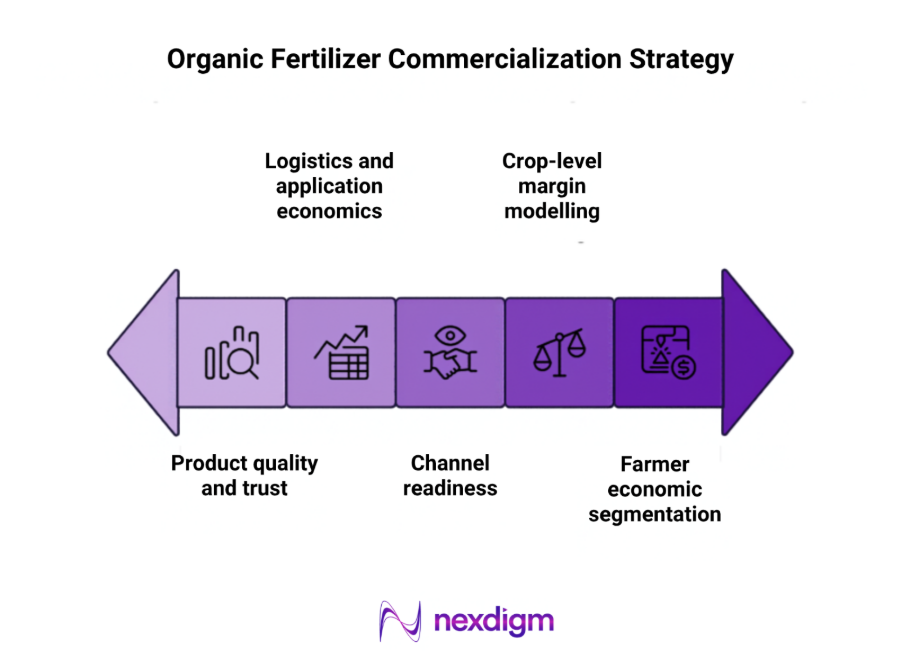
- Farmer economic segmentation: Separate high-value growers, commercial farms and smallholders according to their ability to absorb transition costs and temporary yield variation.
- Crop-level margin modelling: Compare input costs, expected yield changes and farmgate prices across a multi-season conversion period to determine where organic adoption can remain financially viable.
- Logistics and application economics: Quantify freight, storage, handling and field-application costs for bulk, pelletized and liquid formulations across different geographic markets.
- Channel readiness: Assess dealer margins, inventory turnover, credit requirements and product shelf life to determine whether existing rural distribution can support the category.
- Product quality and trust: Evaluate certification, nutrient consistency, traceability and quality-control requirements that influence farmer confidence and repeat purchase.
This analysis can identify which crops and regions can support adoption, what product format is commercially viable and whether the opportunity lies in organic replacement or integrated nutrient management.
Case Study: Making the Transition Economics Work
A fertilizer company evaluated organic-input adoption across 48,000 acres covering vegetables, spices, cotton and cereals. The assessment identified 11,500 acres where farmers had sufficient margins to absorb transition costs. A 30% biological and 70% conventional nutrient programme reduced synthetic nitrogen expenditure by 21% while limiting estimated first-season yield impact to below 4%. At 35% adoption across the priority acreage, the model projected INR 31 crore in annual product revenue and a 19% contribution-margin improvement from the higher-value formulation mix.
To take the next step, simply visit our Request a Consultation page and share your requirements with us.
Harsh Mittal
+91-8422857704