

Organic fertilizers are increasingly relevant to agricultural businesses seeking to improve soil condition, diversify nutrient sources and support more sustainable production systems. They include compost, vermicompost, farmyard manure, enriched organic manure, oil cakes and other inputs derived from plant, animal or biological materials.
Yet organic fertilizer procurement is not straightforward. Nutrient composition can vary by feedstock and production process, while moisture content, maturity, contamination and transportation costs influence the value of each purchase. Agribusinesses need a sourcing strategy that connects product quality with crop requirements, local availability and the economics of application.
Understanding the Organic Fertilizer Supply Landscape
The market consists of producers with different levels of technical capability. Some operate decentralised composting facilities using agricultural or municipal organic waste. Others manufacture enriched products through controlled processing, microbial enrichment or blending. Large suppliers may serve institutional buyers across multiple regions, while smaller producers focus on local agricultural clusters.
This fragmented structure creates procurement challenges. A supplier’s ability to deliver consistent volumes may depend on seasonal feedstock availability, processing capacity and access to transport. Buyers should distinguish between vendors that can provide reliable commercial quantities and those whose operations are better suited to local or small-volume requirements.
The intended production system also matters. An organic input used in horticulture may need a different nutrient profile and physical consistency from one intended for broad-acre field crops or plantation agriculture.
Matching Organic Inputs to Crop and Soil Requirements
Organic fertilizers should be selected according to soil conditions, crop nutrient demand and the wider nutrient management programme. They can contribute organic matter and supply nutrients, but their release patterns and nutrient concentrations differ from those of readily soluble mineral fertilizers.
Agribusinesses should therefore assess nutrient content, carbon-to-nitrogen ratio, moisture, pH, maturity and physical composition. Contaminants, including unwanted heavy metals, pathogens or foreign materials, must also be considered where relevant to the product and applicable standards.
India’s Soil Health Card programme provides plot-level information across 12 soil health parameters and supports recommendations on chemical fertilizers, organic inputs and soil treatments. This reinforces the value of linking procurement specifications to soil test results instead of applying a uniform product specification across all farms.
Using Market Research to Identify Suitable Sourcing Options
Effective organic fertilizer sourcing research helps buyers understand where suitable products are manufactured, which suppliers can meet quality requirements and how sourcing economics vary across regions. It should examine supplier location, feedstock access, processing methods, product certifications, manufacturing capacity and distribution infrastructure.
A useful assessment also separates suppliers by product type. Compost manufacturers, vermicompost producers and enriched organic fertilizer companies may operate under different cost structures and quality-control systems. Comparing them only on price per tonne can produce misleading results.
Buyers should evaluate the delivered cost of usable nutrients and organic matter. High moisture content can increase freight expenses without adding equivalent agronomic value. Similarly, a product with inconsistent maturity may create handling or application difficulties even when its quoted price appears attractive.
Assessing Quality, Compliance and Supplier Reliability
Supplier qualification should include documentation and, where appropriate, independent product testing. Procurement teams should verify whether the product meets the applicable Fertiliser Control Order requirements and relevant notified specifications. Claims such as organic, enriched or certified should be supported by documentation appropriate to the product and intended use.
A supplier audit can examine:
- Feedstock sourcing and traceability.
- Processing, curing and storage practices.
- Batch-level testing and quality documentation.
- Production capacity and seasonal supply planning.
- Packaging, moisture protection and transport arrangements.
Quality assurance should continue after vendor appointment. Periodic sampling, agreed specifications and corrective-action procedures can help prevent variation between deliveries. Contracts should clearly define acceptable quality parameters, rejection conditions and responsibilities for replacement.
Building a Regional and Crop-Specific Sourcing Model
A centralised procurement model may work for standardised products with stable supply, but regional sourcing can be more practical when transportation costs are high or feedstock availability is localised. Buyers can combine approved regional producers with larger manufacturers that offer consistent quality and broader product portfolios.
Forecasting is also important. Organic fertilizer demand may vary with crop calendars, soil improvement programmes and the adoption of organic or integrated nutrient management practices. Procurement teams should coordinate with agronomy and operations functions to estimate demand early enough for suppliers to plan production and dispatch.
Nexdigm helps agribusinesses evaluate organic input markets through supplier mapping, sourcing research, product benchmarking and commercial analysis. This can support vendor shortlisting, regional sourcing decisions and the development of procurement strategies aligned with crop and production requirements.
Organic Fertilizer Sourcing Framework
A structured sourcing assessment should cover:
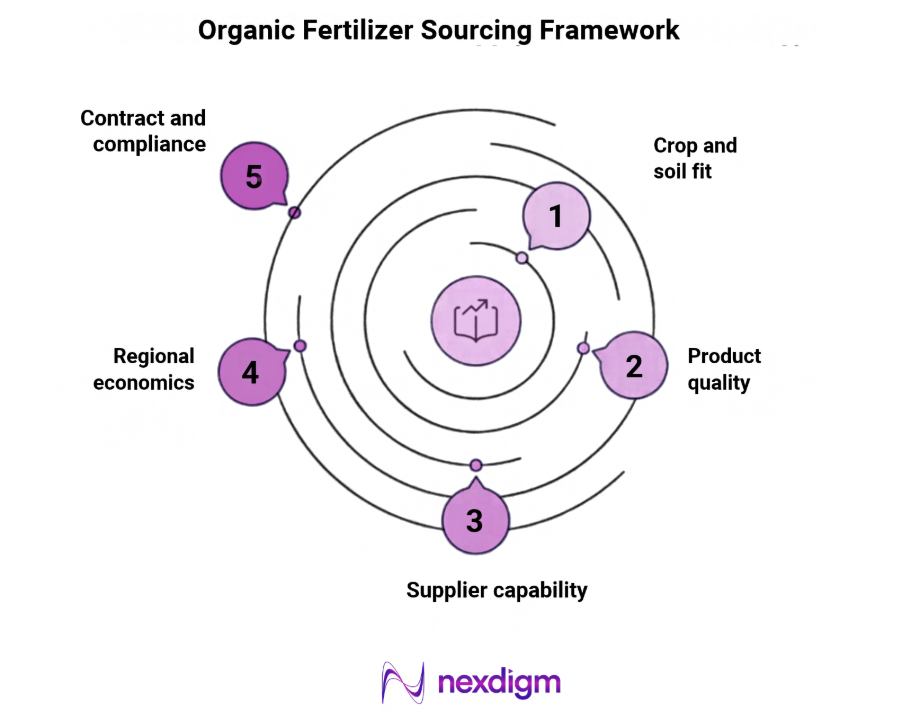
- Crop and soil fit: Nutrient requirements, soil condition and application timing.
- Product quality: Nutrient composition, maturity, moisture, contamination and consistency.
- Supplier capability: Feedstock access, processing infrastructure, capacity and traceability.
- Regional economics: Delivered cost, freight, storage and seasonal availability.
- Contract and compliance: Applicable standards, testing, documentation and quality remedies.
Nexdigm’s Case Study: Assessing Regional Organic Fertilizer Supply
Nexdigm evaluated 36 organic fertilizer producers across 5 regions, comparing product specifications, processing capacity, feedstock access and delivered costs. The assessment identified 9 suppliers meeting the client’s preliminary quality and sourcing criteria.
To take the next step, simply visit our Request a Consultation page and share your requirements with us.
Harsh Mittal
+91-8422857704