

Outsourcing has become an important part of how banks and financial institutions access technology, operations, and specialist capabilities. The Reserve Bank of India’s Report on Trend and Progress of Banking in India 2024–25 shows that the share of IT budgets allocated to outsourced innovation increased between 2019–20 and 2023–24: from 3.3% to 8.1% for public sector banks, 2.1% to 7.6% for private banks, and 5.3% to 14.4% for small finance banks.
As reliance on external providers expands, procurement teams need to assess not only contracted rates but also service-level performance, delivery scope, and supplier dependencies. This makes outsourcing procurement benchmarking consulting BFSI institutions undertake increasingly relevant for identifying cost gaps, evaluating SLA variance, and strengthening commercial terms while maintaining oversight.
Why Outsourcing Costs and Performance Need to Be Benchmarked
Outsourcing arrangements can span IT infrastructure, application support, customer operations, payment processing, back-office functions, and specialist services. Costs are shaped by delivery locations, transaction volumes, staffing models, technology platforms, and contract scope. Without comparable benchmarks, institutions may struggle to determine whether pricing reflects market conditions, whether service levels are competitive, or whether contract structures provide sufficient flexibility as business needs change and regulatory expectations continue to evolve across financial services.
What Makes Outsourcing Procurement Comparisons Complex?
Comparing outsourcing arrangements requires more than reviewing vendor quotations. Differences in service scope, transaction volumes, workforce composition, delivery locations, technology requirements, and performance commitments can make direct comparisons difficult. BFSI organizations therefore need to normalize these variables before assessing supplier competitiveness. A consistent evaluation helps distinguish genuine cost differences from variations in service design and contractual obligations.
Nexdigm’s Role in Strengthening Outsourcing Governance
Selecting a competitive outsourcing partner is only one part of procurement effectiveness. Maintaining accountability throughout the contract lifecycle is equally important. Nexdigm can help BFSI organizations examine supplier governance practices through:
- Governance Framework Review: Assess supplier review mechanisms, reporting structures, escalation procedures, and accountability arrangements to identify potential governance gaps.
- Performance Monitoring Insights: Evaluate performance indicators, review frequency, reporting practices, and corrective-action mechanisms to strengthen ongoing service oversight.
- Contract Lifecycle Assessment: Examine renewal processes, scope changes, transition requirements, and exit provisions to support better management of outsourcing relationships.
By connecting procurement intelligence with supplier governance considerations, Nexdigm can help institutions build more accountable outsourcing relationships and maintain greater control over service delivery.
Nexdigm’s Intelligence for Managing Outsourcing Market Changes
Outsourcing markets continue to evolve as providers adopt automation, expand delivery capabilities, and introduce new service models. These developments can influence range of services available to financial institutions. Nexdigm can help BFSI organizations understand these shifts through:
- Emerging Service Models: Track developments in automation-led operations, cloud-based delivery, and managed services to understand changing outsourcing options.
- Provider Capability Evolution: Monitor service portfolio expansions, technology investments, partnerships, and delivery capabilities across outsourcing providers.
- Industry Practice Assessment: Examine changing market practices in service delivery, resource deployment, and commercial arrangements to identify relevant procurement implications.
Through outsourcing procurement benchmarking, Nexdigm can help institutions incorporate market changes into sourcing strategies, evaluate evolving provider capabilities, and make more informed long-term outsourcing decisions.
Nexdigm’s Outsourcing Procurement Benchmarking Framework
Nexdigm’s experts apply a structured benchmarking framework to help BFSI organizations evaluate outsourcing arrangements across cost, service delivery, and commercial performance. The process connects market evidence with procurement priorities through the following steps:
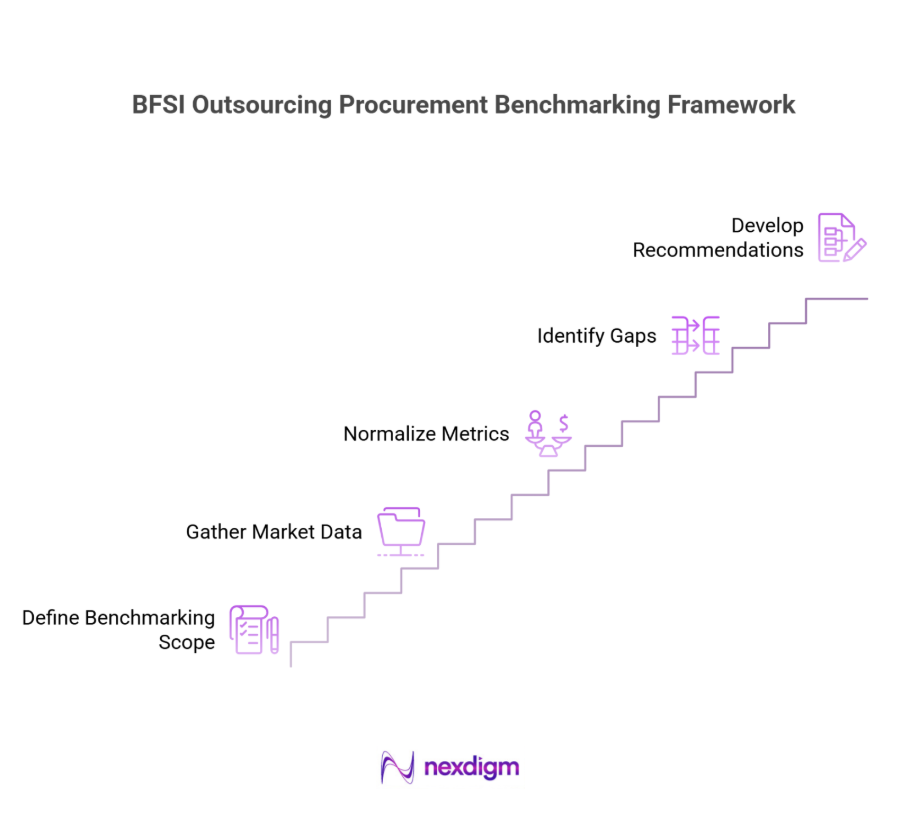
- Define Benchmarking Scope: Identify outsourcing categories, service requirements, providers, contract periods, and performance parameters relevant to the assessment.
- Gather Market and Supplier Data: Collect information on pricing structures, delivery models, resource costs, service commitments, and provider capabilities.
- Normalize Cost and SLA Metrics: Align differences in scope, volumes, service definitions, and delivery conditions to enable meaningful comparisons.
- Identify Performance and Commercial Gaps: Compare existing arrangements against relevant benchmarks to highlight cost variances, SLA gaps, and contractual improvement areas.
- Develop Actionable Recommendations: Translate findings into negotiation priorities, supplier review considerations, contract improvements, and future sourcing opportunities.
This structured approach enables outsourcing procurement benchmarking consulting BFSI organizations undertake to move beyond comparisons and translate benchmarking findings into practical procurement decisions.
How Nexdigm’s Benchmarking Framework Influences BFSI Institutions and Investors
Nexdigm’s outsourcing benchmarking insights can help BFSI institutions evaluate how procurement efficiency, supplier performance, and contractual structures influence operating costs and business resilience. By identifying cost gaps, SLA variations, and opportunities to improve outsourcing arrangements, Nexdigm supports more informed management decisions. For investors, these insights can offer a clearer perspective on institutional cost discipline, operational efficiency, supplier dependency, and governance factors, relevant to assessing long-term business sustainability and performance.
Nexdigm’s Case
A BFSI organization engaged Nexdigm to benchmark 30 outsourcing service providers across IT operations, back-office support, and customer services. The assessment identified 17% potential cost savings, 20% scope for SLA improvement, and 14% potential contract optimization. These findings helped the organization identify negotiation priorities, improve supplier evaluation, and strengthen outsourcing procurement decisions.
To take the next step, simply visit our Request a Consultation page and share your requirements with us.
Harsh Mittal
+91-8422857704