

Financial institutions should identify outsourcing vendors by matching service requirements with provider capability, operating scale and the level of risk attached to the activity. The largest supplier is not automatically the strongest choice, and a low-cost provider may create additional expenses through weak delivery capacity, limited geographic coverage or technology dependencies. A useful vendor search must establish which activities can be outsourced, what capabilities are available in the market and which providers can support the institution over the required contract period.
This distinction is particularly important in banking, financial services and insurance, where outsourcing spans customer operations, technology infrastructure, document processing, data management and specialised support functions.
Start With the Activities That Can Be Outsourced
Outsourcing requirements should be defined at the activity level rather than through broad categories such as IT services or business process outsourcing. A bank considering external support for loan processing, for example, may require document indexing, application data entry, verification support and workflow administration. These activities have different skill, technology and information-security requirements.
Common BFSI outsourcing categories include:
- Customer and business operations: Contact centre services, customer onboarding support, document processing, transaction support and back-office administration.
- Technology services: Application development, infrastructure management, cybersecurity support, testing and maintenance.
- Financial operations: Reconciliation support, data processing, reporting and selected accounting activities.
- Insurance operations: Policy administration support, claims documentation, customer servicing and processing assistance.
- Specialist services: Data analytics, fraud monitoring support, regulatory technology and research services.
The scope must also distinguish support activities from functions that the institution must retain under applicable regulatory requirements. Outsourcing does not transfer ultimate accountability for regulated activities.
Map Providers According to Their Actual Capabilities
Once the activities are defined, the next task is to understand the supplier market. Providers may describe themselves as full-service BFSI outsourcing companies, but their capabilities can be concentrated in particular processes, customer segments or geographies.
A supplier mapping exercise should establish the provider’s service portfolio, industry experience, delivery locations, employee base, technology environment and customer concentration. It should also identify whether the provider delivers services directly or depends on subcontractors.
Scale needs to be interpreted in context. A large contact centre operator may be suitable for high-volume customer interactions but less experienced in specialised insurance administration. A technology services company may have strong application development capabilities without the operational processes needed for transaction processing.
The relevant question is whether the supplier has demonstrated experience in the specific activity being considered.
Assess Delivery Capacity and Operating Geography
BFSI outsourcing often involves time-sensitive processes, customer information and geographically distributed operations. Provider location can influence labour availability, language coverage, business continuity and service costs.
For customer operations, buyers should examine language capabilities, working-hour coverage, workforce availability and the provider’s ability to manage seasonal demand. Technology outsourcing may require access to specialised skills, secure development environments and appropriate infrastructure.
Geographic diversification can also reduce concentration in a single delivery location. However, adding locations creates coordination requirements and may complicate data access, quality monitoring and service management.
A market assessment should therefore compare delivery locations alongside workforce availability, operating costs, infrastructure and the presence of competing service providers.
Regulatory Exposure and Commercial Dependencies
Vendor selection in BFSI requires scrutiny of data handling, subcontracting, operational resilience and service continuity. The RBI’s 2025 outsourcing directions place emphasis on service-provider due diligence, concentration risk, security practices, business continuity and exit planning for applicable regulated entities.
This makes it important to understand the supplier’s wider operating model. A provider may appear financially sound while relying on a small number of subcontractors or infrastructure partners. Another may have a broad service portfolio but limited experience supporting regulated financial institutions.
A structured outsourcing vendor identification for BFSI exercise can help institutions identify these differences before a formal sourcing process begins. Nexdigm’s supplier research can map providers by service capability, customer segment, delivery footprint and market positioning, helping procurement teams develop a more informed supplier universe.
BFSI Vendor Qualification and Shortlisting Framework
A useful identification process should progressively narrow the market rather than apply every qualification requirement at the discovery stage.
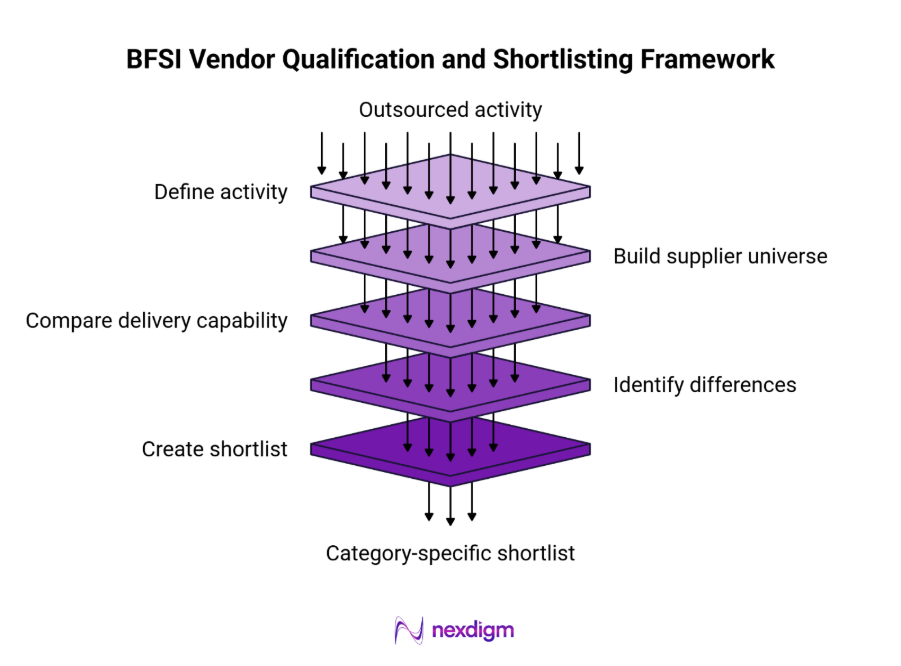
- Define the outsourced activity: Specify process boundaries, expected volumes, service levels, information access and responsibilities retained internally.
- Build the supplier universe: Identify providers by service specialisation, industry experience, geography and delivery model.
- Compare delivery capability: Examine workforce scale, technology infrastructure, operating locations, customer references and subcontracting arrangements.
- Identify commercial and risk differences: Compare pricing models, capacity constraints, financial position, concentration exposure and continuity arrangements.
- Create a category-specific shortlist: Prioritise suppliers that meet the operational requirement and merit deeper due diligence by the institution.
A structured customer service supplier evaluation for the BFSI sector requires assessing regulatory compliance, omnichannel operational capacity, and total cost of delivery.
Nexdigm’s Case: BFSI Outsourcing Vendor Mapping
A private-sector financial institution reviewed 38 outsourcing providers across customer operations, document processing and technology support. The assessment identified 12 suppliers with relevant BFSI experience and narrowed these to seven based on delivery locations, workforce capability and service specialisation.
To take the next step, simply visit our Request a Consultation page and share your requirements with us.
Harsh Mittal
+91-8422857704