

Outsourcing can give financial institutions access to specialised technology, processing capacity and operational expertise. It can also create dependencies that are difficult to unwind. A service provider may manage an important process, rely on several subcontractors and operate infrastructure across multiple locations. If the institution cannot see those relationships clearly, its outsourcing register may understate the actual exposure.
The central procurement challenge is to assess the complete arrangement: the activity being outsourced, the parties performing it, the controls governing it and the institution’s ability to maintain service if the arrangement fails.
Where Outsourcing Risks Tend to Accumulate
- Regulatory and contractual gaps
An outsourcing arrangement may have been approved under an earlier policy or signed before current requirements were introduced. Contracts can lack clear audit rights, incident notification obligations, subcontractor approval provisions, data access terms or exit assistance. These gaps become more significant when the outsourced activity supports a critical business function. - Service and subcontractor dependencies
A primary vendor may rely on another provider for cloud hosting, customer support, data processing or security monitoring. The institution may have a contract with only the primary vendor, while operational delivery depends on several entities. Subcontracting can also make it harder to establish where information is stored and who can access it. - Business continuity and exit risk
A vendor’s business continuity plan does not automatically demonstrate that the financial institution can continue operating. The institution needs to understand recovery arrangements, alternative service options, data portability, transition timelines and the resources required to bring a service back in-house or move it elsewhere. - Concentration and substitutability
Multiple outsourced activities may depend on one provider or a small group of providers. Even where contracts are separate, common infrastructure or specialist capabilities can create correlated disruption. Procurement teams should examine whether alternative suppliers are genuinely available and whether switching is operationally realistic.
What Should an Outsourcing Review Establish?
A robust review should connect the outsourcing inventory with the institution’s operating model. It should identify:
- The business function and processes supported by each arrangement.
- Whether the service is critical or material under the applicable regulatory framework.
- The primary provider, subcontractors and key infrastructure dependencies.
- Data categories, processing locations and access arrangements.
- Contractual rights, service levels and regulatory access provisions.
- Business continuity, disaster recovery and tested exit arrangements.
- Open audit findings, incidents and unresolved compliance issues.
In India, RBI’s outsourcing directions cover both IT services and financial services, with requirements that depend on the nature of the activity and regulated entity. The RBI’s IT outsourcing framework addresses provider evaluation, monitoring, subcontracting, continuity and exit planning. Institutions should map each arrangement to the relevant direction rather than apply one generic classification.
Nexdigm’s BFSI Outsourcing Risk Framework
A outsourcing vendor risk and compliance consulting BFSI review should connect compliance checks with service dependency analysis. The following sequence helps identify where action is needed:
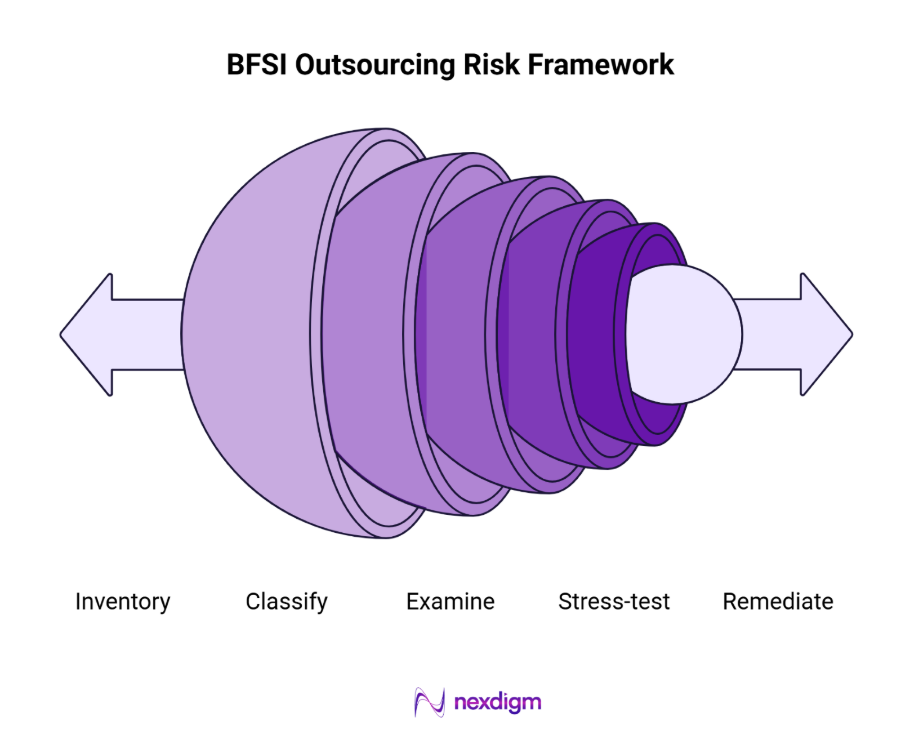
- Inventory: Build a complete record of outsourced services, providers, subcontractors and internal owners.
- Classify: Assess business criticality, data sensitivity, regulatory scope and substitutability.
- Examine: Review due diligence, contractual provisions, control reports, service performance and unresolved findings.
- Stress-test: Evaluate disruption scenarios, provider failure, subcontractor loss, cyber incidents and cross-border service interruption.
- Remediate: Prioritise contract changes, control improvements, contingency arrangements and exit plans according to exposure.
The output should be an actionable view of the outsourcing portfolio, not simply a list of compliant and non-compliant vendors. A service may meet minimum contractual requirements while still presenting unacceptable concentration or recovery risk.
Making Oversight Continuous
Outsourcing risk changes during the life of a contract. Providers change ownership, move infrastructure, appoint new subcontractors, experience incidents or alter the services they deliver. Institutions should therefore establish review triggers alongside scheduled assessments.
Changes in data access, hosting location, service scope, subcontracting, security incidents or financial condition may justify an immediate reassessment. Performance dashboards should also track service availability, incident resolution, audit findings and recovery-test outcomes.
Nexdigm can support outsourcing portfolio reviews, regulatory gap assessments, vendor dependency mapping and continuity-risk evaluation. This helps procurement and risk functions identify which arrangements require stronger controls, closer monitoring or a revised sourcing strategy.
Nexdigm’s Case Study
A financial institution reviewed 32 outsourcing arrangements and identified 7 critical services with incomplete subcontractor records or untested exit plans. It prioritised contract remediation for 5 arrangements and commissioned continuity testing for the remaining 2 before their next renewal cycle.
To take the next step, simply visit our Request a Consultation page and share your requirements with us.
Harsh Mittal
+91-8422857704