

Packaged food demand is shaped by a deceptively simple equation: consumers need to want the product frequently enough, at a price they can accept, and through channels where they can conveniently replenish it.
The scale of India’s food market creates substantial opportunity, but packaged-food companies operate within a highly differentiated consumer landscape. Rural and urban demand are moving at different speeds, smaller packs are becoming more important, and digital channels are gaining influence alongside traditional retail.
Frequency Determines the Quality of Demand
A product purchased every week has a fundamentally different demand profile from one purchased once a month or only during special occasions.
High-frequency categories can support predictable replenishment and wider distribution. Lower-frequency products may depend more heavily on promotions, seasonal demand or premium positioning.
NIQ reported 5.4% FMCG volume growth in Q3 2025, while unit growth outpaced overall volume growth, signalling increased preference for smaller packs.
For packaged-food companies, this means consumption frequency should be analysed alongside pack size.
A consumer buying smaller packs more frequently may represent a different commercial opportunity from a household buying one large pack every month, even if the total quantity consumed is similar.
Price Sensitivity Is Reshaping Pack Architecture
Affordability remains central to packaged-food demand.
PwC India’s 2025 Voice of the Consumer survey found that 63% of Indian respondents were concerned about food costs. Consumers were adapting by shopping across multiple stores, using discounts and buying in bulk.
NIQ’s latest India research similarly identifies affordability pressure and price-point disruption as important features of the FMCG market, including the continued relevance of ₹5 and ₹10 packs.
This makes price-pack architecture a demand lever rather than simply a packaging decision.
A brand can potentially reach different consumer groups through:
- Entry packs: Lower absolute cash outlay and easier trial.
- Regular packs: Core household consumption.
- Family packs: Higher quantity and lower unit economics for consumers willing to buy in advance.
- Premium packs: Higher realization where product differentiation supports the price.
The assessment should determine which architecture fits each market rather than applying one national pack strategy.
Channel Preferences Are Becoming More Fragmented
Consumers increasingly shop across multiple channels.
PwC found that more than 70% of surveyed Indian consumers used supermarkets, 60% used local retailers and 55% used digital delivery platforms.
NIQ’s Q2 2026 FMCG data puts national e-commerce penetration at 7% of FMCG sales, while Q4 2025 data showed e-commerce at 18% across the top eight metros.
The gap between national and metro penetration is commercially important.
A packaged-food brand may need one route-to-market strategy for a digitally advanced metro and another for a rural market where traditional trade remains more important.
Channel preference should therefore be mapped by consumer segment, geography and purchase mission.
Small Brands Are Revealing Where Demand Is Moving
Demand assessment should not focus exclusively on the largest brands.
NIQ reported in 2025 that small players were expanding almost twice as fast as overall FMCG consumption.
Its SMB analysis also found that smaller players contributed more than 23% of food-category volume, with focused innovation around health-first snacking, affordable premium and regional tastes helping them gain relevance.
This creates an important signal for larger packaged-food companies.
Small brands can reveal emerging preferences before those preferences become mainstream. Regional flavours, functional ingredients, premiumization and specialized formats can therefore be monitored as leading indicators of future category demand.
Nexdigm’s packaged food demand assessment consulting helps companies evaluate consumption frequency, affordability, price sensitivity, consumer segmentation, competitive substitution and channel preferences to identify viable packaged-food opportunities.
Nexdigm’s Packaged Food Demand Map
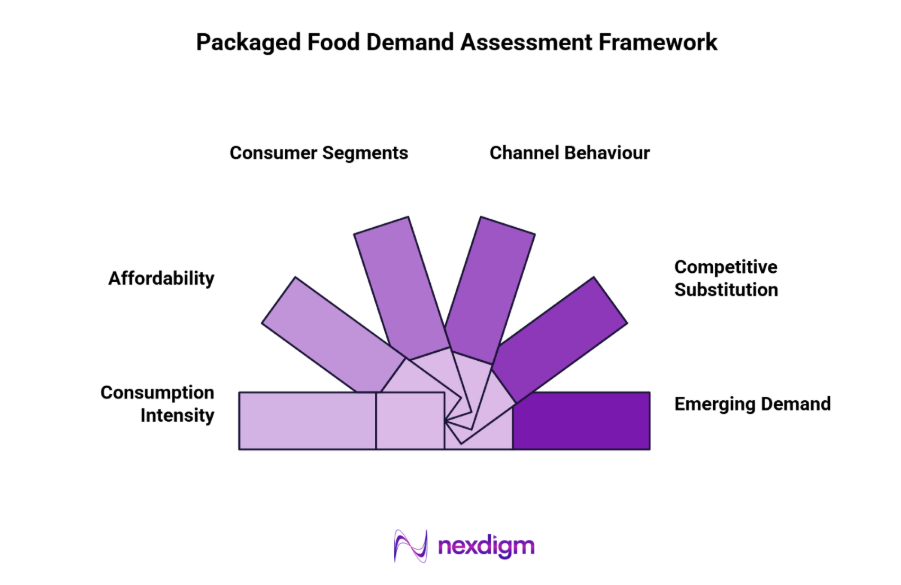
- Consumption Intensity: Measure frequency, quantity, household penetration and purchase occasions.
- Affordability: Establish price elasticity, acceptable price bands and pack-size preferences.
- Consumer Segments: Identify differences by income, geography, household structure and lifestyle.
- Channel Behaviour: Compare general trade, modern trade, e-commerce, quick commerce and foodservice.
- Competitive Substitution: Identify brands and products competing for the same consumption occasion.
- Emerging Demand: Track health, regional taste, convenience and premiumization signals.
The result is a demand map that connects consumer behaviour with commercially actionable decisions.
Nexdigm Case: Mapping Packaged Food Purchase and Channel Preferences
A packaged-food manufacturer evaluated 7 product categories across 8 cities and 3,000 consumers. Nexdigm mapped frequency, price sensitivity and channel preferences, identifying 2 priority consumer segments with 17% higher purchase frequency and 13% greater willingness to pay.
To take the next step, simply visit our Request a Consultation page and share your requirements with us.
Harsh Mittal
+91-8422857704