

The packaged food industry continues to evolve as consumers seek greater convenience, healthier alternatives, premium experiences, and value-driven choices. For brands looking to enter new markets or scale existing operations, achieving retail shelf presence is only the beginning. The real challenge lies in transforming a shelf opportunity into sustainable market share, profitable growth, and long-term brand relevance.
This requires a structured entry strategy that aligns market demand, channel selection, pricing, distribution, competition, and consumer preferences. Through specialized packaged food expansion entry strategy consulting, businesses can significantly improve their chances of market success while minimizing investment risks.
At Nexdigm, we help packaged food companies move beyond market-entry assumptions and develop actionable growth strategies grounded in market realities. Our approach focuses on turning opportunities into scalable business outcomes.
What Is the Right Entry Strategy for Packaged Food Brands?
The answer varies by product category, target consumer segment, and market maturity. However, the most effective entry strategies typically combine market intelligence with disciplined execution. A successful packaged food market entry strategy must answer four fundamental questions:
- Which markets should be prioritized?
- Which retail and distribution channels should lead expansion?
- What pricing strategy will drive adoption?
- How can the brand achieve scale while maintaining profitability?
Nexdigm helps organizations answer these questions through comprehensive packaged food expansion entry strategy consulting solutions.
Step 1: Identifying High-Potential Markets
Not every market offers the same growth potential. While population size often attracts attention, successful expansion depends on deeper market indicators.
Key Market Assessment Factors
- Consumer spending patterns
- Category growth rates
- Urbanization trends
- Modern retail development
- Regulatory landscape
- Competitive intensity
- Supply chain accessibility
Nexdigm’s Market Opportunity Assessment
At Nexdigm, market prioritization extends beyond demographic analysis. Our teams evaluate:
- Category-specific demand
- Regional purchasing behaviors
- Growth projections
- Market entry barriers
- Competitive white spaces
This helps packaged food companies focus their investments on markets that offer the strongest commercial viability and long-term growth opportunities.
Step 2: Winning the Shelf Battle Through Smart Channel Strategy
Shelf availability remains important, but not every shelf contributes equally to growth. The right channel strategy depends on product positioning and consumer purchasing behavior.
Modern Retail
Large supermarkets and hypermarkets offer:
- Product visibility
- High customer traffic
- Brand credibility
- Promotional opportunities
Traditional Trade
Often critical for broad geographic penetration. Advantages include:
- Frequent consumer interactions
- Strong neighborhood presence
- Extensive market coverage
E-commerce and Quick Commerce
Digital channels have become increasingly important for packaged food categories. Benefits include:
- Direct customer access
- Consumer insights
- Product trial opportunities
- Faster geographic expansion
Foodservice and Institutional Channels
For certain packaged food categories, hospitality, education, and institutional buyers can create incremental growth opportunities.
Nexdigm’s Channel Optimization Framework
As part of our packaged food expansion entry strategy consulting services, Nexdigm evaluates:
- Channel attractiveness
- Distribution economics
- Route-to-market efficiency
- Retail partnership opportunities
- Omnichannel strategies
Our objective is to identify the channels that deliver the highest return on investment while supporting long-term brand growth.
Step 3: Pricing for Market Acceptance and Profitability
One of the biggest market-entry mistakes occurs when brands simply replicate pricing models used in existing markets. Consumer purchasing power, competitive dynamics, and category expectations vary significantly between regions.
The Pricing Balancing Act
Successful pricing should:
- Encourage initial product trials
- Support repeat purchases
- Protect profit margins
- Maintain competitive relevance
Key Pricing Models
Selecting the right pricing model is one of the most important decisions for any business entering a new market or launching a product. Pricing not only influences customer purchasing behavior but also affects brand perception, market positioning, and profitability. Some different pricing types for evaluation of market and customer demand are:
- Penetration Pricing: Useful for driving rapid awareness and adoption.
- Value-Based Pricing: Aligns pricing with perceived product benefits.
- Premium Pricing: Suitable for differentiated products with strong brand positioning.
The Nexdigm Pricing Perspective
Nexdigm helps clients assess:
- Consumer willingness to pay
- Competitive pricing benchmarks
- Price elasticity
- Margin optimization opportunities
- Promotional strategies
This ensures that pricing decisions support both short-term market entry and long-term sustainability.
Step 4: Evaluating Competition Before Scaling
Many packaged food brands underestimate the power of local competitors. Market leaders are not always multinational corporations. In many regions, local brands command strong consumer loyalty and retail relationships. Before entering a market, brands should understand:
- Who are the category leaders?
- What is their pricing strategy?
- Which channels dominate sales?
- Where do customer loyalty drivers exist?
- What market gaps remain underserved?
Nexdigm’s Competitive Intelligence Approach
Through detailed market assessments, Nexdigm helps organizations identify:
- Competitive threats
- White-space opportunities
- Emerging challenger brands
- Product portfolio gaps
- Differentiation opportunities
This enables businesses to build strategies that compete intelligently rather than reactively.
The Nexdigm Packaged Food Market Expansion Roadmap
Market entry is only the first phase of growth. The greater challenge is achieving scale while preserving profitability and operational efficiency. At Nexdigm, we guide packaged food companies through a structured expansion roadmap.:
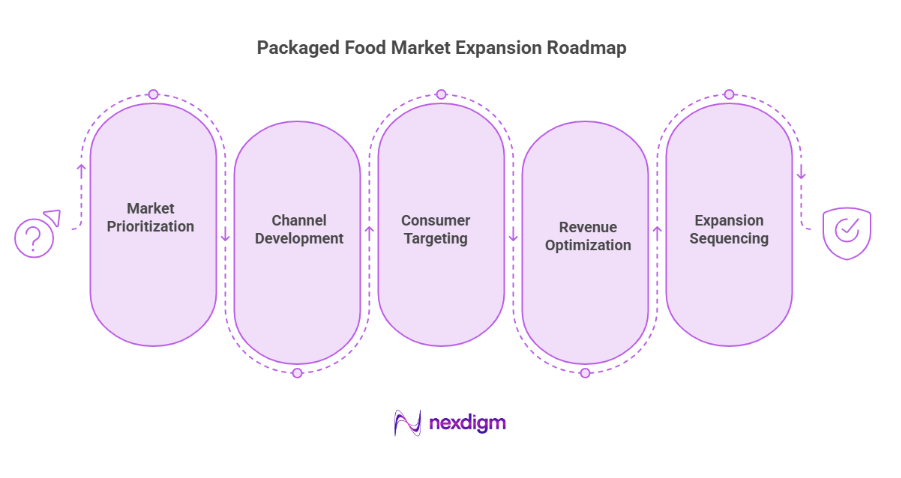
- Market Prioritization: Selecting the most attractive regions and customer segments.
- Channel Development: Building an effective route-to-market strategy.
- Consumer Targeting: Identifying the customers most likely to drive long-term value.
- Revenue Optimization: Aligning pricing, promotions, and product mix.
- Expansion Sequencing: Developing phased growth plans that maximize returns while controlling risk.
Through our packaged food expansion entry strategy consulting services, we help businesses create repeatable growth models capable of supporting regional, national, and international expansion.
Nexdigm’s Case
In a recent engagement, Nexdigm supported a packaged foods client in translating shelf opportunities into a scalable market entry strategy. Real-time analysis improved channel prioritization by 34%, increased demand forecasting accuracy by 29%, optimized assortment decisions by 26%, and accelerated expansion planning by 31%. Nexdigm’s packaged foods assessment approach enabled the client to identify scalable opportunities, refine market entry priorities, and build a commercially viable growth roadmap.
To take the next step, simply visit our Request a Consultation page and share your requirements with us.
Harsh Mittal
+91-8422857704