
India’s packaged-food opportunity is increasingly being shaped by a change in what consumers expect from everyday food.
Staples remain important, but packaged formats are gaining relevance where they provide convenience, consistency, longer shelf life, portability or additional nutritional value. At the premium end, consumers are also looking for products with clearer health credentials and differentiated benefits.
The opportunity is therefore not simply “premium food.” It lies in understanding which consumption occasions are moving toward packaged formats and what consumers are willing to pay for the shift.
Convenience Is Becoming a Product Attribute
The Indian food-processing market reached approximately US382.2billioninFY25andisprojectedtoreachUS689.0 billion by FY34.
IBEF identifies ready-to-eat, ready-to-cook, dairy and processed fruit and vegetable products among areas experiencing increasing consumer demand.
Convenience can take several forms:
- Reduced preparation time
- Longer shelf life
- Easy storage
- Portion control
- Portable consumption
- Consistent quality
- Simplified meal preparation
These benefits create different opportunities across product categories.
A ready-to-cook breakfast product competes differently from a premium packaged snack. A packaged dairy drink competes differently from a shelf-stable meal.
The consumption occasion determines the value proposition.
Premiumization Is Happening Alongside Value-Seeking
The packaged-food market cannot be understood through premiumization alone.
Consumers are simultaneously looking for better value and higher-quality products. PwC’s 2025 India survey found that taste, price and nutritional value were primary food-purchase factors, while health benefits were a significant driver of brand switching.
This dynamic establishes a two-speed market structure.
At one spectrum, consumers target affordable options and lower price thresholds.
At the opposite spectrum, buyers are willing to spend more for superior nutrition, convenience, origin, quality, or specialized features.
Consequently, prime market opportunities exist in the mid-tier segment, balancing meaningful enhancements with cost accessibility.
Health Is Changing the Definition of Premium
Premium packaged food is increasingly associated with what the product does, not merely how it looks.
PwC reports that 84% of Indian consumers highlighted food safety as an important consideration. Its research also found increasing attention to nutritional value, ultra-processed ingredients and pesticides.
This supports opportunities around:
- Healthy Snacking: Defined around attributes such as low calorie, low fat, or gut health.
- Value-Added Traditional Foods: Established Indian food formats repackaged around convenience, quality, portability, and modern retail access without abandoning familiar tastes.
- Channel Shifts: Packaged food demand is increasingly shaped by how consumers discover and purchase products.
- E-Commerce Growth: NIQ reported that e-commerce accounted for 7% of FMCG sales nationally in Q2 2026, with modern trade and e-commerce driving incremental growth.
- Market Divergence & Pricing: Divergence exists between rural and urban markets, alongside a continued influence from pricing.
The Channel Is Changing the Opportunity
Packaged food demand is also increasingly shaped by how consumers discover and purchase products.
NIQ reported that e-commerce accounted for 7% of FMCG sales nationally in Q2 2026, while modern trade and e-commerce were driving incremental growth. It also identified divergence between rural and urban markets and continued influence from pricing.
That means packaged-food companies need to evaluate channel fit alongside consumer fit.
A premium snack may benefit from digital discovery and quick-commerce availability. A staple product may depend more heavily on broad traditional-trade distribution. A niche health product may require a combination of e-commerce, modern trade and targeted physical distribution.
Where the Growth Pockets Can Develop
The most relevant packaged-food opportunities can be grouped by the consumer change they address:
- Time compression
Products that reduce preparation or cooking time. - Health orientation
Products that offer credible nutritional or functional benefits. - Portability
Formats designed for work, travel, school or between-meal consumption. - Premium everyday consumption
Familiar products upgraded through ingredients, sourcing, formulation or packaging. - Regional-to-national scaling
Local food products converted into standardized packaged formats with wider distribution potential. - Digital-first discovery
Products whose differentiation can be communicated effectively through online channels.
Nexdigm’s packaged food market assessment research helps companies identify and evaluate growth opportunities through consumer segmentation, category sizing, trend analysis, pricing assessment, competitor mapping and channel evaluation.
This approach avoids treating packaged food as a single category and instead connects growth to changing consumption behaviour.
Nexdigm’s Packaged Food Growth Opportunity Framework
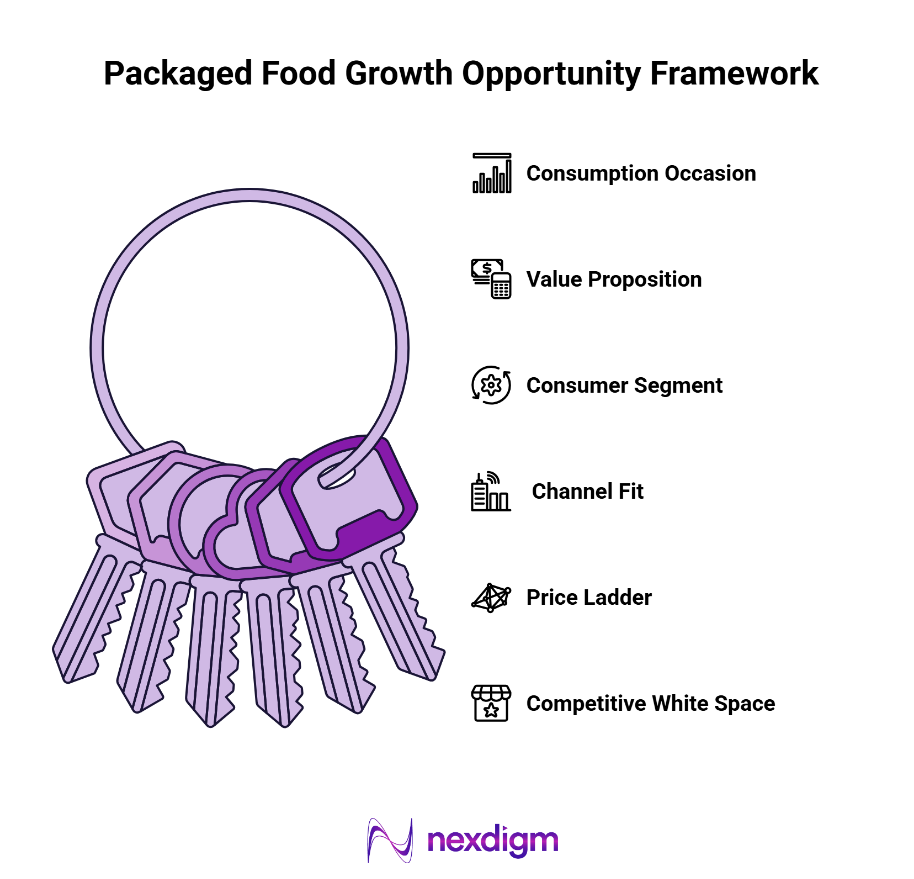
- Consumption Occasion
Identify when, where and why consumers use the product and whether that occasion is shifting toward packaged formats. - Consumer Segment
Assess demographics, income, lifestyle, preferences, health priorities and purchasing behaviour. - Value Proposition
Measure the relative importance of convenience, taste, nutrition, quality, provenance and functionality. - Price Ladder
Map mass, mainstream and premium price points against pack sizes and perceived value. - Channel Fit
Evaluate traditional trade, modern trade, e-commerce, quick commerce, food service and direct-to-consumer channels. - Competitive White Space
Identify underserved combinations of product format, consumer need, price and channel.
This framework allows packaged-food growth to be evaluated as a series of specific opportunities rather than a broad premiumization narrative.
Nexdigm Case Study: Mapping Packaged Food Growth Opportunities
Nexdigm assessed packaged-food opportunities by analysing convenience, health preferences, price sensitivity and channel shifts. With India’s food-processing market at $382.2 billion in FY25 and health benefits influencing brand switching, the assessment helped prioritize product categories with stronger consumer relevance.
The analysis helped the client align its portfolio with emerging consumption occasions, refine premium and mainstream positioning, and prioritize channels for market expansion.
To take the next step, simply visit our Request a Consultation page and share your requirements with us.
Harsh Mittal
+91-8422857704