

In global packaged food market, evaluating growth, cost efficiency, and margin expansion is crucial to understand competitive positioning and long-term value creation. As leading players such as Nestlé, PepsiCo, and Unilever compete across mature and emerging markets, packaged food performance benchmarking becomes a critical tool within competitive intelligence.
By systematically comparing revenue growth rates, cost structures, and margin profiles, companies can identify operational gaps, pricing power, and efficiency levers relative to peers. This integration of financial metrics with competitive intelligence enables firms to track industry leaders, anticipate strategic moves, and refine their own strategies to drive sustainable growth and profitability.
The global packaged food market, valued at roughly USD 3 trillion, is growing at about 4–6% annually, with emerging markets contributing over 60% of incremental growth. Leading companies such as Nestlé and PepsiCo typically report organic revenue growth of 5–8%, while operating margins range between 15–20%.
Cost of goods sold accounts for nearly 55–65% of revenues, highlighting the importance of efficiency. Through packaged food performance benchmarking, firms identify a 200–300 basis point margin gap between top and mid-tier players.
Emerging Market Growth and Competitive Dynamics
Emerging markets drive packaged food growth through rising incomes, urbanization, and demand for convenience. Competitive dynamics intensify as players like Nestlé and Unilever adapt pricing, distribution, and localization strategies.
-
Income Growth and Consumption Shift
Rising disposable incomes increase demand for branded, higher-value foods, shifting consumers from staples to packaged and convenience-oriented products.
-
Urbanization and Changing Lifestyles
Rapid urban migration drives demand for ready-to-eat foods, boosting sales of packaged products through modern retail and e-commerce channels.
-
Localization and Product Adaptation
Companies tailor flavors, formats, and pricing to local preferences, helping brands like Nestlé stay competitive across diverse markets.
-
Distribution Expansion and Retail Penetration
Growth depends on expanding distribution networks, especially in rural areas, leveraging traditional trade alongside modern retail and digital platforms.
-
Pricing Strategies and Affordability
Smaller pack sizes and value pricing help companies reach price-sensitive consumers while maintaining volumes and market share.
Nexdigm Cost Optimization and Operational Efficiency Solutions
Nexdigm Food Cost Optimization and Operational Efficiency Solutions focus on reducing cost structures while improving productivity across operations. Using benchmarking, process diagnostics, and automation, Nexdigm identifies inefficiencies in procurement, manufacturing, and supply chains.
It aligns resources with best-in-class practices, enabling companies to enhance scalability, control operating expenses, and sustain margins, while maintaining quality, compliance, and overall business performance in competitive packaged food markets.
How can Nexdigm improve operational efficiency in packaged food businesses?
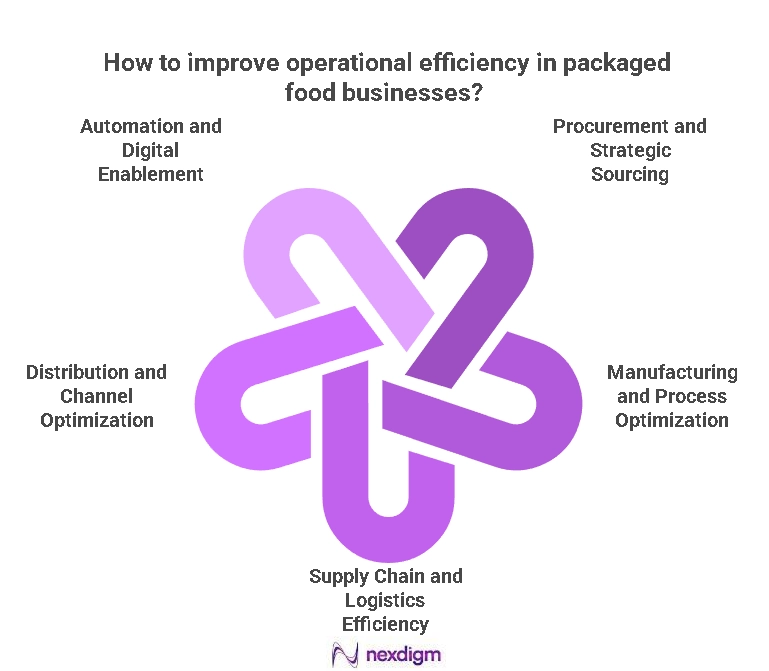
Nexdigm improves operational efficiency across procurement, manufacturing, supply chain, and distribution by identifying inefficiencies, optimizing processes, leveraging automation, and benchmarking performance to reduce costs, enhance productivity, and strengthen margins:
-
Procurement and Strategic Sourcing
Optimize supplier selection, negotiate better contracts, and streamline sourcing processes to reduce input costs and improve overall procurement efficiency.
-
Manufacturing and Process Optimization
Enhance plant utilization, reduce waste, and implement lean practices to improve productivity, consistency, and cost efficiency in production.
-
Supply Chain and Logistics Efficiency
Improve demand planning, inventory management, and transportation networks to reduce delays, lower costs, and increase service levels.
-
Distribution and Channel Optimization
Strengthen distribution networks, optimize route-to-market strategies, and leverage data insights to improve reach and reduce delivery costs.
-
Automation and Digital Enablement
Adopt automation and digital tools to streamline operations, improve accuracy, and enable real-time decision-making across functions.
Nexdigm’s case:
A global food & beverage company engaged Nexdigm to address declining margins and slow innovation. Through competitive benchmarking across 62 SKUs in 9 markets, Nexdigm identified pricing and portfolio inefficiencies. The intervention delivered a 14% improvement in pricing efficiency and supported the launch of three new SKUs generating ~USD 38 million incremental revenue, strengthening both growth and margin performance.
To take the next step, simply visit our Request a Consultation page and share your requirements with us.
Harsh Mittal
+91-8422857704