
Packaged food price benchmarking reports help brands understand how prices, pack sizes, promotions, and retailer margins compare across markets where discounting can erode profitability. Through structured Pricing Analysis, companies can identify price gaps, evaluate promotional effectiveness, assess channel economics, and monitor competitor activity across packaged snacks, ready meals, sauces, cereals, and convenience foods.
These factors support stronger price-pack architecture, disciplined promotion planning, improved net revenue realization, and better portfolio decisions. A data-driven packaged food pricing strategy helps protect margins, strengthen competitiveness, and sustain profitable growth across channels and regional markets.
Studies reveal that pricing programs can reduce promotional margin erosion by 6.8%, improve net revenue realization by 5.9%, lift full-price sales, and increase promotion ROI by 11.4% after refining discount depth, timing, pack structures, and retailer offers across selected priority markets.
Pricing Analysis for Packaged Food Price-Pack and Promotion Performance
Pricing analysis helps packaged food brands align price points, pack sizes, promotions, and channel economics to improve competitiveness, protect margins, strengthen price realization, and support sustainable growth across markets globally. Key steps contributing to promotion performance are:
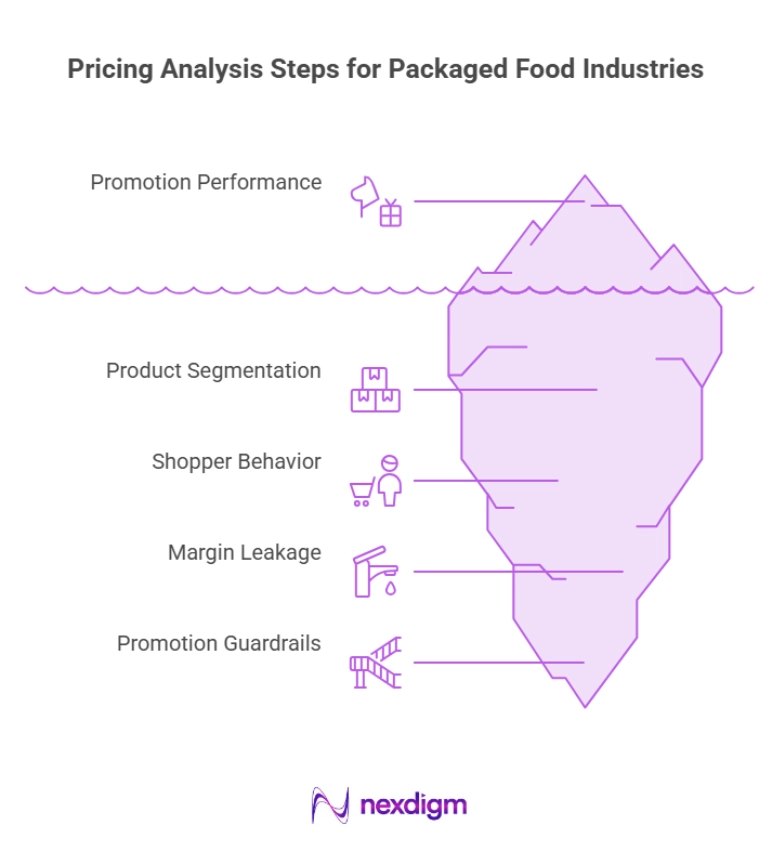
- Segment Products by Pricing Role: Classify products as entry, core, premium, seasonal, or promotional to define suitable price points, pack formats, margin targets, and investment priorities across categories.
- Map Shopper Purchase Behaviour: Analyze basket composition, purchase frequency, brand switching, and pack preferences to understand how consumers respond to different prices, formats, and promotional mechanics.
- Identify Margin Leakage: Review discounts, rebates, retailer funding, markdowns, and trade deductions to uncover hidden margin losses and improve net revenue realization across accounts and channels.
- Design Promotion Guardrails: Set clear limits for discount depth, campaign duration, frequency, and eligibility to support incremental sales without weakening regular-price demand or long-term brand value.
Nexdigm Enabled Smarter Pricing Decisions for Packaged Food Brands
Nexdigm enables packaged food brands to make smarter commercial decisions through data-driven Pricing Analysis and packaged food price benchmarking reports. By combining competitor price benchmarking, pack-price architecture, promotional effectiveness analysis, retailer margin assessments, price elasticity, and channel profitability insights, Nexdigm helps optimize pricing strategies, improve net revenue realization, protect margins, strengthen competitive positioning, and drive sustainable business growth across markets.
Nexdigm’s Data-Driven Pricing Model for Packaged Food Brands
Nexdigm’s model combines shopper behavior, pack economics, promotional performance, channel costs, and market benchmarks to improve packaged food pricing, protect margins, and support sustainable category growth across markets. Some major models referred by the experts are:
- Shelf Price Compliance Model: Tracks recommended and actual retail prices across stores, regions, and channels to identify execution gaps, pricing leakage, and inconsistent consumer value communication in market.
- Basket Interaction Model: Analyzes how packaged food products influence basket composition, cross-category purchases, and add-on behavior to support bundles, price ladders, and higher transaction value growth.
- Trade Spend Efficiency Model: Assesses rebates, retailer funding, listing fees, and promotional allowances to determine which investments improve distribution, sales, and net revenue without unnecessary commercial leakage.
- Promotion Cannibalization Model: Evaluates whether discounts generate incremental sales or shift demand from full-price products, helping brands reduce margin erosion and design more profitable promotional campaigns effectively.
Nexdigm’s Case
Nexdigm supported a packaged food industry for market growth and stabilization, and assessed pack elasticity, promotion cannibalization, shelf-price compliance, and trade-spend efficiency. Recommended pricing actions increased full-price purchase frequency by 8.8%, improved promotion profitability by 13.1%, reduced retailer price deviations by 7.9%, and raised net contribution per pack within two quarters.
To take the next step, simply visit our Request a Consultation page and share your requirements with us.
Harsh Mittal
+91-8422857704