

Packaged food procurement combines ingredient buying, processing, packaging, quality assurance, contract manufacturing, and distribution. These costs are often managed by separate teams, which makes it difficult to determine whether a finished product is being sourced competitively. A lower ingredient price may be offset by poor production yield, expensive packaging, higher rejection rates, or costly minimum-order requirements.
Benchmarking should connect the cost of each input with the commercial and operational conditions under which the finished product is produced and delivered.
Market Context: Processing Capacity Is Expanding
India’s food-processing sector generated gross value added of ₹2.24 lakh crore in 2023-24, up from ₹1.34 lakh crore in 2014-15, according to government estimates. The sector recorded average annual growth of 6.55% over the nine years ending in 2023-24.
Processed food’s share of India’s agricultural exports increased from 13.7% in 2014-15 to 20.4% in 2024-25. This reflects the growing importance of processing and value addition in India’s agricultural trade.
For procurement teams, the trend creates potential opportunities to evaluate contract manufacturers, ingredient processors, and packaging vendors. However, a growing market does not guarantee a competitive quote. Suppliers differ in production capacity, technical specifications, certifications, minimum production runs, and their ability to serve a particular region.
Cost Gaps: What Makes Up the Purchase Price?
The first step is to break expenditure into ingredients, conversion or manufacturing fees, packaging, testing, storage, freight, and additional charges. Spend should be analysed by product, supplier, manufacturing site, and period.
International commodity data can help explain changes in input costs. The FAO Food Price Index averaged 136.0 points in September 2026, 5.8% above its year-earlier level. Cereals were 17.2% higher year on year and vegetable oils 18.3% higher, while sugar was 8.5% lower. These are global reference indicators, not direct benchmarks for Indian finished-product prices.
The relevant question is whether a supplier’s price movement is consistent with the materials, contract terms, and production economics that actually affect the product.
Ingredient and Packaging Benchmarking
Ingredient comparisons must account for grade, formulation, usable yield, quality limits, and pack size. Two materials with similar names may not be interchangeable if they perform differently in production.
Packaging needs its own benchmark. Flexible packs, cartons, labels, trays, and containers can differ by material thickness, dimensions, print requirements, food-contact specifications, tooling, and minimum order quantity.
For packaged food procurement benchmarking services, the analysis should compare:
- Cost per kilogram or litre of usable ingredient.
- Conversion cost per finished unit or production batch.
- Packaging cost per thousand units, including printing and delivery.
- Quality rejection, production loss, and wastage.
- Minimum orders, lead times, inventory exposure, and payment terms.
This reveals whether a price difference is commercially avoidable or explained by a genuine specification or service difference.
Supplier Benchmarking and Sourcing Opportunities
Supplier selection should balance price with production reliability, quality, capacity, and flexibility. A contract manufacturer with lower conversion charges may require longer production runs or offer less flexibility when demand changes. A packaging vendor with a lower unit rate may require larger inventories or have longer lead times.
Potential sourcing opportunities include competitive bidding for comparable inputs, consolidating fragmented volumes, qualifying a second source, and reducing unnecessary specification variation. Any formulation or packaging change should be checked for food safety, shelf life, production compatibility, and customer requirements before implementation.
Packaged Food Procurement Benchmarking Framework
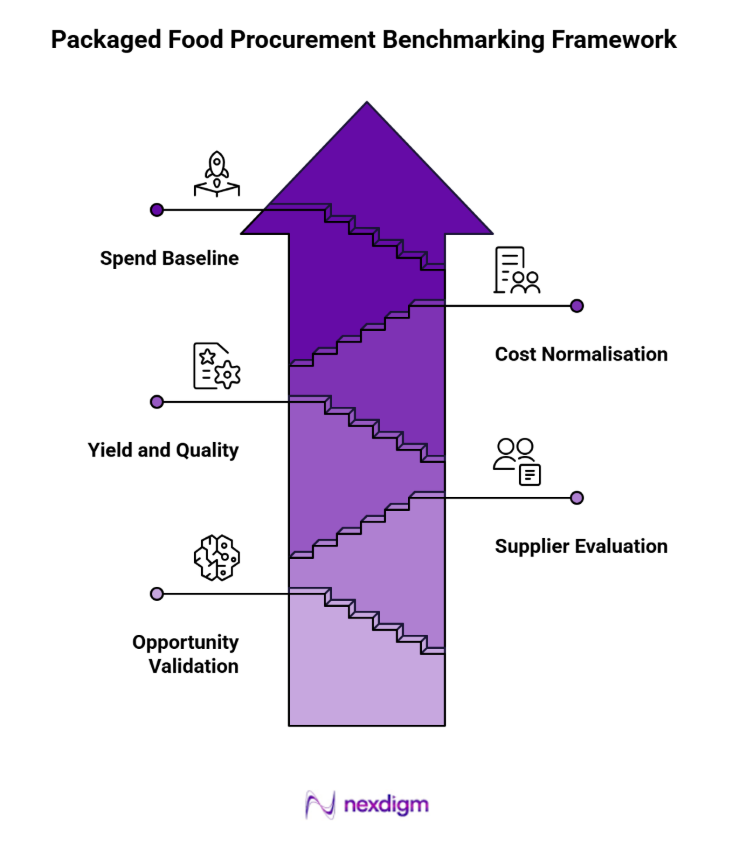
- Spend Baseline: Rank expenditure by product, ingredient, packaging format, supplier, and manufacturing location.
- Cost Normalisation: Compare equivalent specifications, conversion requirements, delivery terms, and landed costs.
- Yield and Quality: Link input prices to production yield, rejection rates, wastage, and cost per saleable unit.
- Supplier Evaluation: Benchmark price, capacity, lead time, quality performance, minimum runs, and commercial flexibility.
- Opportunity Validation: Prioritise negotiations, alternative sourcing, order consolidation, and specification changes by achievable savings and operational risk.
Outlook: Benchmark the Finished Product, Not Just Its Inputs
As processed-food supply chains become more complex, procurement teams need consistent product-level costing and supplier performance data. The best opportunity may lie in contract terms or production yield rather than the ingredient price. A credible benchmark identifies the cause of the gap before recommending a sourcing change.
Nexdigm’s Case Study
A packaged-food manufacturer reviewed ₹34 crore in annual ingredient, contract-manufacturing, and packaging purchases. The assessment identified inconsistent rates for comparable materials and excess packaging variation. The resulting sourcing plan prioritised supplier negotiations, specification alignment, and alternative-source qualification, with financial benefits tracked against actual production and purchasing records.
To take the next step, simply visit our Request a Consultation page and share your requirements with us.
Harsh Mittal
+91-8422857704