

Packaged food procurement combines ingredient costs with processing, packaging, quality assurance, storage, and distribution. These components can vary significantly across products, even within the same category. A biscuit manufacturer, ready-meal producer, and packaged-snack business may all purchase food ingredients, but their cost structures and supplier markets differ.
Spend analysis should identify which products, suppliers, and cost components account for the greatest expenditure, then establish where commercial improvements are realistically available.
Examine the Industry Structure
India’s food-processing sector recorded gross value added of ₹2.24 lakh crore in 2023-24, according to government estimates. The sector’s growing role in agricultural exports also reflects greater value addition beyond primary commodities.
For packaged food buyers, this creates a broad supplier landscape encompassing ingredient processors, contract manufacturers, packaging converters, and specialised production facilities. However, supplier availability is not uniform. Products requiring specialised processing, controlled formulations, or complex packaging may have fewer suitable manufacturers than standard dry goods.
The first step is to identify spend concentration by product category and supplier, rather than assuming that all packaged food purchases have comparable sourcing options.
Trace Costs Through the Product
The cost of a packaged food product can include ingredients, processing yield, labour, energy, packaging materials, printing, quality testing, warehousing, and freight. Changes in any of these components can affect the final purchase price.
For packaged food procurement spend analysis consulting, spend records should be linked to product specifications and supplier processes. A higher unit cost may reflect more expensive ingredients, stricter quality requirements, smaller production runs, or packaging designed to extend shelf life. Without that context, cost comparisons can penalise suppliers that provide materially different products.
Commodity indicators can help identify external pressures, but they should be used selectively. For example, international vegetable oil prices may be relevant to some snack products, but not a complete explanation of their finished product costs.
Identify Concentration and Waste
Spend concentration can emerge in two ways: too much expenditure may be placed with a small number of suppliers, or a small number of products may account for a large share of total purchasing. Both patterns require investigation, but neither automatically indicates a problem.
Supplier concentration matters most when alternatives are difficult to qualify or when vendors share the same upstream source. Product concentration may point to opportunities for specification review, demand planning, or commercial renegotiation.
Inventory and waste should also be included. Short shelf life, obsolete packaging, rejected batches, and inaccurate forecasts can increase effective costs without appearing as higher supplier prices.
Packaged Food Spend Analysis Framework
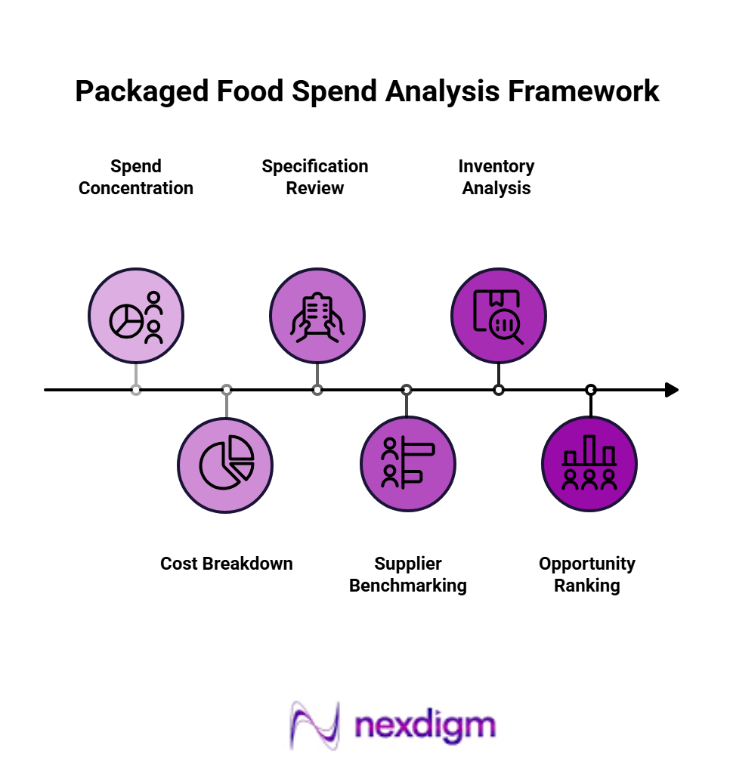
- Spend Concentration: Rank products, suppliers, and categories by expenditure and identify where purchasing dependence or limited alternatives could create commercial risk.
- Cost Breakdown: Separate ingredients, processing, packaging, testing, storage, freight, and additional charges to establish the main drivers of unit cost.
- Specification Review: Compare equivalent formulations, pack sizes, quality standards, shelf life, and packaging requirements before interpreting price differences.
- Supplier Benchmarking: Evaluate comparable vendors on net price, capacity, delivery performance, quality, minimum runs, and commercial flexibility.
- Inventory Analysis: Review stock cover, production batches, expiry, wastage, and obsolete packaging to identify costs arising from purchasing and planning decisions.
- Opportunity Ranking: Prioritise negotiation, alternative sourcing, packaging optimisation, and order consolidation according to addressable spend, feasibility, and product risk.
Prioritise Opportunities That Protect Quality
Not every cost reduction is worth pursuing. Changing an ingredient or packaging specification may require testing, label updates, or customer approval. A supplier with a slightly higher price may offer better consistency or lower wastage. The objective is to reduce total procurement cost without compromising food safety, product performance, or shelf life.
Nexdigm’s Case Study
A packaged-food manufacturer reviewed ₹32 crore in annual purchasing across ingredients and packaging. The analysis identified high spend concentration in two ingredient suppliers and inconsistent pricing for comparable packaging. Revised negotiations and a second-source qualification programme reduced addressable spend by 3.8% while maintaining product and packaging specifications.
To take the next step, simply visit our Request a Consultation page and share your requirements with us.
Harsh Mittal
+91-8422857704