

Packaged food sourcing requires suppliers that can meet product specifications, maintain food safety controls, deliver consistent batches, and support the required production volumes. A supplier capable of manufacturing a successful small batch may not have the equipment, packaging lines, or working capacity needed for a national retail rollout.
Supplier identification should therefore combine market mapping with technical, commercial, and operational screening.
Define the Product Brief
The supplier search should begin with the product itself: ingredients, formulation, processing method, packaging format, shelf life, labelling requirements, target price, and expected volume. Products that appear similar commercially may require different production equipment, preservation methods, or handling conditions.
Requirements also depend on the destination market. Food safety, ingredient declarations, allergen controls, permitted additives, packaging contact requirements, and labelling rules should be checked for the relevant jurisdiction. Codex Alimentarius provides internationally recognised food standards and guidance that can inform assessments, although the legally applicable requirements depend on the destination country.
Map Manufacturers and Co-Packers
Potential suppliers may include established branded manufacturers, private-label producers, contract manufacturers, and specialist processors. Their commercial models differ. Some require substantial minimum runs, while others specialise in shorter production batches or specific product formats.
A supplier longlist should record product categories, manufacturing locations, production methods, certifications, packaging capabilities, minimum order quantities, and experience serving comparable markets. This helps separate businesses that genuinely fit the requirement from suppliers whose broad catalogues conceal technical limitations.
Evaluate Cost and Production Scale
For packaged food supplier identification consulting, quoted manufacturing costs should be compared alongside ingredients, packaging, testing, tooling, freight, wastage, and minimum production runs. Smaller batches may carry higher unit costs, while large orders can increase working-capital needs and expiry risk.
Production capacity should also be tested against realistic lead times. Equipment availability, ingredient sourcing, packaging procurement, quality release, and seasonal demand can all constrain the volume a supplier can deliver on schedule.
Packaged Food Supplier Identification Framework
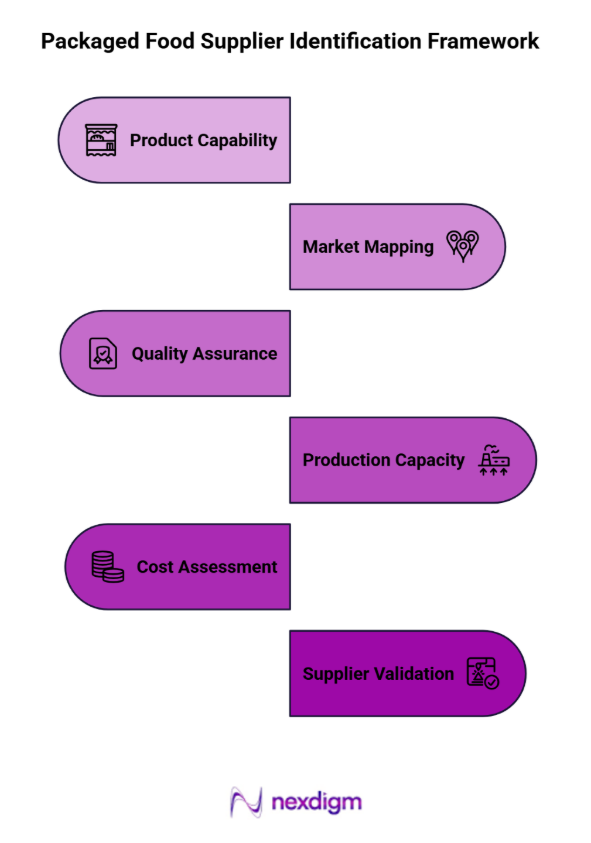
- Product Capability: Confirm formulation, processing method, packaging format, shelf life, and product-specific technical requirements before adding manufacturers to the shortlist.
- Market Mapping: Identify branded manufacturers, private-label producers, co-packers, and specialist processors by product category, location, scale, and target market experience.
- Quality Assurance: Review food safety systems, ingredient traceability, batch records, testing arrangements, allergen controls, and relevant certifications or regulatory approvals.
- Production Capacity: Assess minimum runs, available production lines, lead times, ingredient availability, packaging supply, and the ability to scale without compromising quality.
- Cost Assessment: Compare manufacturing, ingredients, packaging, testing, tooling, freight, wastage, and inventory implications using consistent volume and delivery assumptions.
- Supplier Validation: Request samples, verify documentation, review references where available, and conduct a controlled production trial before committing significant volumes.
Move From Longlist to Qualification
The strongest candidate is not necessarily the largest manufacturer or the supplier with the lowest quoted price. It is the supplier that can consistently meet product, quality, volume, regulatory, and commercial requirements. Qualification should therefore include evidence review and product testing before final contract negotiations.
Nexdigm’s Case Study
A retailer seeking a private-label snack supplier screened 22 manufacturers and shortlisted five based on production capability, quality documentation, and minimum order quantities. Sample testing and landed-cost comparison narrowed the options to two suppliers, including one with a projected 7% lower unit cost at the planned order volume.
To take the next step, simply visit our Request a Consultation page and share your requirements with us.
Harsh Mittal
+91-8422857704