

Packaged food manufacturers operate through supply networks that connect agricultural producers, ingredient processors, packaging manufacturers, contract packers and distribution partners. The finished product may carry one brand, but its quality and availability depend on several independent businesses.
This creates a particular challenge for companies managing multiple product categories. A disruption involving one ingredient or packaging component can affect production across several SKUs. A supplier’s compliance failure may also have consequences beyond the individual batch in which the issue is identified.
The Expanding Packaged Food Market
India’s food-processing sector has become an increasingly important part of organised manufacturing and international trade. Processed food exports reached approximately US$10.1 billion in FY2024–25, representing 20.4% of the country’s agricultural exports. The sector’s gross value added reached ₹2.24 lakh crore in FY2023–24.
The expansion creates opportunities for packaged food manufacturers, but it also increases the complexity of supplier networks. Companies sourcing ingredients from multiple agricultural regions or using specialised packaging materials need visibility into production capacity, geographical concentration and regulatory conditions.
Three Sources of Supplier Vulnerability
Production Risk: Can Suppliers Maintain Output?
Production risk arises when suppliers cannot consistently meet the volume, specification or quality requirements of a manufacturer. Common factors include ageing equipment, high capacity utilisation, dependence on seasonal raw materials and limited investment in testing infrastructure.
The assessment should distinguish installed capacity from dependable output. A supplier reporting an annual capacity of 20,000 tonnes may not be able to deliver that volume consistently if its operations depend on seasonal inputs or experience frequent equipment downtime.
Manufacturers should also examine whether suppliers can scale production during promotional periods, new product launches and seasonal demand peaks.
Sourcing Risk: Where Do Critical Inputs Originate?
Ingredient sourcing can expose manufacturers to regional concentration, weather-related disruptions, import dependence and changes in commodity availability.
For example, a packaged snack manufacturer may depend on a limited number of suppliers for edible oils, spices or specialised starches. A disruption affecting one production cluster could influence multiple product lines simultaneously.
A useful assessment maps:
- Origin of critical raw materials.
- Number and location of alternative suppliers.
- Domestic production versus import dependence.
- Seasonal availability and price volatility.
- Transport routes and storage requirements.
Packaging also deserves separate consideration. Printed films, laminates, closures and specialised barrier materials may have fewer qualified manufacturers than standard ingredients. Replacing these suppliers can require product testing, packaging trials and changes to production settings.
Compliance Risk: Can the Supply Chain Demonstrate Control?
During FY2024–25, Indian food safety authorities analysed 170,535 samples, of which 34,388 were found non-conforming. The data covers food samples across categories and should not be interpreted as a supplier failure rate. However, it demonstrates the importance of product testing and regulatory oversight.
Packaged food suppliers need to maintain accurate ingredient specifications, batch records, test reports, allergen information, packaging declarations and traceability documentation. Businesses should also evaluate how suppliers investigate deviations and prevent repeated failures.
Why Risk Concentration Matters
A supplier with a minor documentation gap may represent limited exposure if the product is easily replaceable. A supplier with a similar gap may represent a critical risk if it provides a specialised ingredient used across 15 product lines.
Risk therefore needs to be assessed through both probability and business impact. The number of affected SKUs, availability of alternatives, qualification time and replacement cost all influence the severity of a supplier dependency.
A Five-Part Method for Mapping Packaged Food Risk
A packaged food supplier risk assessment services engagement can help manufacturers identify vulnerabilities across their supplier networks.
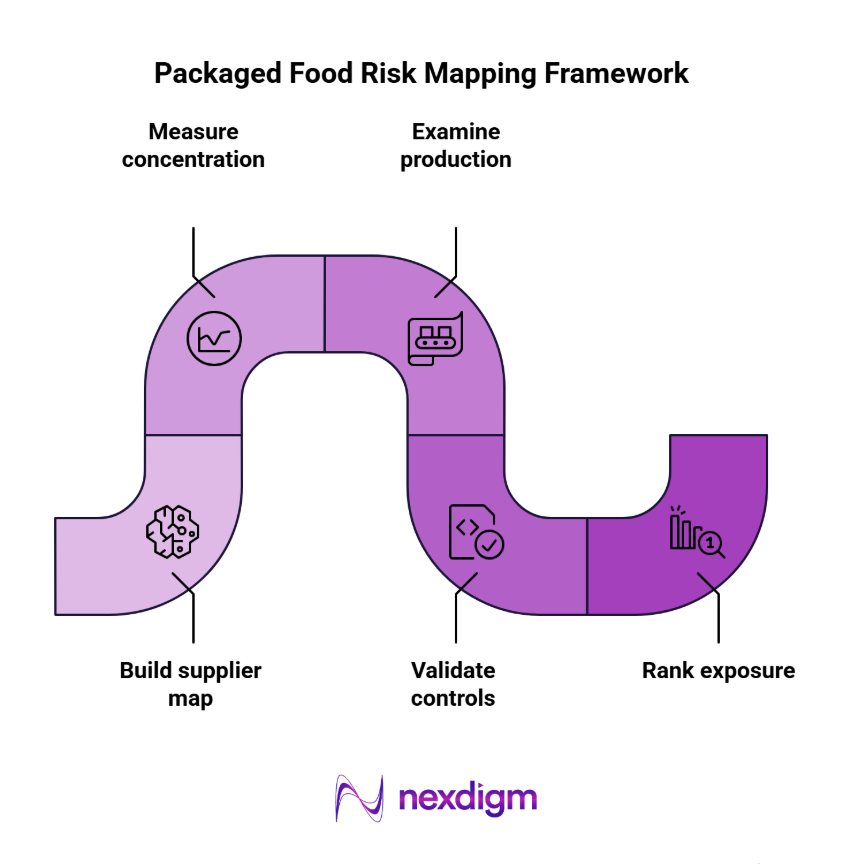
- Build a supplier and material map: Connect each critical ingredient and packaging component to its suppliers, manufacturing locations and end products.
- Measure concentration: Identify dependencies on individual suppliers, production clusters, countries or transport corridors.
- Examine production capability: Compare capacity, utilisation, infrastructure, quality systems and ability to meet changing demand.
- Validate compliance controls: Review licences, testing records, specifications, traceability and corrective-action procedures.
- Rank business exposure: Prioritise risks according to the number of products affected, availability of substitutes and time required to qualify alternatives.
Nexdigm can support businesses through supplier landscape research, market mapping, production-capacity analysis and assessment of industry-level supply risks. These insights help manufacturers understand where their supply networks are most exposed and which markets may offer alternative sources.
Nexdigm’s Case Study
A packaged foods business sourcing 18 key materials from 31 suppliers across 5 states assessed its supplier concentration and operating risks. The review identified 6 materials with limited alternative supply and 8 suppliers requiring compliance improvements. The client qualified 5 additional sources and reduced single-supplier exposure across priority materials by 26%.
To take the next step, simply visit our Request a Consultation page and share your requirements with us.
Harsh Mittal
+91-8422857704