

Packaging demand is becoming increasingly fragmented. Food, beverages, pharmaceuticals, personal care, e-commerce and industrial products are creating different requirements around material performance, shelf life, automation, recyclability and cost.
That makes aggregate packaging growth a weak basis for assessing opportunity. A format can be expanding rapidly in one application while losing relevance in another. The commercial question is therefore where demand is moving, what is causing the shift, and which packaging formats can capture it.
Demand Is Splitting Across Formats and End Uses
The US packaging machinery market provides a useful indication of how diverse these demand pools have become. PMMI estimates US packaging machinery shipments reached $11.7 billion in 2025, with food representing approximately 44% of the market. Food machinery shipments alone were estimated at $5.1 billion and are projected to reach approximately $7.1 billion by 2031.
This matters because machinery investment follows packaging requirements. Changes in product formats, SKU counts, production volumes and packaging materials eventually translate into equipment demand.
Packaging assessment therefore needs to follow the chain:
End-use growth → product requirements → packaging format → material choice → machinery requirement → supplier opportunity
Four Demand Pockets Worth Separating
- Flexible packaging
Demand is shaped by lightweighting, convenience formats, portion sizes and material efficiency. The opportunity varies significantly between food, healthcare, personal care and industrial applications. - Rigid packaging
Bottles, containers, trays and rigid formats remain important where durability, barrier properties, stackability or product protection dominate purchasing decisions. - Sustainable packaging
Recyclability, recycled content, material reduction and regulatory requirements are increasingly affecting specifications. PMMI’s 2026 research found that 82% of packaging end users were actively engaged in sustainability initiatives, while 64% of OEMs said sustainability directly influenced equipment design. - Specialty formats
High-barrier, pharmaceutical, medical, protective and application-specific packaging can command different economics because performance requirements limit substitutability.
The relevant opportunity is therefore determined by the interaction between format and application, rather than format growth alone.
What Actually Changes Packaging Demand?
Several demand signals should be tracked together.
- Product launches can increase SKU complexity and create demand for flexible machinery.
- E-commerce can increase requirements for protection, secondary packaging and efficient fulfilment.
- Sustainability regulation can accelerate material substitution or redesign.
- Food and pharmaceutical production can increase demand for higher-performance barrier and hygienic packaging.
- Automation can make certain formats more commercially viable by reducing labour requirements and improving production consistency.
These drivers do not affect every packaging format equally. Their impact needs to be measured at the end-use level.
The Material Question Cannot Be Separated From the Market
Packaging decisions increasingly involve a three-way trade-off between performance, economics and environmental requirements.
Though a material might provide excellent barrier protection, it can present significant recycling hurdles. Similarly, utilizing recycled content can address regulatory demands, yet it often introduces operational or consistency issues.
Furthermore, adopting a lightweight design lowers material usage, but it may necessitate adjustments to equipment. The analysis needs to establish whether customers are actually willing and able to move toward the proposed format.
Nexdigm can support packaging demand assessment services through market sizing, end-use analysis, format segmentation, customer research, competitive benchmarking, regulatory assessment and demand forecasting.
Nexdigm’s Packaging Demand Opportunity Map
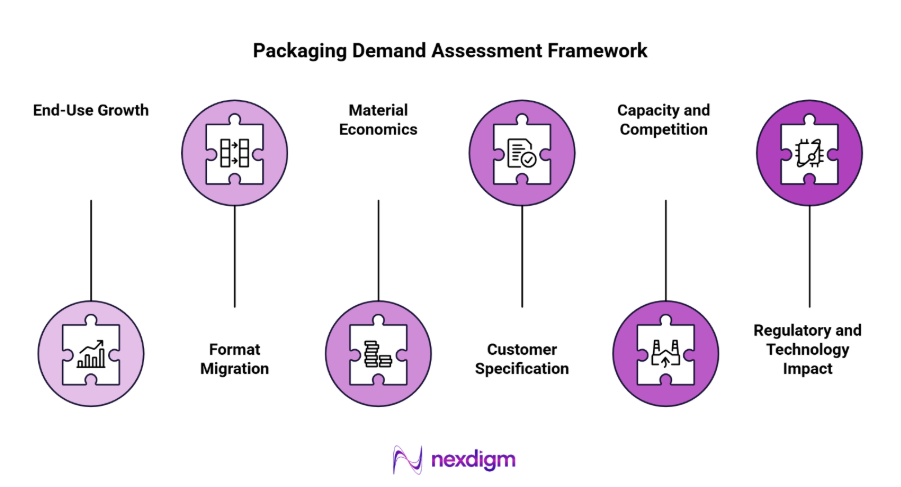
- End-Use Growth
Identify industries, product categories and applications generating incremental packaging volumes. - Format Migration
Track movement between flexible, rigid, specialty and emerging formats. - Material Economics
Compare resin, paper, metal, recycled and alternative-material economics alongside performance requirements. - Customer Specification
Assess purchasing priorities including cost, shelf life, machinability, aesthetics, sustainability and regulatory compliance. - Capacity and Competition
Map existing production capacity, supplier concentration, imports, local manufacturing and planned investments. - Regulatory and Technology Impact
Evaluate packaging legislation, recycled-content requirements, automation and process changes that can accelerate or restrict adoption.
This creates a demand map that connects volume growth with the specific packaging formats capable of capturing it.
Nexdigm Case Study: Prioritizing Packaging Format Opportunities
Nexdigm supported a packaging company evaluating growth opportunities across flexible, rigid and sustainable formats. By analysing the $11.7 billion US packaging machinery market, 44% food share and 82% end-user sustainability adoption, the assessment helped prioritize formats with stronger customer and investment potential.
The analysis enabled the client to focus its product and capacity strategy on packaging segments aligned with end-use growth, sustainability requirements and evolving equipment needs.
To take the next step, simply visit our Request a Consultation page and share your requirements with us.
Harsh Mittal
+91-8422857704