

Packaging products rarely win on one attribute.
A material may offer strong sustainability credentials but run poorly on existing filling equipment. A low-cost format may reduce material expenditure but compromise shelf life. A recyclable structure may require machinery modifications that customers are unwilling to finance.
The commercial opportunity sits where material performance, production economics, regulatory requirements, and customer expectations overlap.
Current packaging investment data shows the scale of the market behind these decisions. PMMI estimates that US domestic packaging machinery shipments reached $11.7 billion in 2025, with food accounting for approximately 44%, or $5.1 billion. Food machinery shipments are projected to reach approximately $7.1 billion by 2031.
The equipment market is changing because the packaging formats themselves are changing.
Cost Still Sets the Commercial Boundary
Packaging buyers operate under constant cost pressure.
Raw materials, energy, transportation, conversion costs, equipment compatibility, scrap, and production speed all influence the final economics.
This is particularly important when brands consider lightweighting or switching substrates. A material with a higher price per kilogram may still be attractive if it reduces material consumption or transport weight. Conversely, an apparently cheaper material can become more expensive if it creates higher scrap or slows production.
Packaging feasibility therefore needs to evaluate cost per functional package rather than simply cost per tonne of material.
Sustainability Is Changing the Specification
Sustainability has moved into the procurement process.
PMMI’s 2026 research found that 82% of end users are actively engaged in sustainability initiatives. It also found that 64% of OEMs say sustainability directly influences equipment-design decisions, while more than half of end users report that machinery limitations prevent them from achieving their sustainability goals.
That creates an important commercial shift.
Packaging companies are no longer evaluating sustainable materials independently from the machinery used to process them. Lightweighted structures, post-consumer recycled content, smaller formats, and elimination of secondary packaging can all require different equipment settings or capabilities.
The packaging material and the production line increasingly have to be designed as one system.
Performance Determines Whether Adoption Lasts
Packaging protects products before it communicates anything to consumers.
Moisture, oxygen, light, temperature, impact, shelf life, seal integrity, puncture resistance, and transportation conditions can all determine whether a packaging format works.
A material that fails these requirements cannot win simply because it has a lower environmental impact.
This is particularly important for food and pharmaceutical applications, where packaging performance can directly affect product safety and shelf life.
The result is a multi-variable buying decision. Sustainability can open the door, but technical performance determines whether the format remains commercially viable.
Regulation Is Creating Regional Differences
Extended Producer Responsibility requirements, recycled-content rules, restrictions on certain materials, and waste-management systems are changing the economics of packaging.
The problem is that regulation is not uniform.
A format that is economically attractive in one country may face higher compliance costs in another. Recycling infrastructure also varies significantly by market, which means that theoretical recyclability does not always translate into practical circularity.
Smithers’ 2026 assessment of post-consumer recycled packaging describes the market as being at an inflection point, with legislation and targets increasing while weak recyclate economics have caused some recycling plants and materials-recovery facilities to close. Stronger growth is expected from 2028 onward.
Packaging strategies therefore need to account for both policy and actual recycling economics.
Customer Fit Can Be More Important Than Product Novelty
The best packaging technology is not necessarily the most sophisticated one.
A customer may prioritize machine compatibility, procurement stability, shelf-life performance, or cost over a technically superior sustainability proposition.
Euromonitor reports that 53% of global consumers trust information on labels, packaging, and company websites, making packaging an increasingly important credibility signal for sustainability claims.
For packaging suppliers, that means understanding both the procurement decision and the consumer-facing proposition.
A successful offering needs to satisfy the manufacturer buying the material and the consumer encountering it.
Nexdigm’s Packaging Market Feasibility Assessment Framework
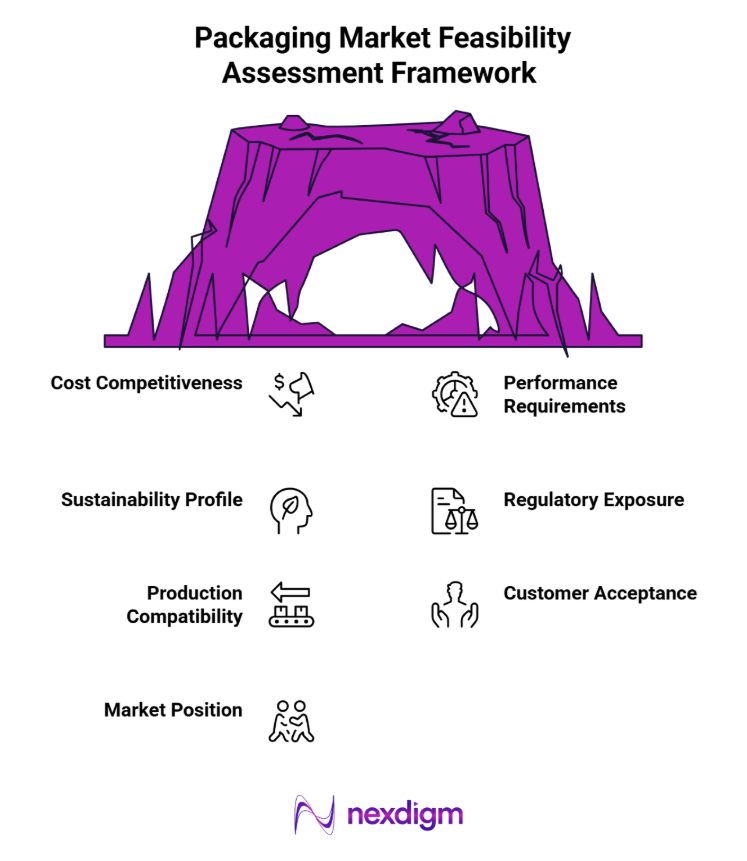
- Cost Competitiveness
Compare material, conversion, logistics, equipment, energy, waste, and total cost per functional package. - Performance Requirements
Assess barrier properties, strength, sealability, shelf life, machinability, safety, and product-specific technical requirements. - Sustainability Profile
Evaluate recyclability, recycled content, material reduction, carbon impact, waste generation, and circularity infrastructure. - Regulatory Exposure
Map EPR requirements, recycled-content mandates, material restrictions, labelling rules, and market-specific compliance costs. - Production Compatibility
Determine whether the format can run on existing equipment or requires changes to filling, sealing, labelling, or inspection systems. - Customer Acceptance
Assess buyer willingness to pay, switching costs, procurement requirements, qualification processes, and adoption barriers. - Market and Competitive Position
Map competing formats, suppliers, price points, technology differentiation, capacity, and potential substitutes.
Case Study: Packaging Market Feasibility Assessment
PMMI found 82% of packaging end users actively pursuing sustainability initiatives in 2026, while more than half reported machinery limitations. Mapping sustainability requirements against cost, machinability, and regulatory exposure can identify packaging formats with stronger adoption potential.
Nexdigm can support packaging market feasibility assessment through customer analysis, competitive benchmarking, pricing, regulatory assessment, material evaluation, and market-entry strategy.
To take the next step, simply visit our Request a Consultation page and share your requirements with us.
Harsh Mittal
+91-8422857704