

Retail packaging procurement is being reshaped by a difficult combination of cost pressure, material availability, sustainability expectations, and evolving regulation. RRD’s 2026 Integrated Packaging Report found that 65% of organizations are looking for ways to cut packaging costs, while the same proportion is increasing its focus on sustainable packaging.
53% plan to diversify suppliers, and 48% are considering more cost-effective materials or processes. Packaging World’s 2026 outlook also found that material reduction and recycled content each rose to 37.5% among considerations when companies make material changes.
Meanwhile, Amcor reports that 91% of European consumers are aware of post-consumer recycled content, while 76% have knowingly purchased packaging containing PCR. These developments make packaging procurement benchmarking reports retail increasingly relevant for comparing material costs, supplier performance, commercial terms, and sustainability considerations.
Why Packaging Procurement Needs a Multi-Dimensional View
Packaging decisions cannot be evaluated through unit price alone. Material choice, specifications, volumes, tooling, freight, supplier capabilities, recycled content, recyclability, and regulatory requirements can all influence the effective procurement cost. A cheaper material may require higher conversion costs, while a sustainable alternative may carry supply constraints or require changes to existing equipment. Benchmarking helps retailers compare these factors together and understand the commercial trade-offs behind packaging decisions.
Factors Shaping the Packaging Competitiveness
A meaningful comparison should connect procurement economics with material and sustainability considerations.
- Material and Supplier Economics: Compare material prices, conversion costs, purchase volumes, supplier terms, and capacity to identify meaningful differences in total packaging economics.
- Sustainability and Performance: Assess recycled content, recyclability, material reduction, product protection, and compliance requirements to determine whether packaging alternatives meet both commercial and operational needs.
- Supply Chain Resilience and Availability: Evaluate supplier diversification, lead times, geographic sourcing dependencies, inventory flexibility, and supply continuity risks to understand how reliably packaging can support business operations during market disruptions.
Together, these dimensions help retailers distinguish between simple price differences and genuine opportunities to improve packaging value.
Nexdigm’s Industry Expertise in Retail Packaging
Nexdigm brings procurement, market, and industry perspectives together to help retailers navigate the evolving packaging landscape. Our understanding of materials, supplier markets, commercial dynamics, and sustainability considerations supports a more informed view of packaging procurement decisions.
This industry perspective helps retailers assess packaging choices in context, considering not only current costs, but also supplier availability, market shifts, operational requirements, and longer-term sourcing implications.
Nexdigm’s Packaging Category Intelligence Approach
Packaging decisions often span multiple materials, suppliers, specifications, and sourcing markets. Nexdigm helps retailers bring these elements together to understand:
- Material Landscape: Material availability, price movements, alternatives, and evolving specifications to understand the factors shaping category economics.
- Supplier Landscape: Supplier capabilities, capacity, geographic presence, pricing, and competitive alternatives to identify changes in the sourcing environment.
- Market Landscape: Demand, regulatory developments, sustainability expectations, and broader market conditions to understand how the packaging category may evolve.
By connecting these perspectives, Nexdigm helps retailers build category-level intelligence that supports more informed packaging sourcing, supplier, and material decisions.
Nexdigm’s Packaging Procurement Benchmarking Framework
Nexdigm can structure packaging procurement benchmarking reports retail through a practical framework that brings commercial, supplier, material, and sustainability factors into one assessment by conducting:
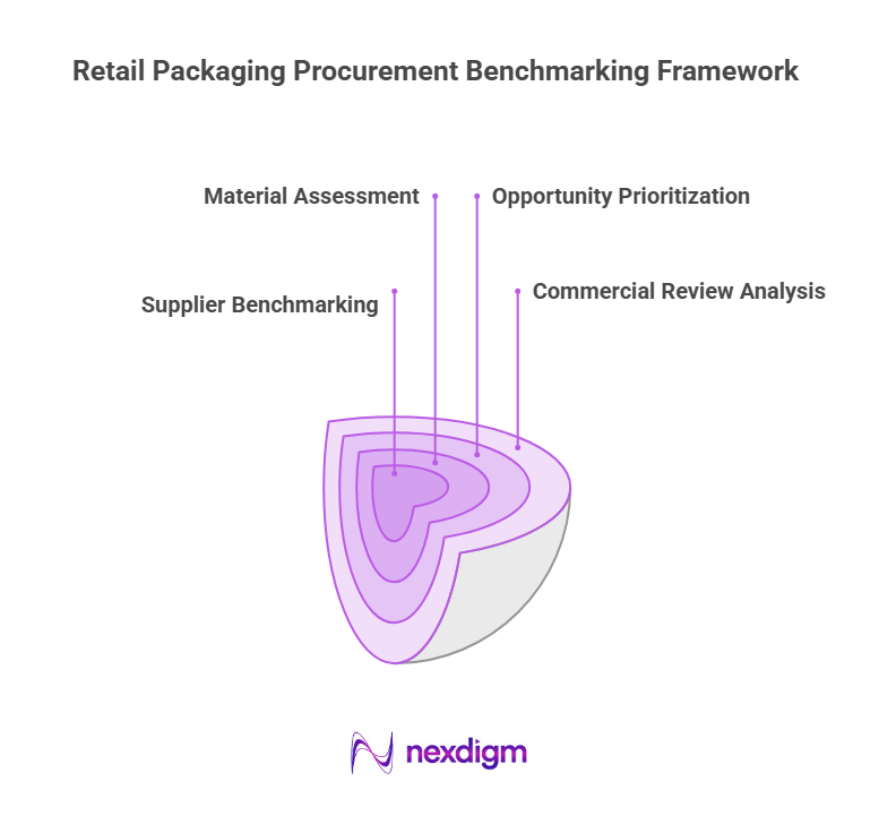
- Material Assessment: Comparison of material types, specifications, prices, availability, and alternatives to understand differences in packaging economics.
- Supplier Benchmarking: Evaluation of supplier pricing, capacity, quality, service levels, geographic presence, and competitive alternatives to assess overall supplier positioning.
- Commercial Review: Examination of volumes, discounts, rebates, payment terms, tooling, freight, and other conditions that influence the effective cost of packaging.
- Opportunity Prioritization: Ranking of identified gaps according to spend, savings potential, supplier concentration, sustainability relevance, operational impact, and implementation feasibility.
This framework helps retailers move from packaging comparisons to a structured view of procurement gaps, supplier options, and opportunities for cost and sustainability improvement.
Nexdigm’s Framework Supporting Packaging Sustainability Improvement
Nexdigm’s framework helps retailers connect packaging procurement decisions with sustainability objectives, making it easier to identify:
- Material Opportunities: Compare material choices, recycled content, material weight, and alternative formats to identify options that could reduce material intensity without compromising required packaging performance.
- Assess Supplier Capabilities: Evaluate suppliers on sustainable-material availability, production capabilities, certifications, innovation, and ability to support changing packaging requirements.
- Balance Cost and Sustainability: Compare the commercial implications of sustainable alternatives, including material costs, availability, logistics, and conversion requirements, to identify viable improvement pathways.
- Prioritize Sustainability Actions: Rank opportunities according to environmental relevance, procurement spend, operational feasibility, supplier readiness, and potential business impact to focus efforts on the most practical initiatives.
This enables retailers to move from measuring packaging sustainability to identifying concrete opportunities for material efficiency, supplier improvement, and more sustainable procurement decisions.
Nexdigm’s Case
Nexdigm’s assessment identified a 16% potential cost-improvement opportunity across prioritized packaging categories, with 12% of spend showing significant supplier-price variation. The analysis also highlighted an 8% opportunity to improve material efficiency and 7% of packaging spend requiring sustainability-focused review, helping the retailer prioritize commercial and sustainability actions.
To take the next step, simply visit our Request a Consultation page and share your requirements with us.
Harsh Mittal
+91-8422857704