

Retail packaging suppliers are increasingly expected to balance cost, product protection, delivery reliability, regulatory compliance, and sustainability. The pressure is visible in current market data. In the UK, 70.5% of packaging waste was recycled in 2025, while plastic achieved a lower 57.3% recycling rate, highlighting continuing material-specific challenges.
In India, packaging has become the country’s third-largest packaging market globally, with the sector growing at an estimated 22–25% annually. Meanwhile, another study reported that 89.5% of its packaging met reusable, recyclable, or compostable criteria by the end of 2025, demonstrating how supplier expectations are moving beyond price and delivery.
Against this backdrop, packaging supplier compliance benchmarking retail can help businesses determine whether suppliers remain competitive across commercial, operational, quality, and sustainability measures.
Why Packaging Supplier Benchmarking Matters
Packaging procurement decisions increasingly involve competing priorities. A lower-cost supplier may have weaker sustainability credentials, while a highly compliant supplier may carry higher costs or longer lead times. Benchmarking creates a structured way to compare these trade-offs and identify where supplier performance is competitive, where gaps exist, and which areas may require corrective action.
Key Measures Behind Supplier Competitiveness
A practical benchmarking exercise should consider the factors that influence both supplier performance and the retailer’s broader packaging objectives.
- Quality: Compare material specifications, defect rates, consistency, testing, and product-protection performance against required standards and peer suppliers.
- Sustainability: Examine recycled content, recyclability, material efficiency, certifications, waste reduction, and progress toward packaging sustainability objectives.
- Cost: Evaluate unit pricing, material costs, volume economics, logistics, and other relevant cost drivers to understand true supplier competitiveness.
- Delivery: Assess lead times, fulfillment reliability, capacity, responsiveness, and service performance to determine whether suppliers can support operational requirements.
Taken together, these measures provide a more balanced view of whether a packaging supplier is commercially competitive, operationally reliable, and aligned with evolving retail expectations.
How Experts at Nexdigm Assess Packaging Supplier Competitiveness
Once the key measures are established, Nexdigm helps retailers look at them together rather than in isolation. The focus is on understanding where a supplier stands today, what drives that position, and where meaningful improvement may exist. Experts at Nexdigm can help retailers:
- See the Full Picture: Connect cost, quality, sustainability, and delivery performance to understand overall supplier competitiveness.
- Spot Meaningful Gaps: Identify where supplier performance differs from requirements, market expectations, or comparable supplier arrangements.
- Turn Gaps Into Opportunities: Use benchmarking insights to guide negotiations, supplier development, specification changes, sustainability improvements, or sourcing decisions.
This creates a practical bridge from measuring supplier competitiveness to understanding what retailers can do to improve it.
Why Retailers Partner With Nexdigm
Packaging supplier decisions often involve trade-offs between cost, quality, sustainability, compliance, and delivery. Nexdigm helps retailers bring these considerations together, providing a broader basis for evaluating supplier competitiveness.
Our approach combines packaging supplier compliance benchmarking, procurement expertise, supplier benchmarking, market intelligence, and commercial analysis to help retailers understand not only where supplier gaps exist, but also what may be driving them.
This enables retailers to make more informed decisions around supplier negotiations, performance improvement, sustainability priorities, sourcing alternatives, and long-term supplier strategy turning benchmarking findings into practical procurement actions.
Nexdigm’s Packaging Benchmarking With a Category View
Packaging suppliers do not operate in isolation. Material choices, specifications, volumes, supplier structures, and market conditions can all influence competitiveness. Nexdigm brings these factors together to help retailers:
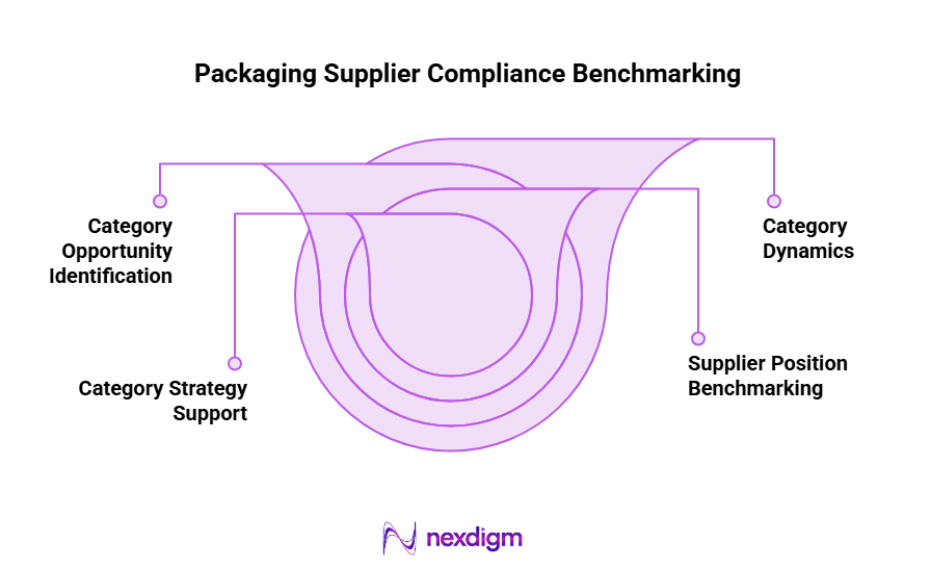
- Understand Category Dynamics: Examine material trends, supplier structures, market conditions, and cost drivers that influence packaging procurement.
- Benchmark Supplier Positions: Compare suppliers against relevant commercial, quality, sustainability, and delivery expectations to identify relative strengths and gaps.
- Identify Category Opportunities: Highlight areas where specification changes, supplier consolidation, alternative materials, or sourcing strategies could improve outcomes.
- Support Category Strategy: Use benchmarking insights to inform supplier segmentation, negotiation priorities, sourcing plans, and longer-term packaging strategies.
This category-level perspective helps retailers move from individual supplier comparisons to a broader understanding of how packaging procurement can become more competitive.
Benefits of Nexdigm’s Packaging Supplier Benchmarking
Nexdigm’s structured benchmarking approach can help retailers turn supplier comparisons into measurable procurement improvements. Major benefits offered from Nexdigm’s expertise are:
- Improved Cost Competitiveness: Identifying pricing gaps, cost drivers, and negotiation opportunities to strengthen commercial outcomes across packaging categories.
- Strengthened Supplier Performance: Highlight quality and delivery variations, helping retailers address recurring issues and improve supplier accountability.
- Advanced Sustainability Goals: Comparing supplier capabilities on recycled content, recyclability, material efficiency, and other relevant sustainability measures.
- Reduced Supply Exposure: Identifying capacity constraints, supplier concentration, and delivery vulnerabilities to support diversification and continuity planning.
- Better Sourcing Decisions: Provide a stronger evidence base for supplier selection, consolidation, negotiations, development, and alternative sourcing.
Overall, Nexdigm’s benchmarking approach helps retailers turn supplier-level insights into practical actions that improve cost, quality, sustainability, and supply resilience.
Nexdigm’s Case
Nexdigm’s benchmarking assessment identified 19% of packaging suppliers with cost competitiveness gaps, while 13% showed delivery-performance variations and 10% presented sustainability improvement opportunities. The review also found 9% of suppliers with quality-related performance gaps, enabling the retailer to prioritize supplier negotiations, performance improvement, sustainability initiatives, and sourcing alternatives across key packaging categories.
To take the next step, simply visit our Request a Consultation page and share your requirements with us.
Harsh Mittal
+91-8422857704