

Packaging protects products, supports transport and storage, communicates product information, and influences how customers experience a purchase. For retailers, the choice of packaging supplier can also affect damage rates, handling requirements, shelf presentation, delivery costs, and compliance obligations.
Selecting a supplier therefore requires a broader assessment than comparing the price of cartons, labels, flexible packaging, or other materials. Retailers need to evaluate performance across the packaging’s full operational use.
Match Packaging to Product and Distribution Needs
Packaging requirements differ according to product fragility, weight, dimensions, storage conditions, shelf life, and transport distance. Packaging designed for store display may not be suitable for parcel fulfilment, where products can face repeated handling and varied transport conditions.
Retailers should specify material composition, dimensions, print quality, closure requirements, protective performance, and expected volumes. Testing should establish whether packaging protects products adequately without adding unnecessary material, weight, or handling complexity.
Compare Cost Beyond the Unit Price
A low quotation can conceal higher costs from damaged products, inconsistent dimensions, printing defects, excess material, or poor delivery reliability. Retailers should compare total cost by accounting for material use, freight, storage, waste, rejection rates, and the operational consequences of supplier delays.
Sustainability also needs evidence. Claims about recycled content, recyclability, or material sourcing should be supported by appropriate documentation and assessed against the requirements of the intended market. The European Union’s Packaging and Packaging Waste Regulation establishes requirements covering packaging design, composition, reuse, recyclability, and waste prevention for packaging within its scope.
Evaluate Suppliers Against Real Operating Conditions
For packaging supplier evaluation and research retail, the central question is whether a supplier can deliver compliant packaging at an acceptable total cost and with consistent quality. A supplier’s performance should be assessed against actual production, transport, storage, and customer requirements.
Trials can reveal problems that quotations and specification sheets cannot. Retailers should evaluate samples under realistic packing and handling conditions, verify print and dimensional consistency, and assess how suppliers respond to defects or changes in demand.
A Framework for Retail Packaging Supplier Evaluation
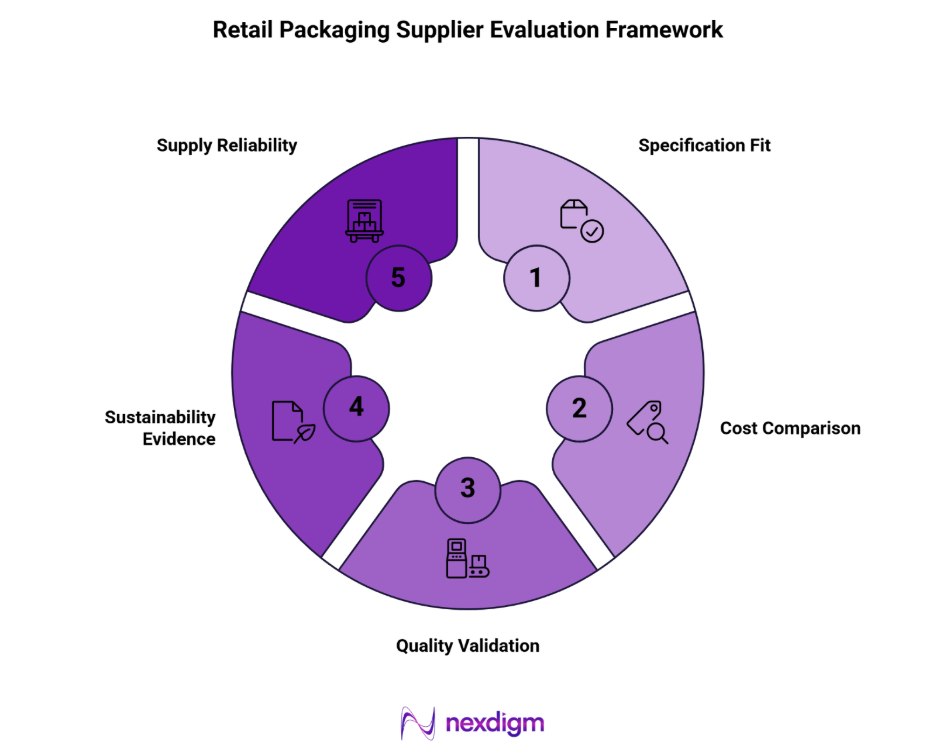
- Specification Fit: Verify material, dimensions, strength, print quality, product compatibility, and protection requirements for the intended product and distribution channel.
- Cost Comparison: Compare unit price, freight, storage, material usage, wastage, defect-related losses, and minimum order quantities to estimate total packaging cost.
- Quality Validation: Test samples under relevant packing, stacking, handling, and transport conditions, then assess defect rates, consistency between batches, and corrective-action processes.
- Sustainability Evidence: Examine documented material composition, recycled content where relevant, recyclability claims, and compliance with destination-market requirements instead of relying on broad environmental marketing statements.
- Supply Reliability: Assess production capacity, lead times, delivery performance, contingency arrangements, and flexibility during seasonal peaks to determine whether the supplier can maintain uninterrupted supply.
Select Suppliers for Long-Term Performance
Supplier selection should balance cost, product protection, environmental requirements, and continuity. A cheaper material may be unsuitable if it increases product damage, while a technically strong alternative may be uneconomic if it requires substantial changes to packing operations.
Retailers should document evaluation criteria, run trials for critical packaging categories, and review supplier performance periodically. This creates a basis for negotiating improvements and adapting specifications as products, regulations, and distribution models change.
Nexdigm’s Case Study
A retail business assessed six packaging suppliers for cartons used in ecommerce fulfilment. Sample testing and landed-cost analysis identified a supplier offering stronger protection with lower material use. A 10-week pilot recorded a reduction in transit-damage incidents from 4.0% to 2.8%, alongside a 3% reduction in packaging cost per shipment, subject to validation.
To take the next step, simply visit our Request a Consultation page and share your requirements with us.
Harsh Mittal
+91-8422857704