

For paints and coatings companies, expansion is rarely just a question of entering a new city or increasing distribution coverage. Growth may come from underserved geographic markets, specialised industrial applications, new customer channels or products that solve problems existing suppliers have not addressed effectively. Each opportunity has different requirements for sales coverage, technical support, manufacturing and working capital.
The challenge is to identify where unmet demand is commercially meaningful and where a company has a credible route to capture it. Expansion decisions should therefore connect market demand with channel economics, competitive positioning and the cost of serving customers.
Paints and Coatings Demand Is Not One Market
Decorative paints, automotive coatings, industrial finishes and protective coatings serve different buying processes. Decorative demand is influenced by housing activity, repainting cycles, consumer preferences and dealer availability. Automotive coatings depend on vehicle production, original equipment manufacturer relationships and technical qualification. Protective and industrial coatings are shaped by infrastructure, industrial maintenance, equipment manufacturing and project specifications.
This diversity creates opportunities, but it also makes broad market estimates insufficient. A region with strong housing growth may not be attractive for a company seeking specialist corrosion protection products. Likewise, a promising industrial cluster may require technical sales capabilities that the company does not currently possess.
Company reporting illustrates these differences. Asian Paints’ FY2024–25 annual report described a challenging domestic coatings environment, with demand and competitive pressure affecting industry performance. Kansai Nerolac’s FY2024–25 reporting noted muted decorative demand alongside growth in areas such as wood coatings, construction chemicals and industrial applications. The implication is not that one segment will always outperform another, but that expansion decisions require segment-level evidence.
Where New Demand and Competitive White Spaces May Exist
The most useful opportunities often sit where customer requirements are changing faster than existing supply. These can include specialised protective systems, coatings for emerging manufacturing applications, premium products with measurable performance benefits or regions where technical service and distribution remain limited.
Four areas deserve separate assessment:
- Decorative paints: Look for underserved districts, dealer gaps, repainting demand, premiumisation and opportunities to improve painter or contractor engagement.
- Automotive coatings: Examine vehicle production clusters, component suppliers, refinish demand, qualification requirements and relationships with original equipment manufacturers.
- Industrial coatings: Map demand from machinery, appliances, fabricated metal, manufacturing facilities and industrial maintenance.
- Protective coatings: Evaluate infrastructure projects, energy assets, marine environments and other applications where corrosion resistance, durability and maintenance costs influence purchasing decisions.
An apparent white space is not automatically an opportunity. It may exist because customers are unwilling to pay for the product, volumes are too small, technical qualification is difficult or an incumbent has an advantage that is hard to overcome.
Choosing the Right Expansion Geography and Sales Channel
Geographic selection should begin with customer concentration and the economics of service. Companies should map demand at a level that reflects how customers buy, whether by district, industrial cluster, dealer catchment or project location.
Channel strategy then determines how that demand can be reached. Decorative paints may require dealer coverage, painter engagement and reliable replenishment. Industrial and protective coatings may depend more heavily on direct technical selling, approved applicator networks, project relationships and after-sales support.
The evaluation should compare channel reach, sales productivity, inventory requirements, credit exposure and service costs. It should also identify whether existing distributors can support the proposed product range or whether specialised partners are necessary.
Assessing Expansion Economics Before Committing Resources
Revenue potential must be evaluated alongside the cost of winning and serving customers. New territories may require dealer incentives, additional sales personnel, local stock, technical demonstration facilities or extended credit terms. Industrial segments may require product testing, site visits and lengthy customer approval cycles before commercial volumes develop.
A focused assessment should answer three questions:
- Can the company reach enough qualified customers? Estimate addressable demand, likely conversion and achievable market share.
- Can it differentiate beyond price? Test whether product performance, service, availability or application expertise creates a defensible reason to switch.
- Can the opportunity generate acceptable returns? Model contribution margins after discounts, freight, channel costs, support and working capital.
A paints and coatings expansion entry consulting assessment can connect these questions to a practical rollout plan, helping management decide where to invest first, which channels to use and what capabilities must be added.
Turning Market Mapping into an Expansion Plan
Expansion should be sequenced rather than treated as a single nationwide commitment. A company can test a small number of territories or applications, track customer acquisition and repeat orders, then scale only when commercial assumptions hold.
Useful early indicators include qualified leads, trial-to-order conversion, time to customer approval, repeat purchase rates, contribution margin and channel productivity. These metrics help distinguish initial interest from durable demand.
Paints and Coatings Expansion Prioritisation Framework
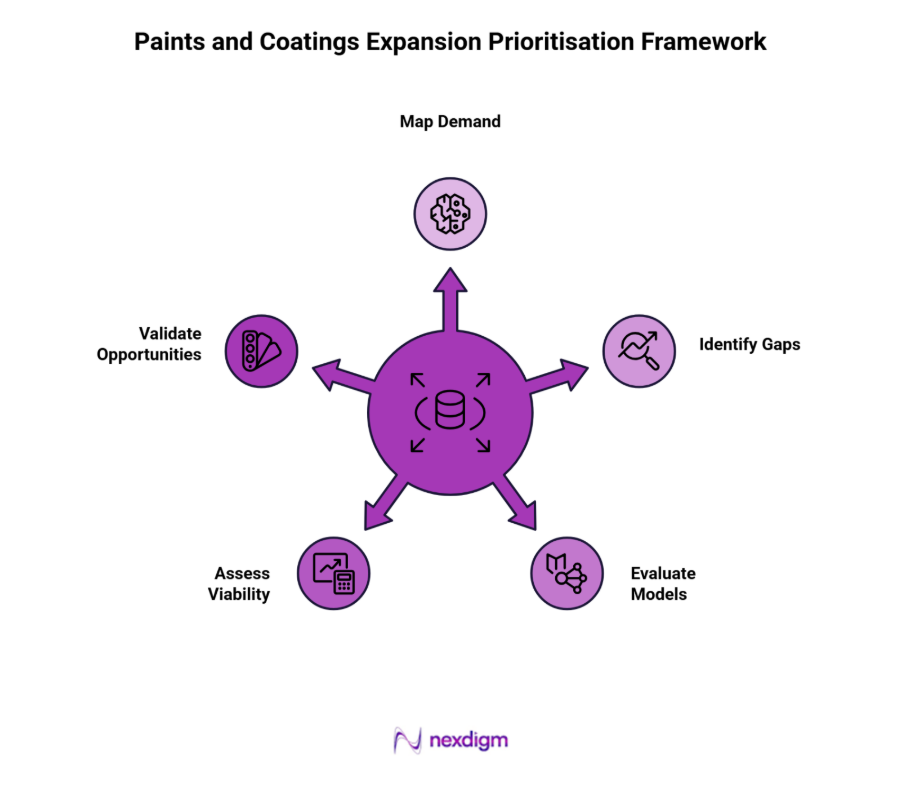
- Map Demand Across Geographies and Applications: Assess demand by region, end-use industry, application type and customer segment to identify markets with strong growth potential and attractive demand characteristics.
- Identify Underserved Segments and Market Gaps: Examine existing supply, competitor presence, product availability and customer requirements to understand where demand remains unmet and what is driving the gap.
- Evaluate Market Entry and Distribution Models: Compare direct sales, dealer networks, distributors and technical partnerships based on market reach, customer relationships, technical support requirements and control over the sales process.
- Assess Commercial Viability and Resource Requirements: Estimate customer acquisition costs, expected margins, distribution expenses, working capital requirements and after-sales support needs to determine the investment required for each market.
- Validate Opportunities Through Targeted Pilots: Test priority markets and applications through limited launches, distributor partnerships or focused sales programmes. Measure performance against defined thresholds for sales conversion, revenue, margins and repeat purchases before committing to wider expansion.
Nexdigm Case Study
A coatings manufacturer assessed six expansion opportunities across decorative and industrial applications. Demand mapping identified three territories with stronger customer density, while channel and margin analysis favoured two industrial clusters. A phased rollout focused on technical sales and distributor readiness before broader geographic expansion, reducing the risk of investing ahead of validated demand.
To take the next step, simply visit our Request a Consultation page and share your requirements with us.
Harsh Mittal
+91-8422857704