

A paint manufacturer entering India faces several markets within one industry. Decorative coatings depend on housing activity, repainting cycles, dealer reach and consumer preferences. Automotive coatings are tied to vehicle production and technical qualification. Protective coatings serve industrial assets where corrosion resistance, durability and compliance can matter more than the initial purchase price.
Treating these segments as one market can produce misleading demand estimates. Each has its own buyer, sales cycle, technical requirements and cost of entry.
Four Coatings Markets, Four Different Commercial Questions
- Decorative paints reach households through dealers, contractors and painting services. Demand depends on new housing, renovation, consumer spending, seasonality and brand availability. A new entrant needs to decide whether it can compete on price, distribution, product performance or a clearly defined niche.
- Industrial coatings serve factories, machinery, infrastructure components and equipment manufacturers. Buyers may require consistent performance, application support and product specifications matched to their operating environment. Relationships with original equipment manufacturers and industrial distributors can be central to market access.
- Automotive coatings require more demanding qualification processes. Products must meet appearance, durability, corrosion and process requirements, often within a vehicle manufacturer’s established production system. Approval timelines and technical service requirements can make this segment difficult to enter without relevant expertise or partnerships.
- Protective coatings are used on assets such as pipelines, storage tanks, bridges, industrial structures and marine equipment. Their value is linked to extending asset life, reducing maintenance and protecting against corrosion or chemical exposure. Project specifications, applicator networks and the cost of failure influence purchasing decisions.
Demand Signals: What Recent Industry Results Suggest
The FY2024–25 annual report of Kansai Nerolac described subdued demand across parts of the Indian paints industry, intensified pricing competition and weather-related disruption to decorative paint demand. It also reported healthy automotive coatings growth, while industrial coatings were supported by infrastructure-related activity and demand for high-performance protective coatings.
The contrast is useful. A softer decorative market does not necessarily mean that every coatings category is unattractive. Equally, growth in automotive coatings does not establish that a new supplier can win OEM approvals or achieve sufficient scale.
Asian Paints’ FY2024–25 reporting also described a challenging domestic coatings environment, reinforcing the need to test market conditions at segment and product level rather than rely on broad industry growth assumptions.
The Commercial Questions That Decide Entry
A manufacturer should resolve the following before selecting its target segment:
- Which buyers can be reached? Map dealers, contractors, OEMs, industrial buyers, applicators and project specifications.
- What performance is required? Identify durability, finish, corrosion resistance, application conditions and applicable standards.
- How much does access cost? Account for distribution, technical service, tinting systems, laboratory testing, trials and customer qualification.
- What drives repeat sales? Evaluate repainting cycles, maintenance schedules, recurring industrial demand and customer retention.
- Can margins survive competition? Model raw materials, pigments, resins, packaging, freight, rebates and capacity utilisation.
This is where paints and coatings feasibility study entry consulting can connect market evidence to the operating requirements of the chosen segment. The assessment should compare achievable selling prices with the costs of product development, customer qualification, distribution and ongoing technical support.
Paints and Coatings Market Entry Framework
The Paints and Coatings Market Entry Framework helps prioritise a segment and define the route to market.
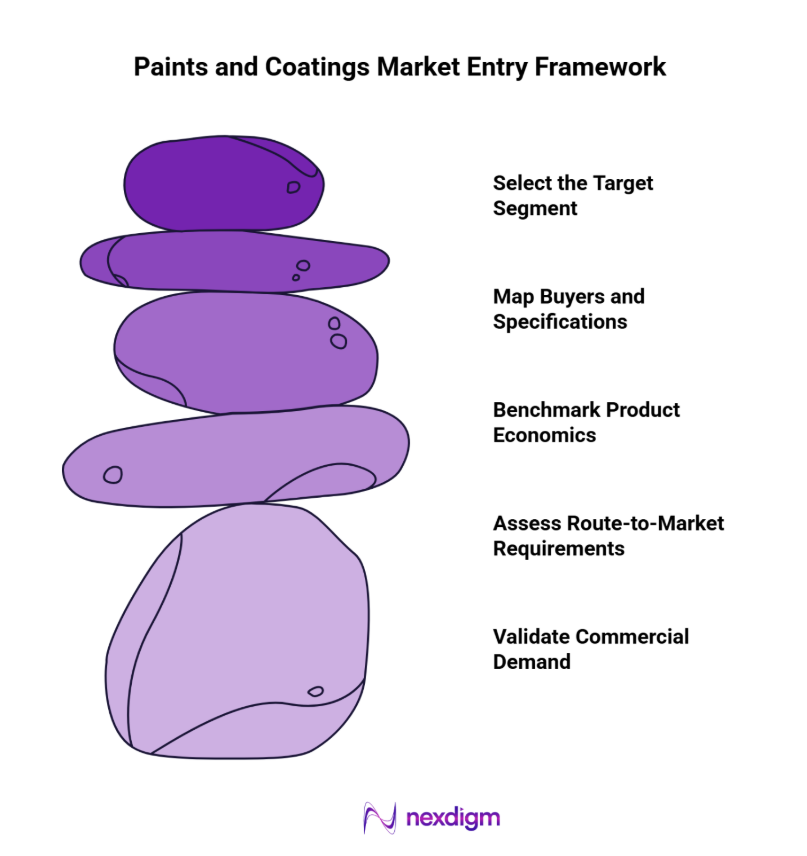
- Select the Target Segment: Compare decorative, industrial, automotive and protective coatings by demand and competitive intensity.
- Map Buyers and Specifications: Identify purchasing channels, qualification processes, performance standards and buying criteria.
- Benchmark Product Economics: Model raw materials, production costs, logistics, pricing and contribution margins.
- Assess Route-to-Market Requirements: Evaluate dealer coverage, OEM access, applicator partnerships and technical service capacity.
- Validate Commercial Demand: Test customer interest, trial requirements, repeat purchase potential and realistic sales volumes.
Nexdigm Case Study
Nexdigm compared four coatings segments for a prospective entrant, reviewing demand drivers, qualification barriers, channel costs and margin potential. Industrial and protective coatings advanced to customer validation, while decorative paints required a stronger distribution proposition. The client prioritised two product lines for technical trials before committing to broader capacity expansion.
To take the next step, simply visit our Request a Consultation page and share your requirements with us.
Harsh Mittal
+91-8422857704