

The global coatings market is growing, but its most important shifts are happening beneath the headline market size. Construction remains the largest demand base, automotive is being reshaped by electric vehicles and new materials, industrial users are moving toward lower-emission technologies, and protective coatings are benefiting from investment in infrastructure and asset life extension.
Nexdigm estimates the global coatings market at $82.8 billion in 2025 and $87.3 billion in 2026, with a projected CAGR of 6.1% through 2033. Asia Pacific represented 46.1% of global revenue in 2025.
The commercial question is therefore not whether coatings demand is growing. It is which applications are generating the most attractive incremental demand.
Construction remains the volume anchor
Architectural and construction coatings continue to represent a substantial share of global consumption. Demand is linked to residential and commercial construction, renovation, infrastructure investment and urbanization.
Slower construction activity in some mature markets is being offset by infrastructure and residential development in parts of Asia, the Middle East and other emerging markets. At the same time, energy-efficiency requirements are increasing demand for products designed around durability, insulation and building performance.
The uploaded market research identifies waterborne acrylics, cool-roof systems and direct-to-metal finishes among relevant technology directions.
This means construction opportunity should be segmented by application rather than treated as a single architectural coatings market.
Automotive is creating new technical requirements
Nexdigm estimates the global automotive coatings market at $27.0 billion in 2026, rising to $38.3 billion by 2033 at a 5.1% CAGR. Asia Pacific accounted for 49.2% of revenue in 2025.
Vehicle production remains an important demand driver, but the transition toward electric vehicles is changing coating requirements.
Battery systems can require dielectric insulation, thermal management and fire-protection solutions. Lightweight materials and composites can also require different adhesion, curing and surface-protection characteristics.
This creates opportunities for coatings suppliers that can solve a specific technical requirement rather than simply supply another standard finish.
Industrial coatings are being pushed by regulation and efficiency
Industrial manufacturing represents another important demand pool across machinery, appliances, coil, wood, metal and other applications.
The direction of technology is increasingly toward lower-emission and higher-efficiency systems. Powder coatings, UV-cured systems and other high-solids technologies can reduce reliance on solvent-intensive processes.
The global powder coatings market is estimated at $12.2 billion in 2026 and projected to reach $18.5 billion by 2033, representing a 6.2% CAGR. Asia Pacific held 38.2% of the market in 2025.
However, adoption depends on equipment compatibility, curing requirements, finish quality and total process economics.
A technology can have regulatory momentum without automatically becoming the preferred solution.
Protective Coatings Are Tied To Infrastructure Investment
Protective coatings have a particularly interesting commercial profile because demand is linked to the value and lifespan of the assets being protected.
Nexdigm estimates the global protective coatings market at $15.7 billion in 2026, growing to $24.2 billion by 2033 at a 6.3% CAGR. Construction, oil and gas, power generation, marine, mining and industrial assets are among the major applications. Asia Pacific represented 79% of revenue in 2025.
The supplied research identifies energy infrastructure, offshore wind, LNG facilities, pipelines and desalination as important application areas for high-performance protective systems.
These applications can support higher-value products because failure carries significant economic consequences.
Mapping demand by application rather than market size
A structured paints and coatings market assessment services approach should connect four layers.
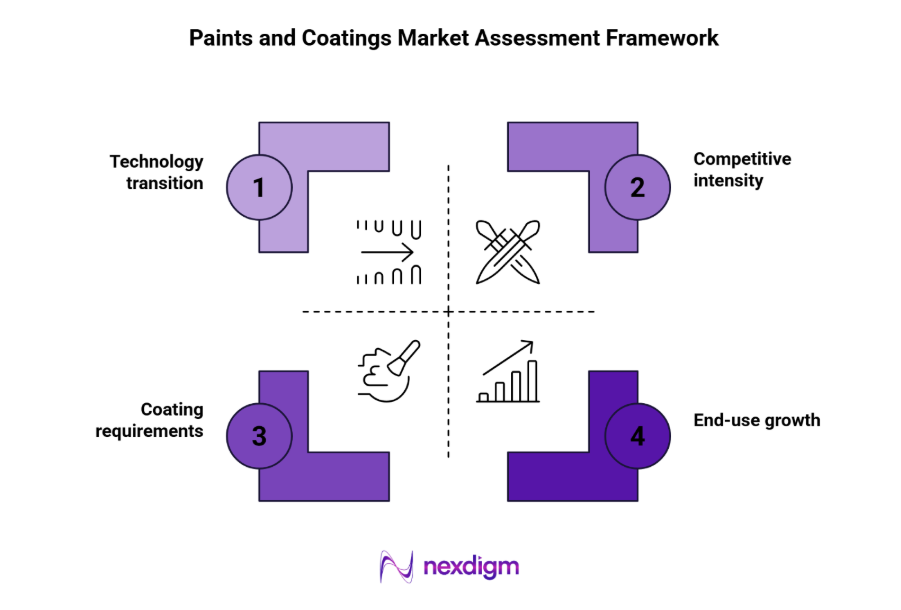
- End-use growth
Measure construction activity, vehicle production, industrial output, infrastructure investment and asset maintenance by geography. - Coating requirements
Identify the technical specifications associated with each application, including corrosion resistance, thermal performance, chemical resistance, curing temperature, durability and finish. - Technology transition
Track movement between solvent borne, waterborne, powder, UV-cured and high-solids systems. Regulatory requirements can accelerate substitution, but the technology must also meet production requirements. - Competitive intensity
Map major suppliers, regional producers, formulation capabilities, distribution networks and customer qualification requirements.
This framework prevents a common market-assessment error: treating a large end-use market as automatically attractive for every coating supplier.
Where Value Is Shifting
The strongest growth opportunities may increasingly sit in applications where coatings perform a functional role beyond appearance.
Automotive electrification is creating new requirements around insulation and thermal protection. Industrial decarbonization is encouraging lower-emission coating technologies. Infrastructure expansion is increasing demand for corrosion protection. Construction is generating demand for durable and energy-efficient systems.
The market is therefore becoming more application specific.
A coating supplier evaluating expansion should determine not only where volumes are growing, but where technical requirements are becoming more complex, customer switching is justified by measurable performance and competitive supply remains limited.
Regional Demand Requires Different Strategies
Asia Pacific combines large construction, manufacturing and automotive markets with expanding industrial capacity. The region’s dominance across overall coatings and automotive coatings makes it central to future volume growth.
Mature markets can offer a different opportunity through replacement demand, infrastructure refurbishment, regulatory-driven technology transition and high-performance applications.
This creates a portfolio question, a company may pursue volume growth through architectural coatings in one market while building margin through protective, automotive or industrial specialties in another.
Nexdigm Case: Coatings Demand Mapping
A coatings producer with $310M revenue assessed 6 applications across 8 countries. Nexdigm benchmarked 52 competitors and 21 end-use indicators, identifying protective and automotive specialty coatings as priority segments with a combined $640M addressable market.
To take the next step, simply visit our Request a Consultation page and share your requirements with us.
Harsh Mittal
+91-8422857704