

Coatings demand is spread across construction, automotive, industrial equipment, infrastructure, marine and other applications, but their growth profiles are increasingly different. The global paints and coatings market was valued at $226.9 billion in 2025 and is projected to reach $306.1 billion by 2034, representing a 4.5% CAGR. Asia Pacific accounted for 46.8% of global revenue in 2025, making the region central to future volume expansion.
For a coating’s producer, however, overall market growth says little about where the most attractive opportunities actually sit. An application needs to offer sufficient demand, technical differentiation, and pricing potential to justify investment.
Growth Is Uneven Across Coating Applications
Architectural coatings remain the largest demand pool, supported by construction, renovation and repainting. Industrial and protective applications offer a different proposition, with demand linked more closely to manufacturing capacity, infrastructure investment, asset maintenance and corrosion protection.
The distinction becomes clearer when individual markets are examined.
The global protective coatings market was valued at $17.19 billion in 2025 and is projected to reach $32.41 billion by 2034, representing a 7.3% CAGR. Asia Pacific held approximately 46% of protective-coatings revenue in 2025.
India provides another indication of where growth is forming. Its paints and coatings market was valued at approximately $13.6 billion in 2025 and is projected to reach $18.4 billion by 2030 at a 6.24% CAGR. Within the market, industrial coatings are forecast to grow at 6.78% annually, compared with 5.84% for architectural coatings.
Different applications consequently create different commercial propositions:
- Architectural coatings: Driven by housing, construction, repainting and consumer spending.
- Automotive coatings: Linked to vehicle production, refinishing, and changes in vehicle manufacturing.
- Industrial coatings: Supported by manufacturing expansion, equipment production and asset maintenance.
- Protective coatings: Benefiting from infrastructure, energy, marine, mining and corrosion-control requirements.
- Advanced coatings: Addressing applications where performance, regulatory compliance, or process efficiency creates scope for premium pricing.
The application with the highest growth rate is therefore not automatically the best target. Qualification periods, customer concentration, technical requirements, and competitive intensity can significantly change the economics.
Technology Is Creating New Application Pockets
Technology migration is also changing where coatings demand is forming. Globally, waterborne coatings accounted for 40.9% of paints and coatings revenue in 2025, while powder coatings are projected to be the fastest-growing product category through 2033, with a 6.1% CAGR.
India shows a similar shift.
Waterborne coatings represented 45.41% of the Indian market in 2025 and are forecast to grow at 9.72% annually through 2031. Architectural applications remained dominant, accounting for 77.12% of market revenue, but industrial applications are expanding faster.
This creates opportunities where technology change intersects with end-use demand:
- Lower-VOC systems for regulated applications
- Powder coatings for efficient industrial finishing
- High-solids systems that reduce application volume
- Protective formulations designed for longer asset life
- Waterborne technologies that meet environmental requirements without sacrificing performance
For producers, the commercial opportunity can therefore emerge from a change in formulation technology as much as from growth in the underlying application.
Where Does the Strongest Opportunity Sit?
A paints and coatings opportunity market assessment should compare applications on both market potential and the conditions required to capture it.
For example, architectural coatings offer considerable volume, but the segment can be highly competitive and distribution intensive. A smaller protective-coatings application may offer better economics when customers face substantial costs from corrosion, downtime or premature asset replacement.
The assessment should examine:
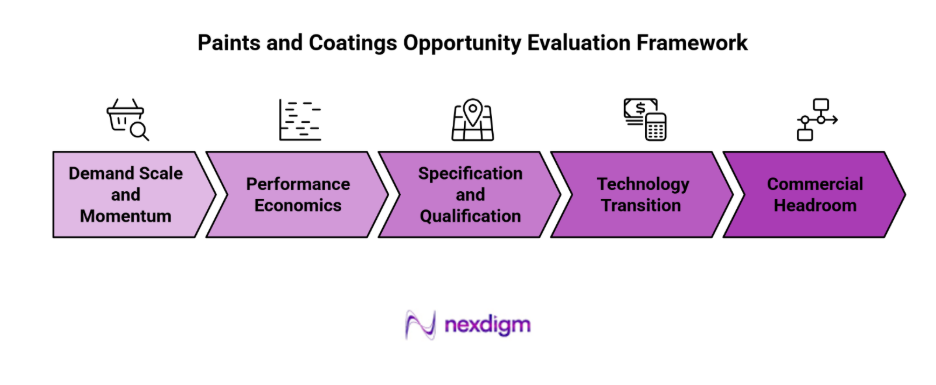
- Demand Scale and Momentum
Measure market size, application volumes, historical growth and the industries driving future consumption. Regional differences should be retained rather than relying solely on global averages. - Performance Economics
Determine how much the coating contributes to asset life, production efficiency, corrosion prevention, appearance or maintenance costs. Applications with measurable consequences from coating failure can support stronger value propositions. - Specification and Qualification
Identify who controls product selection and how difficult it is to replace an incumbent formulation. OEM approval, engineering specifications, testing requirements, and contractor preferences can create substantial barriers to entry. - Technology Transition
Track adoption of waterborne, powder, high-solids, UV-cure, and other technologies. Regulatory requirements can accelerate substitution, while improvements in formulation performance can open applications previously dominated by conventional systems. - Commercial Headroom
Compare achievable pricing with raw material exposure, formulation costs, qualification investment and competitive intensity. This determines whether application growth can actually translate into attractive returns.
From Application Growth to Investment Priorities
Nexdigm combines market sizing, end-use analysis, customer research, competitor intelligence and technology assessment to rank coating applications by commercial attractiveness.
The resulting analysis can identify where demand growth is strongest, which applications offer technical or pricing headroom, and where entry barriers are manageable. This allows producers to distinguish between markets that are simply large and those where additional capacity, product development, or market entry can generate a defensible return.
Nexdigm Case: Coating Application Prioritisation
A coatings manufacturer evaluated 16 applications across 4 end markets. Nexdigm assessed demand growth, 52 customer requirements, qualification barriers and competitor pricing, identifying 5 priority applications with estimated annual revenue potential of $86 million.
To take the next step, simply visit our Request a Consultation page and share your requirements with us.
Harsh Mittal
+91-8422857704