

Pallets are a fundamental component of logistics and warehousing operations. They support the storage, handling and transportation of goods across manufacturing facilities, distribution centres, retail networks and industrial supply chains. Although often treated as standard warehouse consumables, pallets influence loading efficiency, storage utilisation, product protection and compatibility with material handling equipment.
For procurement teams, identifying suitable pallet suppliers requires an understanding of material options, manufacturing capacity, product specifications, geographical coverage and lifecycle costs. A supplier that meets the requirements of one industry may not necessarily offer the same suitability for another.
Understanding the Pallet Supplier Landscape
The pallet market includes manufacturers offering wooden, plastic, metal and composite products. Each category serves different operational requirements.
- Wooden pallet manufacturers supply conventional pallets used across manufacturing, export logistics, agriculture and general warehousing. They offer flexibility in dimensions and load configurations, although quality, moisture exposure and treatment requirements need to be assessed.
- Plastic pallet manufacturers provide reusable products commonly used in food processing, pharmaceuticals, retail distribution and environments requiring consistent hygiene standards. Their resistance to moisture and ease of cleaning can make them suitable for repeated handling cycles.
- Metal pallet suppliers generally serve industrial applications involving heavy loads, specialised equipment or demanding operating conditions. Their durability can be valuable in closed-loop material handling systems.
- Composite pallet manufacturers offer products made from engineered materials and recycled inputs. Their suitability depends on load requirements, handling conditions and the intended reuse cycle.
The supplier landscape should also include pallet pooling and rental operators. These providers allow businesses to access reusable pallet networks without purchasing and managing every unit themselves.
What Should Procurement Teams Compare?
Pallet selection begins with understanding the products being transported and the conditions in which the pallets will be used.
Load capacity is a primary consideration. Suppliers should specify safe working loads under static, dynamic and racking conditions, since these values can differ considerably. Dimensions must also match warehouse racking, forklift configurations, conveyors and transportation containers.
Material selection is equally important. Wooden pallets may require compliance with ISPM 15 when used in international trade. Plastic pallets may offer advantages in washdown environments, while metal alternatives can be appropriate for demanding industrial applications.
Procurement teams should also evaluate manufacturing consistency, repairability, availability of replacement units and quality inspection procedures.
Comparing Supplier Scale, Availability and Commercial Models
A supplier’s production capacity should be assessed against the buyer’s geographical footprint and expected procurement volumes. Organisations operating across several distribution centres may require suppliers capable of maintaining consistent specifications across locations.
Commercial models can vary considerably. Direct purchases involve upfront capital expenditure and ongoing pallet management. Rental and pooling arrangements can reduce ownership responsibilities but introduce recurring charges and dependence on network availability.
The comparison should account for unit prices, transportation costs, replacement rates, repair expenses, retrieval charges and expected service life.
Sustainability is another relevant consideration. Reusable pallets may reduce repeated procurement, but the environmental value depends on their durability, transport distances, repair requirements and eventual disposal.
Pallet Supplier Evaluation Framework
A structured pallet supplier landscape research exercise should cover six areas:
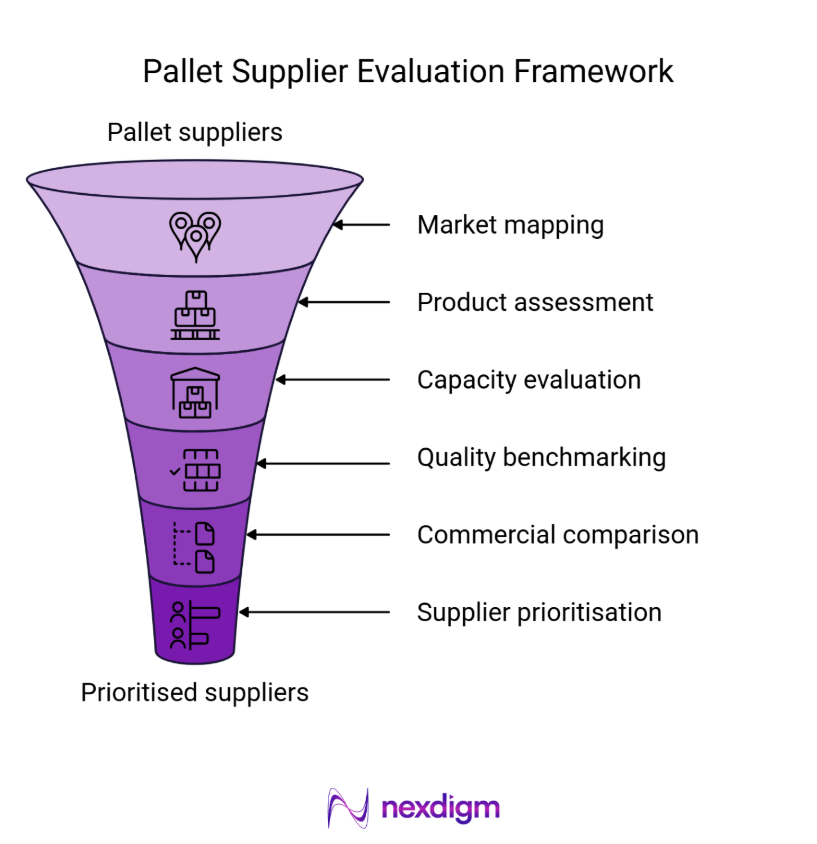
- Market mapping: Identify wooden, plastic, metal and composite pallet manufacturers, alongside pooling providers.
- Product assessment: Compare dimensions, material quality, load ratings and equipment compatibility.
- Capacity evaluation: Examine production volumes, regional availability and delivery lead times.
- Quality benchmarking: Review inspection procedures, repairability and consistency across production batches.
- Commercial comparison: Assess purchase prices, rental charges, transportation and lifecycle expenses.
- Supplier prioritisation: Rank providers based on operational suitability, reliability, geographical reach and total cost.
Nexdigm can support organisations through pallet market research, supplier mapping, product benchmarking and procurement intelligence. These assessments help businesses identify suitable suppliers across material categories and evaluate commercial models according to their warehousing and distribution requirements.
Nexdigm’s Case Study: Optimising Pallet Procurement Across Facilities
Nexdigm assessed 14 pallet suppliers across 3 material categories and 5 operating regions. The research shortlisted 4 providers, identified a 16% variation in comparable procurement costs and established 6 benchmarks covering load capacity, durability, availability and lifecycle expenses.
To take the next step, simply visit our Request a Consultation page and share your requirements with us.
Harsh Mittal
+91-8422857704