
Parcel delivery is expanding as e-commerce, SME shipping, marketplace activity, and changing consumer expectations reshape logistics networks. Pitney Bowes reported 23.1 billion U.S. parcel shipments in 2025, up 3.3% year over year, with volumes projected to reach 31 billion by 2031.
The growth extends beyond consumer purchases. SMEs are increasingly using digital channels to reach customers, marketplaces are widening seller participation, and businesses are shipping smaller orders more frequently.
For them, the challenge is understanding where parcel volumes are growing, what is driving that growth, and whether existing networks can support future demand. A Parcel delivery market assessment helps connect these market forces.
Nexdigm combines shipment growth, e-commerce activity, SME shipping, consumer preferences, returns, carrier capacity, infrastructure, and geographic demand to identify commercially relevant parcel opportunities.
The Parcel Market Is Becoming More Complex
Parcel growth is no longer driven by large retailers. SMEs, direct-to-consumer brands, marketplace sellers, subscription businesses, and individual online shoppers are contributing to increasingly fragmented shipment flows.
At the same time, customers expect affordable shipping, reliable tracking, flexible delivery options, and faster fulfillment. This creates a more demanding operating environment for parcel carriers.
Nexdigm approaches this shift by connecting market demand with the operational and infrastructure changes required to serve it.
Where the Growth Is Coming From
Several forces are reshaping parcel volumes. Growing online transactions, wider market access, and evolving customer expectations are creating sustained demand for parcel, fulfillment, and last-mile logistics infrastructure.
- E-commerce expansion continues to increase consumer shipments and create demand for fulfillment and last-mile capacity.
- SME digital adoption allows smaller businesses to reach customers beyond traditional geographic markets, increasing shipment frequency.
- Consumer expectations are pushing businesses toward faster, more flexible, and more visible delivery services.
These drivers interact differently across markets, making Nexdigm’s assessment increasingly important.
Nexdigm’s Parcel Delivery Market Assessment Framework
Nexdigm’s Parcel delivery market assessment helps organizations understand demand trends, customer expectations, network readiness, and infrastructure requirements needed to support sustainable parcel delivery growth. This takes place through:
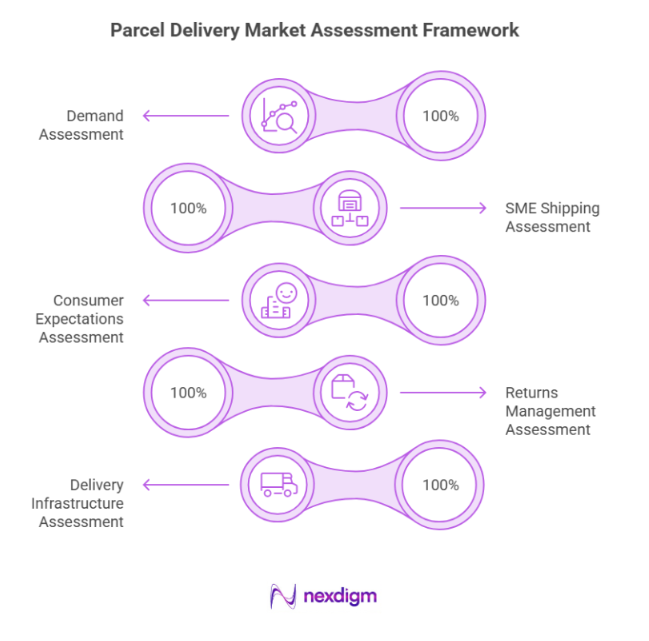
- Demand Assessment: Assessment of parcel volume growth drivers by evaluating e-commerce adoption, shipment frequency, geographic expansion, and seasonal demand fluctuations. The analysis helps identify markets with strong and sustained requirements for parcel delivery services.
- SME Shipping Assessment: Evaluation of the contribution of small and medium-sized enterprises to parcel demand. The assessment focuses on digital adoption, shipment characteristics, shipping cost sensitivity, and business growth trends that influence parcel delivery opportunities.
- Consumer Expectations Assessment: Reviewing customer preferences related to delivery speed, affordability, convenience, and service flexibility. The assessment helps determine how evolving consumer expectations may impact delivery networks and service offerings.
- Returns Management Assessment: Assessment of the scale and complexity of reverse logistics operations by evaluating return volumes, customer return expectations, and the effectiveness of existing return processing networks. The analysis highlights the role of returns in overall parcel ecosystem performance.
- Delivery Infrastructure Assessment: Evaluation of the operational capabilities required to support parcel growth, including delivery stations, fleet capacity, route efficiency, and last-mile delivery infrastructure. The assessment determines whether existing networks can support future demand.
Strategic Outcomes of Nexdigm’s Assessment
The Parcel Delivery Market Assessment enables Nexdigm to translate market analysis into actionable strategic insights. By evaluating demand trends, customer expectations, SME participation, returns networks, and delivery infrastructure, the assessment highlights the key areas such as:
- Market Growth Opportunities: Identifies high-potential markets, customer segments, and geographic regions where increasing parcel volumes can support network expansion and revenue growth.
- Customer-Centric Service Enhancement: Highlights evolving customer expectations related to delivery speed, convenience, flexibility, and affordability to support service differentiation and customer retention.
- SME Market Development: Identifies opportunities to strengthen engagement with SMEs by offering scalable, cost-effective, and flexible parcel delivery solutions tailored to business needs.
- Returns Optimization: Evaluates reverse logistics requirements to improve return processing efficiency, reduce operational complexity, and enhance the overall customer experience.
How Nexdigm’s Market Assessment Helps Businesses
Nexdigm’s Parcel delivery market assessment can support different decisions across the logistics ecosystem. Carriers can identify markets requiring additional delivery capacity or sorting infrastructure.
- Retailers and e-commerce businesses can evaluate fulfillment locations, shipping models, and carrier strategies. SMEs can identify delivery solutions that balance cost and service requirements.
- Investors and developers can assess markets where parcel growth may support new logistics assets.
- Technology providers can identify demand for routing, tracking, fulfillment, and delivery-management solutions.
Nexdigm’s Case
A parcel operator used Nexdigm’s Parcel delivery market assessment to identify growth zones and capacity gaps. Within 11 months, parcel processing capacity increased 26%, delivery productivity improved 21%, average transit time declined 17%, and network utilization increased, supporting stronger service performance and scalable market expansion.
To take the next step, simply visit our Request a Consultation page and share your requirements with us.
Harsh Mittal
+91-8422857704