

Healthcare is becoming one of the largest growth areas for investors such as changing demographics, rising chronic diseases, and increasing demand for medical services to reshape the industry. The WHO estimates that by 2030, one in six people globally will be aged 60 years or older, creating higher demand for specialty care, chronic disease management, and long-term healthcare services.
For investors, understanding where healthcare demand is increasing is critical. Expanding a hospital, launching a specialty clinic, or investing in healthcare technology requires clear visibility into future patient volumes. This is where Patient demand analysis helps organizations understand healthcare needs, identify market opportunities, and make better investment decisions.
Nexdigm helps healthcare organizations use analytics to study patient trends, population changes, and healthcare utilization patterns, supporting smarter planning for growth, expansion, and resource allocation.
Understanding Healthcare Demand
Healthcare investments depend heavily on understanding the relationship between population needs and service demand. A growing population does not always mean equal demand across all healthcare segments.
Investors need to evaluate several patterns before committing resources. Patient volume forecasts can provide insights into whether a location has enough demand to support a new healthcare facility, specialty service, or digital health solution.
Nexdigm enables organizations to analyze these demand signals by combining demographic information, healthcare usage trends, and operational data.
Nexdigm’s Role in Patient Demand Analysis
Healthcare organizations generate large amounts of data through patient records, appointments, referrals, and service utilization. However, this data becomes valuable only when it helps answer important business questions. Nexdigm’s healthcare analytics approach helps organizations identify:
- Areas with growing healthcare demand
- Services likely to experience higher patient volumes
- Regions with healthcare access gaps
- Opportunities for expansion and improvement
For investors, these insights can support market evaluation and reduce uncertainty.
Nexdigm in Supporting Business Decisions
Patient-volume forecasting can inform several strategic decisions. By estimating future healthcare demand, organizations can align resources, infrastructure, and investments with market needs. It also helps reduce investment risk by identifying opportunities where demand is expected to outpace existing healthcare capacity
- Hospital Capacity: Estimate requirements for beds, operating theatres, ICUs, consultation rooms, and medical equipment.
- Specialty Planning: Determine demand across cardiology, oncology, orthopedics, women’s health, pediatrics, and other specialties.
- Location Strategy: Identify geographies with high unmet demand or insufficient healthcare infrastructure.
- Diagnostics Planning: Forecast test volumes and assess requirements for laboratories and imaging centres.
- Workforce Planning: Estimate requirements for physicians, nurses, technicians, and support staff.
- Investment Decisions: Evaluate whether expected patient volumes can support expansion, new facilities, or service-line investments.
Nexdigm’s Patient Demand Forecasting Framework
Nexdigm uses Patient demand analysis to connect population-level healthcare needs with realistic patient-volume forecasts and business opportunities.
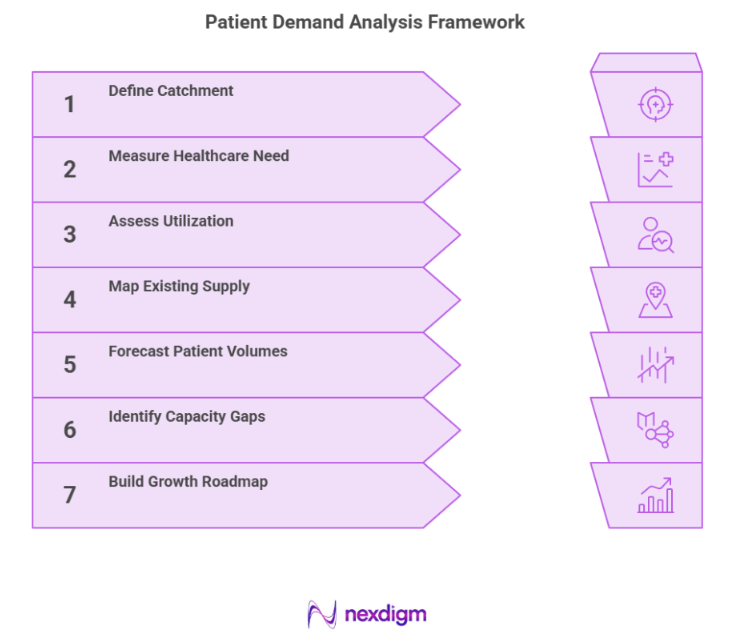
- Step 1 | Define the Catchment: Identify the geographic market, population base, demographics, accessibility, and relevant customer segments.
- Step 2 | Measure Healthcare Need: Assess disease prevalence, age-related requirements, epidemiological trends, and healthcare needs across the target population.
- Step 3 | Assess Utilization: Evaluate treatment-seeking behaviour, affordability, insurance, referral pathways, provider preferences, and current healthcare utilization.
- Step 4 | Map Existing Supply: Analyze hospitals, clinics, diagnostic centers, specialties, beds, equipment, service capacity, and competing providers.
- Step 5 | Forecast Patient Volumes: Translate addressable demand into consultations, admissions, procedures, diagnostic tests, or other relevant service volumes under different scenarios.
- Step 6 | Identify Capacity & Market Gaps: Compare projected demand with existing healthcare supply to identify underserved geographies, specialties, and patient groups.
- Step 7 | Build the Growth Roadmap: Prioritize locations, specialties, capacity additions, partnerships, and investments based on expected demand and commercial feasibility.
Through Patient demand analysis, Nexdigm enables data-driven decisions on capacity planning, market expansion, specialty development, and investments, helping clients align growth strategies with future healthcare demand.
Nexdigm’s Case
Nexdigm evaluated 12 target locations for a healthcare services company, assessing patient demand, affordability, competition, and access gaps. The analysis identified six priority launch markets and 20 potential provider partners, with the recommended expansion strategy projecting an 18% improvement in patient reach within the first year.
To take the next step, simply visit our Request a Consultation page and share your requirements with us.
Harsh Mittal
+91-8422857704