

Patient journey analysis examines how individuals move across healthcare touchpoints from symptom onset to diagnosis, treatment, and follow-up revealing where delays and inefficiencies occur. In a competitive intelligence context, it provides actionable insights into how providers perform on access, coordination, and experience.
By analyzing patient journey analysis data, organizations can benchmark competitors, identify friction points impacting outcomes, and refine strategies to improve timeliness, differentiation, and overall quality of care delivery.
Patient journey analysis shows measurable impact of delays across care pathways. Studies indicate diagnostic delays affect nearly 20–25% of clinical outcomes, particularly in chronic and acute conditions. Around 30% of patients experience delays between primary consultation and specialist referral, while treatment initiation delays can extend by 2–4 weeks in emerging markets.
Additionally, nearly 40% of patients report fragmented care across touchpoints, highlighting coordination gaps that directly influence outcomes, patient satisfaction, and overall healthcare system efficiency.
Competitive Intelligence in Patient Journey Mapping
Competitive intelligence in patient journey mapping analyzes how competitors manage care touchpoints, identify delays, and optimize experiences, enabling organizations to benchmark performance, reduce inefficiencies, and improve patient outcomes:
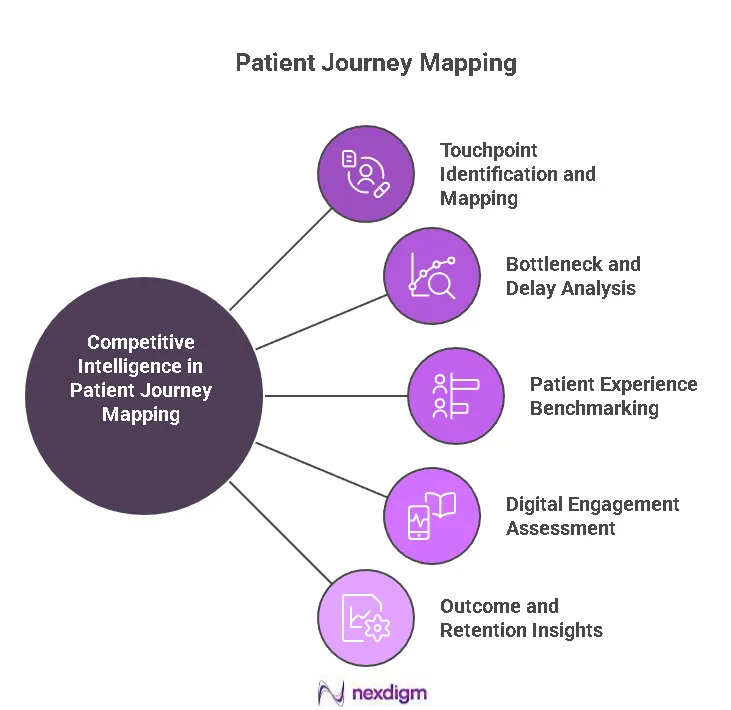
- Touchpoint Identification and Mapping: Analyze key patient interactions across diagnosis, treatment, and follow-up to understand competitor pathways and identify experience gaps.
- Bottleneck and Delay Analysis: Evaluate where delays occur in competitor journeys, including referrals, diagnostics, and treatment initiation impacting overall outcomes and efficiency.
- Patient Experience Benchmarking: Compare satisfaction, wait times, and engagement levels across competitors to identify differentiation opportunities and improve service delivery.
- Digital Engagement Assessment: Assess competitor use of apps, telehealth, and portals to streamline journeys and enhance patient interaction across touchpoints.
- Outcome and Retention Insights: Link journey efficiency to clinical outcomes and retention rates, enabling data-driven strategies to improve patient loyalty and care quality.
Nexdigm Patient Retention and Engagement strategy
Nexdigm Patient Retention and Engagement Strategy focuses on improving continuity of care by enhancing patient interactions across touchpoints. It leverages data analytics, personalized communication, and digital tools to strengthen engagement, reduce drop-offs, and improve adherence to treatment plans. By benchmarking patient journey performance and identifying friction points, the approach enables healthcare providers to build trust, increase loyalty, and drive better clinical outcomes while optimizing operational efficiency.
Nexdigm Healthcare Journey Risk Management Solutions
Nexdigm Healthcare Journey Risk Management Solutions identify and mitigate delays, drop-offs, and inefficiencies across patient touchpoints using data analytics, predictive insights, and process controls to improve outcomes and care continuity.
- Risk Identification Across Touchpoints: Analyze patient journey stages to detect delays, drop-offs, and operational risks impacting timely care delivery and overall clinical outcomes.
- Predictive Risk Analytics: Use advanced analytics to forecast high-risk cases, enabling proactive interventions and reducing potential disruptions in patient care pathways.
- Process Control and Monitoring: Implement real-time tracking systems to monitor patient flow, ensuring adherence to timelines and minimizing inefficiencies across healthcare operations.
- Mitigation and Intervention Strategies: Design targeted actions to address identified risks, improving coordination, reducing delays, and enhancing patient experience across touchpoints.
- Performance Tracking and Continuous Improvement: Measure key metrics, refine processes, and ensure sustained optimization of patient journeys for better outcomes and operational efficiency.
Nexdigm’s case:
A Nexdigm project aimed at improving the patient journey through care network, it was discovered that delays in diagnosis and treatment were significantly affecting patient outcomes. Analysis revealed that nearly 35–40% of patients experienced delays at critical touchpoints such as specialist referrals and diagnostics, aligning with studies showing patient delays can affect prognosis and quality of life. By implementing real-time tracking and predictive analytics, the project reduced diagnostic turnaround time by 25% and improved treatment initiation speed by 18%, enhancing overall patient outcomes and care continuity.
To take the next step, simply visit our Request a Consultation page and share your requirements with us.
Harsh Mittal
+91-8422857704