

Patient monitoring devices are essential to clinical operations across intensive care units, emergency departments, operating theatres, general wards and outpatient facilities. Their role extends beyond displaying vital signs. Modern systems capture physiological data, generate alerts, connect with hospital information systems and support continuous observation of patients whose conditions require regular assessment.
A device suitable for a general ward may not meet the monitoring requirements of an intensive care unit. Similarly, a technically capable monitor may create integration challenges if it cannot communicate effectively with the hospital’s existing infrastructure.
Understanding the Patient Monitoring Device Categories
Patient monitoring covers several device types; each designed for particular clinical applications.
- Multiparameter patient monitors: Measure combinations of ECG, heart rate, oxygen saturation, non-invasive blood pressure, respiration and temperature. Their configuration should match the patient population and care environment.
- Portable and transport monitors: Support patient observation during transfers, emergency response and movement between departments. Battery performance, durability and portability become important.
- Central monitoring systems: Aggregate data from multiple bedside monitors and allow clinical staff to observe patients across a unit.
- Specialised monitors: Include devices designed for neonatal, maternal, anaesthesia and other specific applications, with different measurement and alarm requirements.
- Remote monitoring solutions: Enable physiological data to be collected outside conventional bedside settings, depending on the clinical use case and system design.
The categories are not interchangeable. Procurement specifications should reflect the monitoring parameters, patient population, operating environment and intended clinical workflow.
Comparing Accuracy, Technology and Clinical Suitability
Measurement accuracy is a fundamental supplier comparison criterion. Buyers should examine the performance specifications for each parameter rather than relying on a general claim of device accuracy. ECG signal quality, blood pressure measurement performance, pulse oximetry specifications and alarm behaviour should be evaluated against the intended application and relevant standards.
Other technical considerations include:
- Measurement range and supported physiological parameters.
- Signal quality and performance under movement or challenging conditions.
- Alarm configuration, prioritisation and escalation functions.
- Display readability and usability in different clinical environments.
- Sensor compatibility and availability of consumables.
- Calibration, maintenance and technical support requirements.
Clinical suitability also depends on patient categories. Neonatal monitoring, for example, requires different sensor configurations and measurement considerations from adult monitoring. A supplier’s product portfolio should therefore be assessed by application rather than by the number of models it offers.
Connectivity and Hospital-System Integration
Modern monitoring devices operate within wider hospital technology environments. Connectivity can influence how effectively patient data moves between bedside equipment, central stations and clinical information systems.
Healthcare buyers need to examine:
- Compatibility with relevant communication standards, including HL7 and device interoperability protocols such as IEEE 11073 where applicable.
- Integration with hospital information systems and electronic medical records.
- Central monitoring and remote observation capabilities.
- Data export, storage and reporting functions.
- Network security, access controls and software-update policies.
- Integration requirements, licensing and ongoing support costs.
India’s Ayushman Bharat Digital Mission has placed greater emphasis on interoperable digital health infrastructure. The Unified Health Interface, launched in June 2026, is intended to enable interaction across digital health platforms through common technical standards. Although this does not automatically make a bedside monitor ABDM-compatible, it reinforces the importance of evaluating interoperability within the broader healthcare technology ecosystem.
Supplier Comparison and Commercial Fit
The market includes established medical technology manufacturers such as Philips, GE HealthCare, Mindray, Dräger, Nihon Kohden, Schiller and BPL Medical Technologies. Their product portfolios, regional presence, service networks and positioning differ across monitoring categories.
A supplier comparison should cover:
- Product range and clinical application coverage.
- Relevant regulatory registrations and product documentation.
- Manufacturing and distribution footprint.
- Installation, training and after-sales service availability.
- Warranty, maintenance and spare-parts arrangements.
- Device, accessory, software and lifecycle costs.
The purchase price alone is an incomplete measure of value. Sensors, cables, consumables, software licences, service contracts and replacement parts can influence the total cost of ownership over the device’s useful life.
A structured patient monitoring device supplier analysis helps healthcare organisations compare manufacturers against specific clinical and operational requirements. It can also identify differences in product availability, regional service coverage and supplier positioning.
Nexdigm’s market and procurement research can support this assessment through supplier mapping, product portfolio comparisons, geographic market analysis and evaluation of commercial and distribution conditions. Clinical acceptance and technical validation remain the responsibility of qualified healthcare professionals and relevant institutional teams.
Patient Monitoring Device Supplier Assessment Framework
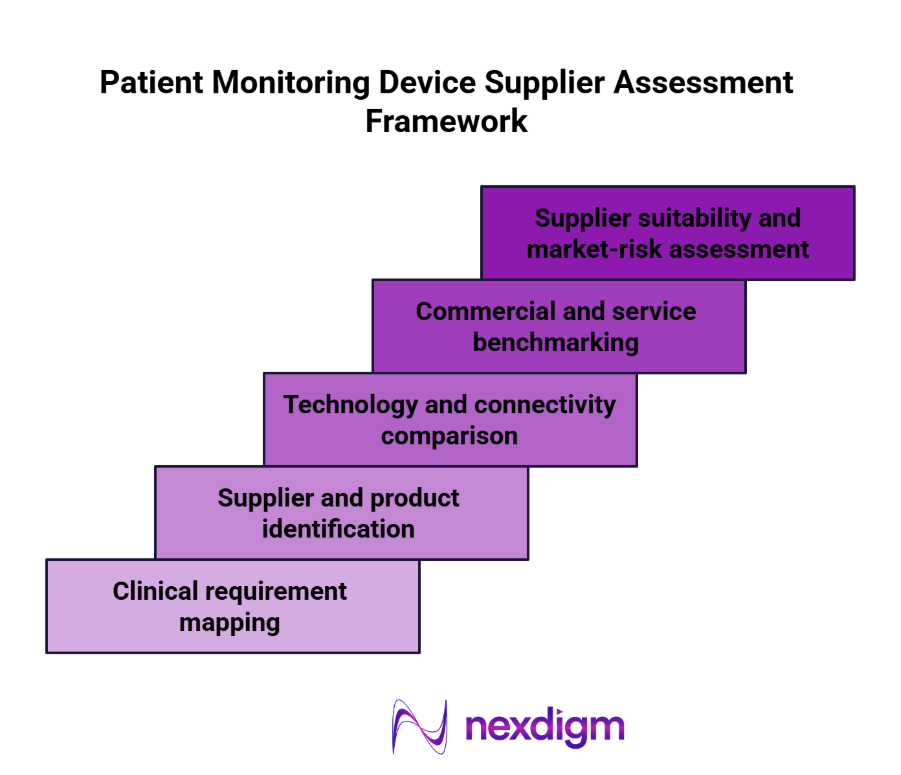
- Clinical requirement mapping: Define patient categories, monitoring parameters, care settings, alarm requirements and intended workflows.
- Supplier and product identification: Map manufacturers by device category, product range, market presence and distribution network.
- Technology and connectivity comparison: Assess measurement specifications, interoperability, software capabilities, cybersecurity considerations and integration requirements.
- Commercial and service benchmarking: Compare acquisition costs, accessories, consumables, warranties, maintenance and technical support coverage.
- Supplier suitability and market-risk assessment: Examine product availability, regulatory documentation, geographic coverage, service dependencies and alternative suppliers.
Case Study: Comparing Patient Monitoring Suppliers
A hospital group assessing equipment for intensive care and general wards needed to compare device capabilities and service coverage. Nexdigm’s research mapped 16 suppliers across 4 markets, compared product portfolios and distribution networks, and identified 5 vendors for further clinical and technical evaluation.
To take the next step, simply visit our Request a Consultation page and share your requirements with us.
Harsh Mittal
+91-8422857704