

Patient price sensitivity research helps healthcare providers understand how out-of-pocket spending influences care decisions, treatment selection, and service utilization. As part of pricing analysis, it evaluates patient willingness to pay, affordability thresholds, and demand response across essential, elective, and preventive services.
This research supports data-driven pricing strategies by identifying where cost concerns may delay care, reduce adoption, or shift patients toward lower-cost alternatives. It enables providers to align pricing with patient affordability, market expectations, and sustainable revenue objectives.
Studies show healthcare price elasticity often ranges from -0.1 to -0.3, while higher cost-sharing can reduce care utilization by 10–30%. Pricing analysis helps improve affordability, timely care access, patient conversion, and revenue predictability in out-of-pocket-driven markets.
Patient Price Sensitivity Analysis for Out-of-Pocket Healthcare Markets
Patient price sensitivity analysis evaluates how out-of-pocket costs influence healthcare decisions, helping providers optimize pricing, improve affordability, protect demand, and strengthen access across cost-sensitive markets. Its major focus areas include:
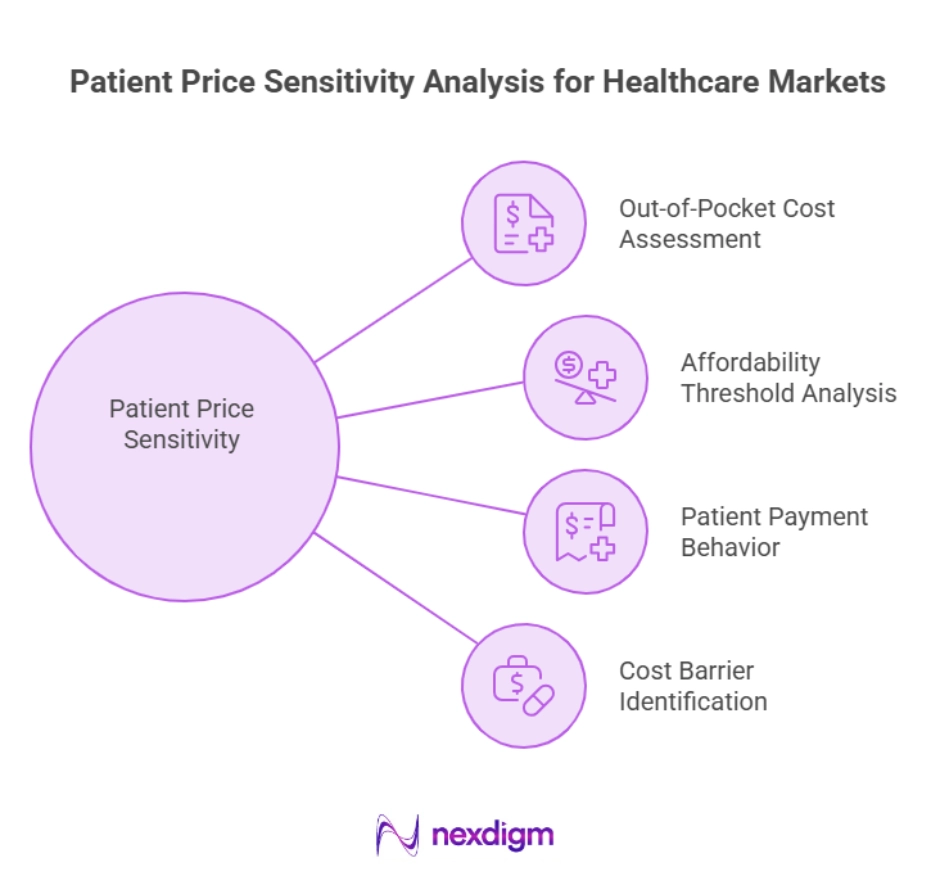
- Out-of-Pocket Cost Assessment: Measuring how direct patient payments affect service selection, treatment timing, care continuation, and overall healthcare affordability.
- Affordability Threshold Analysis: Determining pricing levels where patients may delay, avoid, or switch care based on financial constraints.
- Patient Payment Behavior: Analyzing how patients make care decisions when direct expenses influence treatment access, provider choice, and service continuation.
- Cost Barrier Identification: Identification pricing points where patients may delay appointments, reduce treatment frequency, or choose lower-cost alternatives.
Nexdigm’s Strategic Support in Patient-Centric Healthcare Pricing Analysis
Nexdigm’s strategic support in patient-centric healthcare pricing strategy helps providers understand price sensitivity, out-of-pocket affordability, demand response, and patient willingness to pay. Through structured pricing analysis, Nexdigm supports data-driven pricing decisions that improve access, optimize service utilization, strengthen competitive positioning, and balance patient affordability with sustainable revenue growth in cost-sensitive healthcare markets.
Nexdigm’s Demand-Based Pricing Architecture for Healthcare Markets
Nexdigm’s Demand-Based Pricing Architecture helps healthcare providers assess patient price sensitivity, affordability thresholds, and demand behavior to optimize pricing across out-of-pocket healthcare markets. Its key elements include:
- Out-of-Pocket Spend Review: Assessing how direct patient payments influence healthcare choices, service demand, and affordability across cost-sensitive markets.
- Care Decision Mapping: Analyzing where pricing impacts treatment timing, provider selection, follow-up frequency, and continuation of care.
- Price Sensitivity Segmentation: Classification of patients by cost awareness, willingness to pay, affordability limits, and demand behavior.
- Utilization and Revenue Modeling: Modeling how pricing changes affect patient volumes, service utilization, revenue stability, and growth potential.
- Access-Led Pricing Analysis: Building pricing approaches that improve affordability, reduce care delays, and support sustainable healthcare revenue.
Nexdigm’s Case
exdigm supported an anonymous healthcare provider in assessing patient price sensitivity across out-of-pocket markets. The engagement identified affordability gaps, optimized service pricing, and improved access-led pricing decisions. The client achieved a 17% increase in patient conversions, 13% uplift in service utilization, and 10% improvement in revenue predictability.
To take the next step, simply visit our Request a Consultation page and share your requirements with us.
Harsh Mittal
+91-8422857704