

Digital commerce has changed what merchants expect from payment infrastructure. As SMEs, D2C brands, marketplaces, and established retailers move more sales online, payment gateways increasingly sit between customer acquisition and completed revenue.
In India, the payment gateway market was estimated at $2.07 billion in 2025 and is projected to reach $4.01 billion by 2031.
The broader digital payments ecosystem processed more than Rs 200 trillion across 18,000 crore transactions in FY2024–25.
Digital Commerce Is Expanding the Merchant Base
The addressable market is widening as businesses that once depended on physical or cash transactions adopt digital channels. SMEs and regional retailers are increasingly selling through websites, marketplaces, social platforms, and messaging-led commerce.
D2C businesses are also building payment capabilities into their customer journeys from the beginning.
This creates different requirements across merchant groups:
- Enterprise retailers need reliable acceptance across channels, consolidated reporting, reconciliation, and payment flexibility.
- Growing D2C brands place greater emphasis on fast checkout, refunds, multiple payment methods, and easy integration.
- Smaller merchants typically value simple onboarding, payment links, low setup friction, and tools that work without extensive technical support.
The opportunity therefore depends on more than the number of businesses entering digital commerce. It depends on how deeply payments are embedded in their sales model.
Acceptance Is Becoming a Competitive Variable
Consumers increasingly expect to pay through the method they already use. For merchants, this makes payment acceptance part of the customer experience rather than a back-office function.
India illustrates the scale of this shift. UPI accounted for a substantial share of digital payment activity in 2025, while cards, wallets, EMI, and other payment methods continue to serve different customer and transaction needs. International merchants face an even more fragmented environment, where local payment preferences can influence whether a customer completes a purchase.
For gateway providers, broad acceptance can therefore become a source of differentiation. A merchant entering a new market may need local payment methods, reliable settlement, fraud controls, and support for multiple currencies. The gateway that can simplify these requirements becomes more valuable than one offering processing alone.
Checkout Experience Can Influence Merchant Growth
The payment page is one of the final points at which a customer can abandon a purchase. Complicated forms, unavailable payment methods, failed transactions, slow responses, or an unclear refund process can create friction after a merchant has already spent money acquiring the customer.
This makes checkout performance commercially important.
Merchants are increasingly looking for experiences that reduce unnecessary steps, work well on mobile devices, support preferred payment methods, and make refunds straightforward. For D2C brands in particular, the gateway becomes part of the conversion journey.
The implication for market demand is significant: a gateway can be evaluated on its ability to help merchants’ complete transactions, not simply on whether it can process them.
Merchant Economics Shape Gateway Selection
Price remains important, but it is rarely the only consideration. A merchant may accept a slightly higher processing cost if the gateway improves transaction completion, simplifies reconciliation, supports more payment methods, or reduces operational effort.
The commercial attractiveness of a merchant segment can therefore depend on:
- Transaction volume and growth
- Payment-method mix
- Average transaction values
- Price sensitivity
- Checkout requirements
- Refund and dispute needs
- Potential demand for additional payment or financial services
- Competitive intensity
A large merchant pool dominated by price-sensitive, low-value transactions may offer less attractive economics than a smaller segment with higher digital engagement and broader payment requirements.
A Payment gateway market demand analysis should connect merchant growth with the factors that determine actual gateway demand.
Nexdigm’s Payment Gateway Demand Framework
Nexdigm can assess the opportunity through a structured sequence:
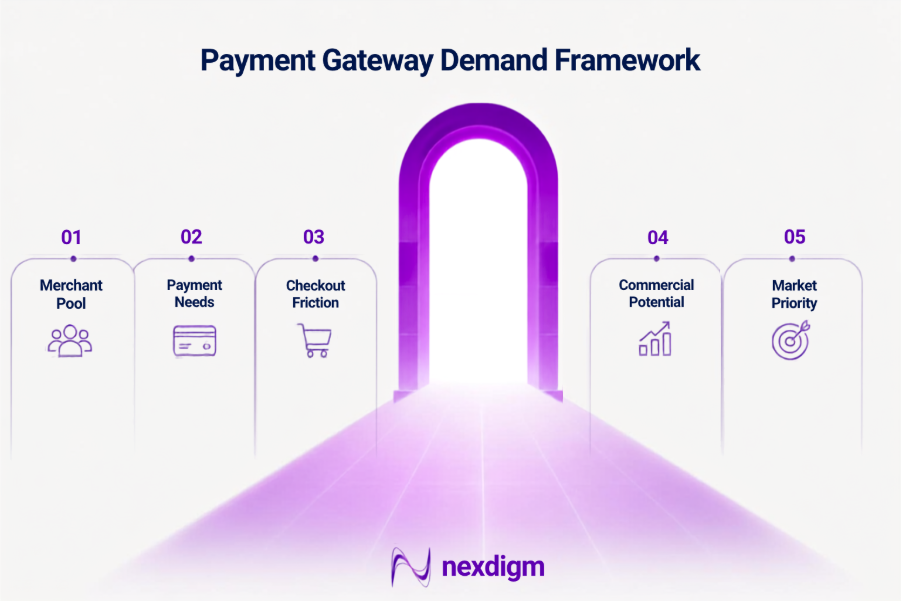
- Merchant pool: Identify businesses by size, sector, geography, digital maturity, and transaction profile.
- Payment needs: Map payment methods, settlement requirements, cross-border needs, and operational challenges relevant to each segment.
- Checkout friction: Examine abandonment, payment failures, mobile experience, refund processes, and other barriers affecting transaction completion.
- Commercial potential: Evaluate transaction growth, willingness to pay, competitive conditions, and opportunities for additional services.
- Market priority: Rank merchant segments and geographies according to demand strength, accessibility, and long-term commercial potential.
This allows a gateway provider, investor, or financial institution to distinguish between markets with high transaction activity and those where demand can support sustainable commercial growth.
How Nexdigm Identifies the Merchant Pools Worth Pursuing
A payment provider assessed 6 regional markets covering over 10,000 active merchants. Nexdigm analysed digital adoption (50% to 75% across tiers), payment preferences, checkout friction, and unit economics to identify the top 3 high-potential segments. This focused acquisition on merchants with 20%+ YoY digital sales growth requiring 3+ payment rails (such as local real-time payments, wallets, and BNPL).
Payment gateway demand will continue to evolve alongside digital commerce, but transaction growth alone will not determine where the strongest opportunities emerge. Merchant needs are becoming more differentiated, and checkout experience is increasingly connected to conversion, retention, and revenue.
To take the next step, simply visit our Request a Consultation page and share your requirements with us.
Harsh Mittal
+91-8422857704
[email protected]