

Payment infrastructure is scaling rapidly, making cost efficiency increasingly important for banks, payment institutions, and financial platforms. India’s payment systems recorded 26.8% growth in transaction volume during FY2025-26, while retail payment value increased 14%. UPI alone grew 30% in volume and 20.6% in value, accounting for nearly 86% of retail payment transactions during the year.
The scale continued into 2026. In August 2026, UPI processed 24.9 billion transactions worth approximately ₹30.15 lakh crore, equivalent to nearly 79 crore transactions per day. Over FY2025-26, UPI processed around 24,162 crore transactions.
This expansion increases the importance of understanding the economics behind payment infrastructure. Processing fees, technology platforms, network charges, cloud and hosting costs, fraud controls and contractual commitments can all influence the final cost of operating payment capabilities. Payment infrastructure procurement cost analysis can help institutions identify these cost drivers and determine where commercial efficiency can be improved.
Payment Infrastructure Costs Are Becoming More Layered
Payment ecosystems increasingly combine gateways, processors, APIs, fraud-management tools, reconciliation platforms, cloud infrastructure, security services, and network connectivity. As transaction volumes rise, even small differences in per-transaction pricing or minimum commitments can create material cost implications. The challenge is therefore not simply reducing individual supplier rates. Institutions need to understand how pricing models, transaction volumes, technology architecture, and commercial terms interact to determine the overall economics of payment infrastructure.
Transaction Scale Can Change the Economics of Payment Infrastructure
As payment volumes increase, the economics of infrastructure can change significantly. Nexdigm can assess how payment growth influences infrastructure economics, helping institutions understand:
- Transaction Growth: Compare actual and projected volumes to determine whether higher activity is improving unit economics or increasing overall costs.
- Pricing & Capacity: Examine transaction rates, processing capacity, API usage, settlement activity, and minimum commitments to identify cost pressures.
- Supplier Economics: Evaluate contracted terms against usage patterns to identify pricing inefficiencies, volume benefits, and potential procurement opportunities.
This analysis helps institutions make better-informed decisions on payment infrastructure costs, supplier terms, and procurement strategy as transaction activity scales.
Nexdigm’s Expertise in Offering Payment Infrastructure Procurement Services
Nexdigm can combine financial-services knowledge, procurement expertise, supplier intelligence, commercial benchmarking, and technology assessment to evaluate payment infrastructure costs. Its approach can examine the complete supplier ecosystem, including processors, gateways, platforms, APIs, infrastructure, security, and supporting payment technologies.
By connecting transaction volumes, supplier pricing, contractual terms, utilization, and technology requirements, Nexdigm can help institutions understand the factors shaping payment costs and identify areas where procurement arrangements can be made more efficient.
Nexdigm’s Payment Infrastructure Procurement Cost Assessment
Nexdigm can apply payment infrastructure procurement cost analysis to assess the complete cost and commercial structure of an institution’s payment ecosystem. The assessment can focus on:
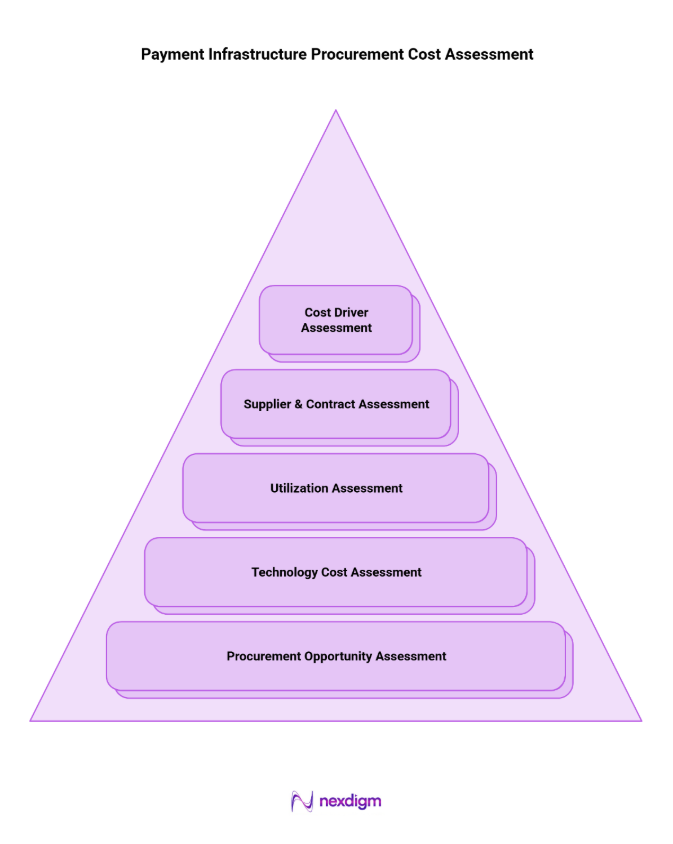
- Cost Driver Assessment: Examine processing fees, transaction charges, infrastructure costs, technology services, support fees, and other components contributing to total payment expenditure.
- Supplier & Contract Assessment: Compare supplier pricing, volume tiers, minimum commitments, renewal terms, service charges, and contractual obligations across relevant arrangements.
- Utilization Assessment: Compare contracted capacity with actual transaction volumes, payment activity, and service usage to identify excess commitments or underutilized capabilities.
- Technology Cost Assessment: Evaluate gateways, processors, APIs, cloud infrastructure, security, reconciliation, and integration requirements that influence overall payment economics.
- Procurement Opportunity Assessment: Identify potential opportunities for renegotiation, right-sizing, supplier consolidation, volume-based pricing, or alternative sourcing.
This assessment provides a structured view of where payment costs originate, how supplier economics compare, and where procurement improvements may be achievable, creating a strong foundation for subsequent optimization decisions.
Business Benefits of Nexdigm’s Procurement Assessment
Nexdigm’s payment infrastructure procurement cost analysis can deliver several practical benefits for institutions. These are:
- Improved Cost Efficiency: Identify pricing inefficiencies, excess commitments, and avoidable charges to support more effective payment-infrastructure spending.
- Stronger Negotiating Position: Provide benchmark-based evidence that helps procurement teams approach suppliers with clearer pricing and commercial expectations.
- Better Resource Allocation: Highlight high-impact cost areas so institutions can prioritize procurement efforts and direct resources toward the most relevant opportunities.
- Greater Supplier Visibility: Create a clearer understanding of supplier economics, dependencies, utilization, and commercial performance across the payment ecosystem.
- Scalable Cost Management: Help institutions anticipate how transaction growth and changing payment requirements may affect infrastructure costs over time.
These benefits enable institutions to make more informed procurement decisions while balancing cost efficiency, payment performance, scalability, and long-term business requirements.
Nexdigm’s Case
Nexdigm assessed payment infrastructure suppliers across processing costs, transaction volumes, technology charges, and contractual terms. Against a market where UPI transaction volumes grew 30% during FY2025-26, the assessment examined whether supplier pricing and commitments remained aligned with rapidly increasing payment activity. The findings supported supplier prioritization, commercial reviews, and opportunities to improve payment-infrastructure cost efficiency.
To take the next step, simply visit our Request a Consultation page and share your requirements with us.
Harsh Mittal
+91-8422857704