

Payment processing expenditure is often distributed across contracts that cover different stages of a transaction. A financial institution may pay one provider for switching, another for payment gateway technology, and separate suppliers for reconciliation, network connectivity, fraud monitoring, and technical support.
This makes it difficult to establish the actual cost of processing a payment. Individual contracts can appear commercially competitive while the combined expenditure reveals overlapping services, inconsistent pricing structures, or charges that are difficult to reconcile with transaction activity.
A meaningful spend analysis follows the transaction across its processing lifecycle. It connects the cost of infrastructure and services with the payment volumes, channels, and operating requirements they support.
Transaction Volume Does Not Explain Every Cost
Transaction processing charges are usually among the most visible components of payment expenditure. Providers may charge per transaction, apply volume-based pricing tiers, or offer fixed monthly arrangements.
However, the cost of processing a transaction depends on its type and route. Card payments, account-to-account transfers, real-time payments, and cross-border transactions can involve different infrastructure and commercial arrangements. Even within the same payment category, pricing may vary according to transaction value, processing complexity, authorisation requirements, and settlement arrangements.
The distinction between successful transactions, declined payments, reversals, and other billable events also matters. Contracts may define these activities differently, creating inconsistencies when procurement teams compare suppliers using headline rates alone.
Network and Infrastructure Costs Can Be Difficult to Separate
Payment networks and settlement infrastructure introduce expenditure that may sit outside a processor’s main service agreement. Banks may incur charges for connectivity, network participation, switching infrastructure, security controls, and specialised processing services.
Some costs are passed through directly, while others are incorporated into a broader service fee. A provider may also bundle infrastructure and transaction processing, making it difficult to determine how much the institution is paying for each component.
The analysis should identify the commercial owner of every major charge and establish whether it is included elsewhere in the payment processing arrangement. This helps procurement teams avoid double-counting expenditure and understand where costs are being allocated.
Platforms and Support Services Add Another Layer
Payment platforms can include gateways, transaction orchestration systems, card management applications, reconciliation tools, fraud monitoring, and reporting software. Their pricing models may depend on licences, transaction volumes, users, modules, hosting requirements, or data consumption.
Operational services introduce further costs. These can include technical support, system monitoring, dispute management, maintenance, reconciliation assistance, and service management. When several suppliers provide overlapping capabilities, the institution may be paying for functions that are already available through existing platforms.
The expansion of digital payments in India has increased the importance of understanding these cost structures. Different payment rails and transaction types rely on distinct infrastructure and commercial arrangements. Aggregate transaction growth alone does not explain how much a financial institution spends on processing or which components account for the largest share.
Understanding the Commercial Structure Behind the Spend
A useful payment processing spend analysis BFSI sector assessment should connect internal expenditure with the supplier market. This means examining how providers structure processing charges, platform subscriptions, network-related fees, support services, and additional transaction costs.
The analysis should distinguish between fixed and variable expenditure. Fixed platform and support charges can represent a substantial cost for institutions with lower transaction volumes. At higher volumes, per-transaction pricing and network-related charges may have a greater effect on overall expenditure.
Supplier positioning also matters. A specialist processor may offer a narrower service at a competitive rate, while a larger provider may combine several capabilities under one contract. Neither model is automatically more economical. The comparison must account for the actual scope, usage assumptions, and services included.
Payment Processing Spend Analysis Framework
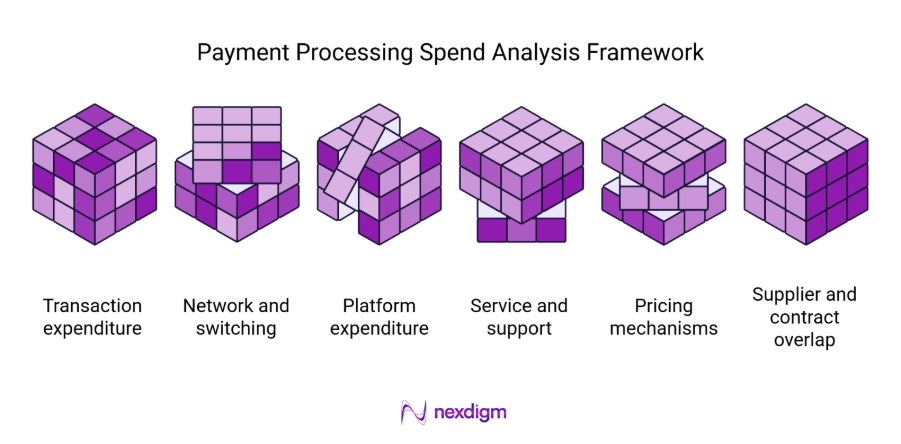
- Transaction-level expenditure: Separate charges for successful transactions, declines, reversals, refunds, and other billable events.
- Network and switching costs: Identify connectivity, routing, network participation, and settlement-related charges.
- Platform expenditure: Examine gateway, orchestration, card management, reconciliation, and software licence costs.
- Service and support costs: Map monitoring, maintenance, dispute support, technical assistance, and other operational services.
- Pricing mechanisms: Compare per-transaction rates, fixed fees, volume slabs, usage-based charges, and bundled contracts.
- Supplier and contract overlap: Identify duplicated capabilities, inconsistent billing structures, and service components that may be sourced separately.
Nexdigm’s market research can support the assessment through supplier mapping, pricing research, service profiling, and comparisons of payment technology providers. The resulting analysis helps financial institutions understand the cost drivers behind their payment operations and identify categories where further commercial evaluation may be useful.
Nexdigm’s Case: Consolidated Spend Mapping Revealed Overlapping Charges
A financial institution reviewing its payment processing expenditure mapped costs across card and account-to-account transactions, covering 11 supplier agreements. The review separated platform, processing, network, and support charges, identifying overlapping reconciliation services and differences in how providers billed transaction exceptions.
To take the next step, simply visit our Request a Consultation page and share your requirements with us.
Harsh Mittal
+91-8422857704