

Payment systems depend on a network of institutions and technology providers. A single transaction may involve a payment gateway, processor, card network, issuer, acquirer, settlement bank, fraud-monitoring service and infrastructure provider. Each participant performs a defined function, but the institution’s exposure often sits in the connections between them.
For banks and other financial institutions, payment vendor risk is therefore best assessed across the transaction lifecycle. Reviewing a processor’s security certificate or service-level agreement in isolation may leave important dependencies undiscovered.
The Transaction Lifecycle Reveals Where Exposure Sits
Processing: transaction integrity and availability
Payment processors and gateways handle transaction messages, authorisation requests and routing. Risks include service outages, duplicate or incomplete messages, unauthorised access, weak API controls and inadequate fraud monitoring. A processor may meet its average uptime target while still experiencing failures during peak transaction periods.
Procurement teams should examine:
- Authorisation success rates and transaction latency.
- Peak-volume capacity and failover arrangements.
- Encryption, tokenisation and privileged-access controls.
- Reconciliation procedures for failed, reversed or duplicated transactions.
- Incident reporting and escalation responsibilities.
Settlement: accuracy, timing and reconciliation
Settlement involves the movement and allocation of funds between participants. Vendor exposure may arise from delayed files, incorrect settlement instructions, incomplete reconciliation, unclear responsibility for exceptions or dependence on a single settlement service provider.
The institution should establish how settlement obligations are calculated, monitored and reconciled. It should also review cut-off times, exception handling, dispute processes and the availability of records needed to investigate discrepancies.
Infrastructure: the less visible dependency layer
Payment processing depends on data centres, cloud services, network connectivity, telecommunications, security operations and software platforms. These providers may not interact directly with customers, but their failure can affect multiple payment functions at once.
Concentration deserves particular attention. Several payment vendors may rely on the same cloud platform, network provider or identity service. The institution may appear to have multiple suppliers while retaining a single underlying point of failure.
Risk Indicators Worth Comparing Across Vendors
A payment vendor assessment should combine operational data with control evidence. Useful indicators include:
- Availability: Service uptime, outage frequency, duration and recovery performance.
- Processing quality: Failed transactions, duplicate messages, reversals and unresolved exceptions.
- Settlement performance: Delays, reconciliation breaks and unresolved discrepancies.
- Security posture: Access-control exceptions, vulnerabilities, incident history and audit findings.
- Dependency exposure: Critical subcontractors, infrastructure concentration and geographic dependencies.
- Recovery capability: Recovery time objectives, recovery point objectives and results of resilience tests.
These indicators should be evaluated against the service’s role and transaction volumes. A low-volume reporting tool does not need the same resilience profile as a processor handling a large share of an institution’s payment traffic.
Why The Regulatory Perimeter Matters
In India, RBI’s Storage of Payment System Data direction requires payment system providers to store payment-system data in systems located in India, with defined clarifications for certain foreign transaction legs. The RBI also places responsibility for compliance on authorised or approved entities, including where service providers and intermediaries are involved. This makes data location and subcontractor visibility relevant procurement questions, not merely technical preferences.
For institutions operating in the European Union, the Digital Operational Resilience Act (DORA) adds requirements around ICT third-party risk, due diligence, contractual provisions and concentration risk. The exact obligations depend on the institution, service and applicable regulatory scope.
Payment Vendor Risk Mapping Framework
A payment solutions vendor risk analysis BFSI exercise should map the complete transaction chain before assigning risk ratings. A useful assessment sequence is:
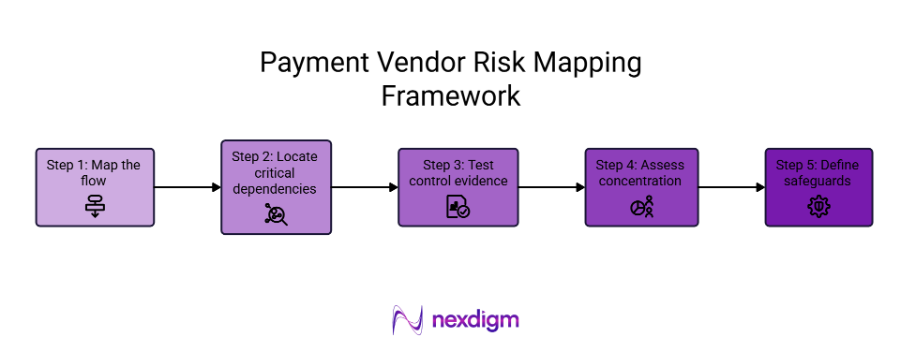
- Map the flow: Identify every vendor involved in authorisation, processing, routing, settlement and infrastructure.
- Locate critical dependencies: Determine which services could interrupt transactions or delay settlement if unavailable.
- Test control evidence: Review security assurance, operational performance, reconciliation controls and recovery testing.
- Assess concentration: Identify shared subcontractors, cloud platforms, networks and geographic dependencies.
- Define safeguards: Set service levels, escalation requirements, audit rights, contingency arrangements and exit options.
Nexdigm can support financial institutions with payment ecosystem mapping, supplier due diligence, operational risk assessment and comparative vendor research. The objective is to identify where exposure accumulates across the payment chain and where additional controls are needed.
Nexdigm’s Case Study
A bank reviewed 11 vendors supporting card and digital payment operations. Mapping their dependencies showed that 4 critical services relied on the same infrastructure provider. The bank prioritised resilience testing, revised escalation requirements and evaluated an alternative processing route for its most time-sensitive payment activity.
To take the next step, simply visit our Request a Consultation page and share your requirements with us.
Harsh Mittal
+91-8422857704